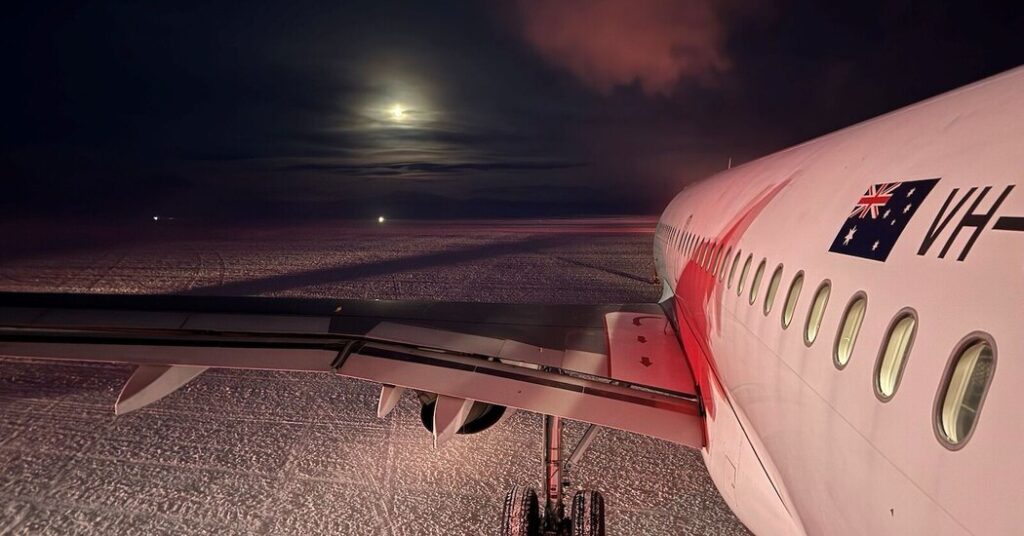
In the small hours of the morning in southern Australia, a plane full of rescue workers took off on a rare mission.
About five hours away, a U.S. national needed an urgent medevac — from Antarctica.
The mission, carried out last week by the Australian Antarctic Division and the Australian aviation company Skytraders, took the crew to the bottom of the world at the most perilous time of year: the middle of winter in the southern hemisphere. Requests for rescue operations in Antarctica, with its subfreezing temperatures, almost constant darkness and extreme weather conditions, are few and far between. Scientists and others working there often go through various health checks before their departure, and there are several doctors at various stations if needed.
Still, things go wrong.
Louise Robertson, a captain on last week’s flight, said it was a type of mission that had never been carried out in July before.
“It’s the most extreme conditions that you can operate there in,” she said in an interview with The New York Times. “It’s complete blackness, the coldest operating conditions, so it’s close to the operating limits of the aircraft.”
The company, which usually flies staff members to the icy continent during the warmer months, rushed to prepare an Airbus A319 with the necessary crew. The U.S. national in need of medevac, whom the authorities have not identified, was at the American Antarctic base known as McMurdo Station. The rescue team hoped to reach a nearby airstrip, Phoenix Airfield, as soon as possible.
But something went wrong. A snowstorm in Antarctica delayed the team’s departure by 12 hours.
Finally, on July 31 at 2:44 a.m. local time, the plane left Hobart, Tasmania, for its journey south.
There were times during the flight where the temperature at various altitudes was growing too cold for the plane, and the crew was forced to fly lower, Ms. Robertson said.
The most challenging part was the approach and landing, she said. As the team neared the airstrip around 10 a.m. local time, it was under complete darkness and temperatures hovered at minus 45 Fahrenheit (minus 43 Celsius).
“It basically just looked like a floating set of lights with no light around it,” Ms. Robertson said of the airstrip, adding that it created a “black hole effect,” a visual illusion that can affect depth and height perception.
That meant the pilots had to rely on the plane’s technology, rather than their eyes, to help them land. Ms. Robertson’s husband, Captain Rod Robertson, was the pilot who completed this part of the mission.
Once the rescue team had landed, the patient was transferred onto the aircraft. The plane could only remain on the ground for a short period of time to ensure that critical liquids — such as hydraulics — did not freeze, Ms. Robertson said.
Within an hour, as worsening weather conditions closed in on the area, the plane took off and made its way to Christchurch, New Zealand, touching down almost five hours later.
The U.S. National Science Foundation told the Australian Broadcasting Corporation that the patient had been “admitted to Christchurch Hospital in serious condition.”
Another pilot on the flight, Captain Al Wallach, said in a statement that all Antarctic missions needed “absolute precision” but that winter operations were significantly more complex.
“The conditions we encountered were right on the edge of even the most specialized aircraft capability,” he said.
The success of the mission reflected years of preparation, training and coordination among flight crews, meteorologists, runway teams and medics, he said.
In her 25 years of flying, Ms. Robertson said she had never completed a flight like it.
“I would definitely say that there was some nerves and anxiety in there,” she said, “but it was a great relief to get it done.”
The post Inside the Mission to Carry Out a Midwinter Medevac in Antarctica appeared first on New York Times.