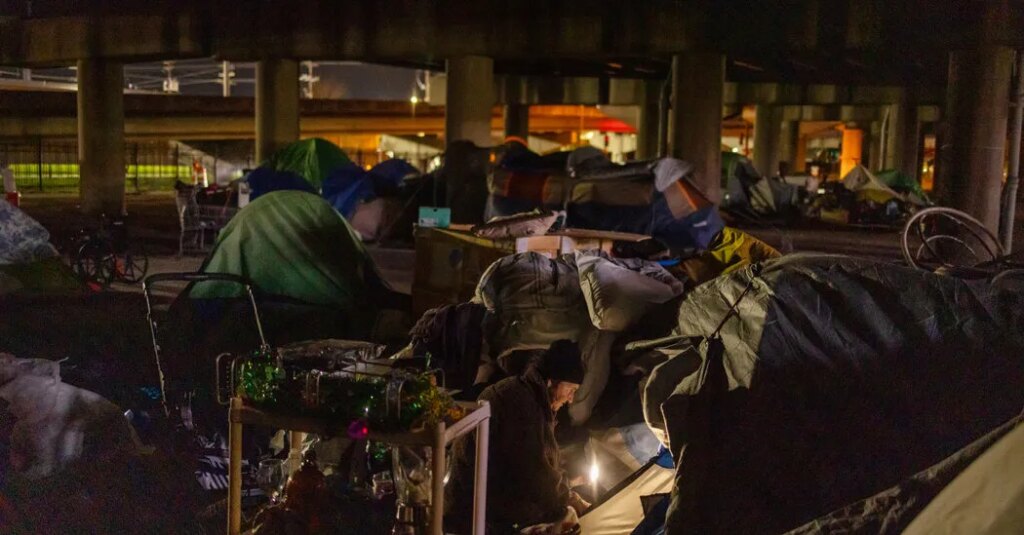
The United States last year experienced the largest decline in homelessness since an annual count began nearly two decades ago, the Department of Housing and Urban Development announced late Friday.
The drop of more than 6 percent was the second consecutive year that the figure had fallen, and reduced the number of homeless people by more than 47,000. Homelessness still far exceeds prepandemic levels.
The reasons for the decline are contested, though the trend likely reflects in part the ebbing of a crisis that began in 2022 when a wave of people seeking asylumwere bused to Northern cities, where they flooded shelters. Most have since left.
The data comes from the annual point-in-time count, which hundreds of local groups conduct every January. While the housing department usually compiles the data into a detailed report before announcing it, the agency instead appeared to hurry a press release on Friday announcing the decline and crediting President Trump.
The department acted after learning that two nonprofit groups had tallied the data from many of the local groups and were releasing their own analyses during what has become a bitter policy debate. Both groups — the National Alliance to End Homelessness and Community Solutions — oppose sweeping changes the Trump administration is trying to make, and see the decline as evidence that progress is possible under current policies.
The Trump administration last year waited months later than usual to release its report on the previous year’s data, which showed a decline of 3 percent. The nonprofit groups seemed eager to avoid a similar delay.
The administration wants deep cuts in so-called Housing First programs, which provide long-term rental subsidies without demanding that homeless people enter treatment for mental illness or addiction. The housing department wants to shift the money to short-term programs with treatment mandates, to address what it calls the root causes of homelessness.
In separate analyses, both nonprofit groups found that the population of homeless people in shelters fell more than 7 percent last year. Unsheltered homelessness dropped nearly 5 percent. In addition, the alliance found that homelessness among veterans declined nearly 8 percent.
The decline “is not only continuing, it’s accelerating,” said Ann Oliva, the alliance’s chief executive officer. “The system is working for a lot of people. The administration’s efforts to gut these programs are way off base.”
According to the counts compiled by Community Solutions, nearly half of last year’s drop in homelessness occurred in four cities that became major destinations for people seeking asylum: New York, Chicago, Boston and Denver. That bolsters the argument that the surge of homelessness that began in 2022 had less to do with the merits of homelessness policy than cross-border flows.
But Adam Ruege, who wrote the Community Solutions report, said that last year’s decline in homelessness went well beyond those cities and amounted to a broader trend. Among the 182 local groups for which he had data, 57 percent registered declining homeless populations.
“More communities are seeing reductions, so that tells us there’s a trend here,” he said. “We believe the country has turned a corner.”
Many other forces might have fueled the drop, and varied greatly from place to place, Mr. Ruege added. He cited increased civic cooperation in cities including Denver, Atlanta and Oklahoma City, and a possible cooling of the housing market in some areas, which might have reduced the number of people entering homelessness.
Even a cursory look at the data Mr. Ruege compiled suggests how intensely local homelessness trends can be. Homelessness fell by 26 percent in affluent Montgomery County, Md., but rose by 3 percent in affluent Fairfax County, Va., just across the Potomac River.
It rose in Los Angeles (1 percent), Seattle (8 percent) and Las Vegas (14 percent), three large urban homelessness hubs. But it fell in two others, San Francisco (8 percent) and Honolulu (8 percent).
In percentage terms, the largest decline occurred in western North Carolina, where homelessness fell by about two-thirds during the ongoing recovery from Hurricane Helene — an up-and-down trend that says little about homelessness policy.
In a press release, Scott Turner, the housing secretary, attributed the decline to “President Trump’s actions to secure the border, get criminal illegals off our streets, and restore safety to our communities.” The press release placed the 2025 homeless population at 698,425 people.
Devon Kurtz, an analyst for the Cicero Institute, an administration ally, argued that the decline undercut the progressive argument that homelessness is mostly caused by high housing costs. “Housing remains spectacularly expensive in most of the country and yet homelessness still fell,” he said.
Chronic homelessness did not improve, rising about 1 percent, the alliance found. That is a concern, because the chronically homeless are by definition disabled.
But homelessness among veterans continued its long-term drop, falling 7 percent. It has now fallen nearly 60 percent since 2010. Much of that progress has occurred under a Housing First program called HUD-Vash, which Congress funds at much higher levels than other homeless programs. Advocates often cite the trend to argue for the effectiveness of well-funded housing programs.
Ms. Oliva made a point of praising the frontline workers who staff homelessness programs. Some conservatives have argued that the field attracts radical members of the “homelessness industrial complex” who want the problem to grow, to discredit the economic status quo.
“They have been doing incredible work, and they are a big part of the reason that we’re seeing declines two years in a row,” she said.
The post U.S. Homeless Population Had Record Drop in 2025 appeared first on New York Times.