Brian Cashman was a summer intern with the New York Yankees in the mid-1980s when an assistant in the general manager’s office approached him with an assignment: George Steinbrenner wanted a haircut. “The Boss needs someone to drive, and you got the short straw,” Cashman says the assistant told him. Everyone knew that Steinbrenner, who owned the Yankees from 1973 until his death in 2010, was prone to sudden fits of rage, justified or otherwise. “You’re going to want to get him out of the car as quickly as possible,” the assistant said. He suggested a shortcut, crossing the Harlem River from the Bronx to Manhattan on the Willis Avenue Bridge. “And there’s no Waze,” Cashman reminded me. “There’s no cellphones. There’s none of that stuff.”
It didn’t go well. “I told him, ‘This way is faster,’” Cashman says, but the bridge was closed for renovations. “And he starts going ballistic: ‘You effing idiot. Take me back to the effing stadium.’ He’s crushing me from the back seat. I mean, my hair was blowing forward because of his bellowing from the back. It was relentless, because that’s how he was. If somebody told me the same story and said they crawled up into the fetal position, I could understand it.”
Cashman didn’t panic. He tightened his hands on the steering wheel, turned the car around and found another route into Manhattan. He kept driving, even after Steinbrenner’s barrage escalated when the car hit a pothole on Franklin D. Roosevelt Drive. “I tuned him out,” Cashman says.
Cashman still refers to the drive as “the worst experience of my life.” Yet Steinbrenner never mentioned it again. “It was like a tornado,” says Cashman, who spent a decade of his youth in Lexington, Ky., where actual tornadoes sometimes whipped through. “The sun would come out, and it was back to normal. Same with the Boss. So long as you were still employed, he turned the page. It was as if it never happened.” It proved to be an object lesson in dealing with Steinbrenner and, eventually, running the Yankees.
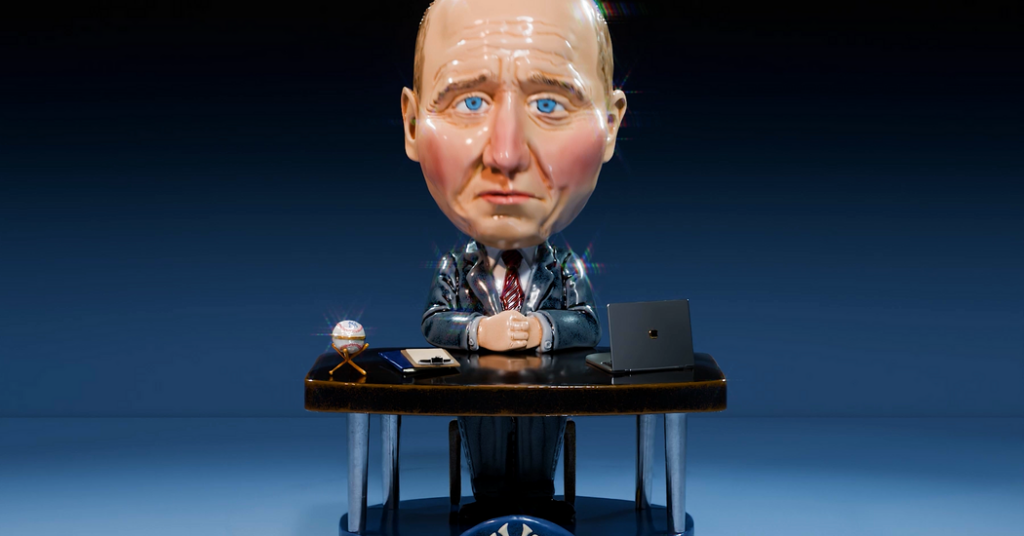
Cashman has been the Yankees’ general manager since 1998. His 28 years with one team is the longest active tenure of any G.M. in any major sports league in North America — and the longest by 16 years in Major League Baseball. By now, he ranks as the most accomplished executive to run any team’s baseball operations since the leagues began adding new franchises in 1961. His teams have played in seven World Series and won four, and they’ve never had a losing record. “Which is miraculous, really,” says Dave Dombrowski, the Philadelphia Phillies’ president of baseball operations, who has built contenders in five M.L.B. markets. “You always figure there’s going to be a down year when you just collapse as a team.” Even more astonishing, Cashman’s Yankees have played more than 4,500 games on his watch and have been out of playoff contention for just 22 of them, almost completely avoiding those meaningless Septembers that every other team goes through regularly.
For the Yankees, though, that isn’t good enough. Most ballparks and arenas commemorate all their team’s titles, division and league included, with flags or other signage. At Yankee Stadium, only the franchise’s 27 championships are recognized. The team hasn’t added a new one since Steinbrenner died in 2010 and his children inherited it. That helps explain why a June poll taken on one fan site, Pinstripe Alley, revealed that, by a margin of 91 percent to 9 percent, fans said they disapproved of Cashman, whose contract expires after this season.
Cashman won’t discuss his contract, but he seems to want to keep his job. “It doesn’t wear him out,” says Brian Sabean, who won three World Series as the San Francisco Giants’ general manager and now is an adviser to Cashman. “He has the ability to erase the past and just move on.” Yet Cashman told me that his dominant emotion after a Yankee win is relief that it wasn’t a loss. “And the losses are crushing,” he says. “It’s a heavy burden, with the expectation that you’re expected to win. I feel the pain more than I feel the joy.” That pain has been compounding over the 16 years since that last title. “It controls you, no doubt about it,” he says. “I’m not a yeller or a screamer, but you lose sleep. It affects your way of life.”
For much of the 20th century, Yankees fans had reason to expect that their team would win the World Series every year, or at least play in it. The team celebrated three championships in the 1920s, five in the 1930s, four in the 1940s and every American League pennant but two from 1949 to 1964. “Over the years, many of their followers have come to watch them with the stolidity, the smugness and the arrogance of holders of large blocks of blue-chip stocks,” Roger Angell wrote of the Yankees in The New Yorker in 1972. “These fans accept no less than perfection.” More than half a century later, Cashman knows this remains true. “New York will keep you motivated,” he told me. “New York will keep you honest. New York will force you to be committed. You can’t cut corners in New York. You can’t take a day off in New York. You can’t sometimes breathe in New York.”
Angell’s description of the Yankees appeared a year before Steinbrenner and a group of investors bought the team from CBS for $10 million. Four years later, they won the first of back-to-back World Series. They wouldn’t win another one for 18 seasons, the longest such drought since their first championship, in 1923. To keep the Yankees relevant, Steinbrenner brought back Billy Martin, the manager who won the 1977 World Series, fired him, hired him again, fired him again, hired him again — five round trips in all in the 1970s and ’80s. He packed his roster with All-Stars. The annual additions — Dave Winfield, Don Baylor, Rickey Henderson — seldom fit well into the existing contours of the roster, but they made the team impossible to ignore. “He commanded the universe of baseball to say, ‘You’ve got to pay attention to the Yankees at all times,’” Cashman says. “I mean, who else could take the Yankees, with all their history and championships, and build on them and somehow improve them and magnify them as a commodity?”
But the price of Steinbrenner’s extraordinary efforts is one that Cashman continues to pay. “If there are 10 million Yankee fans in the metro area, that mentality has created 10 million George Steinbrenners who are now buying the tickets and calling the talk shows,” he says. “He created an atmosphere of expectation and demand. He weaponized the environment to a level of need, desire, expectation that is impossible to meet.” In 2023, for the first time in seven years, and only the fifth time during Cashman’s tenure, the Yankees didn’t make the playoffs. They didn’t come particularly close, missing out by seven games, but still managed a winning record. “But you’d think we lost 100 games,” he says. “I mean, it was ugly and hostile.”
Nevertheless, Cashman keeps a photo of Steinbrenner mounted on the wall of his office. “I wouldn’t be here without him,” he told me during one of our meetings there. His parents, John and Nancy, knew Steinbrenner from the horse-racing business. In 1986, Cashman was a freshman playing second base at Catholic University in Washington. He had few interests outside of baseball. “Other kids would go to the beach in the summer,” Nancy Cashman told me. “Brian just wanted to go to the ballpark.” When he ran out of money on his team’s spring break trip to Florida, his father, whose Kentucky-based company owned the Pompano Park racetrack, told him to meet up with an executive there who would give him what he needed. The executive, who happened to be wearing a Yankees’ championship ring, said that Steinbrenner, who kept horses there, was a close friend. That led to a summer internship with the Yankees.
From then on, Cashman’s interactions with Steinbrenner were much the same as everyone else’s. He incurred that volcanic wrath when he made a mistake, and occasionally when he didn’t. “Cashman was always the scared rabbit,” the longtime agent Scott Boras told me. “I mean, George would run him ragged.” And when Steinbrenner wasn’t yelling, he was often disdainful. “It was definitely a hostile work environment,” Cashman says now, yet he was able to thrive. “It was normal to me.”
Cashman attracts surprisingly little attention in a crowd. He looks less like a former athlete or a businessman than the manager of an electronics store. He could be someone you knew in high school. “In different circumstances,” says Russell Martin, a former catcher who played with the Yankees in 2011 and 2012, “he could be one of my boys. Like, we could be friends.”
Those who do approach Cashman in public rarely seem intimidated. In March, we were sitting behind the first-base dugout in Port St. Lucie, Fla., watching the Yankees play the Mets, when a middle-aged man wearing a Yankees cap came down the aisle and handed Cashman a dollar bill. Written on it were six trades the man wanted Cashman to make. “Think about them,” the man said before disappearing back into the crowd. Cashman glanced at it for a moment, then handed the dollar to someone nearby. Over the winter, he had re-signed the former M.V.P. Cody Bellinger, whose contract had expired, to a new five-year deal and traded for the pitcher Ryan Weathers, but that was mostly it. And by the start of August, he hadn’t made any of the trades proposed on the dollar bill, nor any others, despite pleas in every conceivable media outlet for the Yankees to “act like the Yankees,” as one fan I spoke with put it, “and just go get somebody!”
Cashman prides himself on his transparency. “He’s the most honest baseball executive I’ve ever encountered,” says Derek Shelton, the Minnesota Twins’ manager, who worked in the Yankees organization in the early 2000s. Billy Beane, the former general manager and executive vice president of the Oakland Athletics, calls him “a truth-teller — he’s like that privately, and he’s like that publicly. And he can be brutally honest.”
But although he’ll respond to questions with admirable candor, the answers often aren’t what fans want to hear. When Aaron Judge, the team’s right fielder and baseball’s best hitter, was diagnosed with a fractured rib in early June, Cashman admitted that Judge had been hurt six weeks earlier but nobody in the organization had realized it. Because Judge was likely to be out for several months, a reporter wondered if Cashman would seek a replacement. His response — that someone already on the team would need to step up — seemed frustratingly consistent with how he has run the team since the Steinbrenner children took control.
Steinbrenner’s son Hal, who is now the Yankees’ managing general partner, doesn’t interfere with Cashman the way his father did; some of Steinbrenner’s acquisitions were made without his general manager’s knowledge, much less his consent. But a system of increasingly onerous taxes now penalizes M.L.B. teams for player payrolls that exceed specific levels, and Hal’s appetite for handing out record-setting contracts isn’t nearly as robust as his father’s was. These days, the default destination for the top free agent each winter is no longer the Yankees but the Los Angeles Dodgers. That may help explain the animosity toward Cashman. To many fans, he symbolizes the end of the extended era of their team’s pre-eminence, even as he guides it to one winning season after another.
Some general managers are former players who pride themselves on talent evaluation. Others present themselves as deal makers. A few never played beyond high school (or even as far as that) and let analytics guide them. Cashman doesn’t purport to be an expert in any of those areas — or in anything at all, really. “I’m not the smartest knife in the drawer,” he told me once. When I ask baseball insiders what makes him so successful, I get no consensus.
What he believes he does well is attract talented employees and give them reason to stay. When Cashman walks through the Yankee Stadium offices, nearly everyone he sees is someone he hired, or someone who was hired by someone he hired. It makes him comfortable that so many have been there for a decade or even two, which perhaps explains why the Yankees have employed only three managers during his tenure. If he ever went somewhere else, he explained once, he wouldn’t have that.
Cashman also cites his creeping unease, fomented by all those years under Steinbrenner, that the Yankees will fall behind and he’ll be blamed. He says he can’t shake the feeling that some team somewhere — in M.L.B., or maybe in another professional sport, or at a college, or even at some other type of business — is doing something the Yankees should be doing. While Steinbrenner tried to keep the team competitive by signing superstars, Cashman has done it by finding multiple ways for it to be a little smarter, in the process creating the same kind of incremental advantages that helped low-budget rivals like the Tampa Bay Rays and the Milwaukee Brewers and Beane’s A’s accumulate division titles over the years. But those teams, his detractors point out, haven’t won the World Series either.
In the weeks after Judge’s injury, it became evident that none of the other Yankees were compensating for the loss of their star outfielder. After Judge left the lineup, the Yankees were hitting .221 as a team as of Aug. 4, the lowest average in M.L.B., and had fallen into second place in their division, behind Tampa Bay. And in late July, one week before the trade deadline, Bellinger, who was second on the team behind Ben Rice in hits and runs batted in, hurt a hamstring. He was placed on the injured list with the expectation that he would be out for at least a month.
As that week progressed, the Yankees were reported to be inquiring about many of baseball’s best hitters, superstars like the Houston Astros’ Yordan Alvarez and the Kansas City Royals’ Bobby Witt. On Aug. 2, the day before the deadline, the team sent four pitchers to the Washington Nationals for an infielder, Luis Garcia Jr. Perhaps because of the gaudy names that supposedly had been in play, reaction was muted, even though Garcia was leading the National League in slugging at the time. “Cashman refuses to do what it takes,” Max Kellerman, the former ESPN and CNN host and commentator, wrote on X the next evening. The Yankees had tried for bigger names, Cashman said after the deadline had passed. “But ultimately, in the end of the day,” he said, “there was no opportunity that existed that we felt good enough about.”
If the Yankees don’t catch Tampa Bay, a team that’s not the Yankees will win the American League East for the 11th time in the last 14 seasons, an unprecedented run. That alone, some fans believe, is reason enough for Hal Steinbrenner to get another general manager. As usual, too, most have set their sights higher than the division title. “If this team does not win the World Series,” someone commented on the Instagram page of WFAN, the Yankees’ flagship radio station, “they should completely fire every single person that has anything to do with this team.”
Cashman and I were discussing his future when he interrupted to tell me his favorite quote, one attributed to the Brazilian writer Fernando Sabino. “It will all be OK in the end,” he said. “If it’s not OK, it’s not the end.” Cashman doesn’t need some fan’s post to remind him that everything is not OK with the Yankees, not with 16 years gone by since their last parade up Broadway. (Even the Knicks have now held one since then.)
Depending on what happens this October, the Steinbrenners could decide that his time has passed. “It’s like the weather,” Cashman told me in early August. “I can’t control the weather. And I can’t control that.” If it happens, baseball historians will glorify the string of winning seasons and the four World Series rings. But Yankees fans will doubtless remember all the years since the last one, and Cashman would be inclined to do the same. If he chooses to try for a fifth ring somewhere else, he should have no shortage of opportunities. As jarring as it would be to see him running the San Diego Padres or the Miami Marlins or even the New York Mets, it’s hard to imagine Cashman willingly walking away from being a G.M. with no championship to show for the entire second half of his career. And if he isn’t OK doing that, it won’t be the end.
Bruce Schoenfeld is a contributing writer for the magazine and the author of “Game of Edges: The Analytics Revolution and the Future of Professional Sports.”
The post Does He Have the Most Stressful Job in Sports? appeared first on New York Times.