About a month after Megan Davis’ biological mother died of a drug overdose in July 2025, she went out for drinks with a friend in Northgate, a cluster of bars in College Station, Texas.
She downed a couple of shots and got into an altercation with another group of patrons after bumping into them, according to Davis and body camera footage. Security at the bar kicked Davis out and called the police, who charged her with public intoxication, resulting in an overnight jail stay and a $450 fine.
“Right before my mugshot was taken, I had a panic attack,” says Davis, who was 23 at the time. “I knew I made a big mistake.” After being released the next morning, she set up a payment plan for the fine, and put the incident behind her.
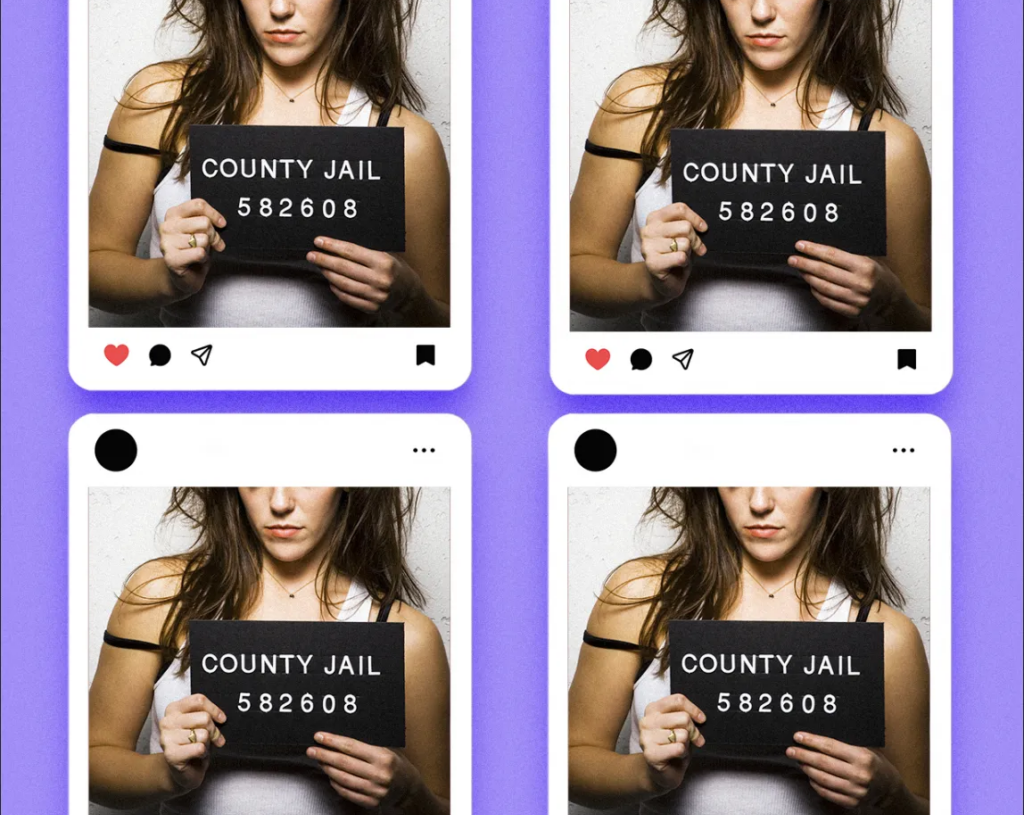
Beginning the day of her arrest, on August 21, 2025, Davis’ mugshot started going viral. It was first posted to the Facebook page SayCheese Brazos County Mugshots & Arrests, one of about a dozen Texas-specific mugshot pages under the SayCheese brand, then turned into a hoax on Facebook, alleging she was an Olive Garden waitress who’d been arrested for throwing breadsticks at a customer over tips. Then, on October 12, 2025, her mugshot appeared on Mugshawtys, a popular Instagram account that posts mugshots of young women, often framed as thirst traps.
Thousands of people have now commented—and harshly judged—Davis’ looks and character; when Mugshawtys reposted her photo in a roundup in June, a man wrote in comment on the post “I bet there [sic] parents are proud of them.” Davis replied underneath that her mother had died weeks before the mugshot was taken. “I hope she’s proud of what I’ve done to better myself since this happened,” she wrote.
Almost a year later, Davis is still wading through the fallout. “All that this has been for me is just being dragged through the mud,” Davis says, adding that she’s taken “full accountability” for the incident.
“I just don’t understand where we are going to draw a line with social media and privacy.”
Mugshawtys was started around a decade ago by Josh Jeffery, a 31-year-old electrician in California. Up until very recently, it had about 1.8 million Instagram followers, including many loyal, mostly male fans—some of whom trawl arrest bookings and mugshot sites to send in submissions. The brand, which gained a million followers after being featured on Joe Rogan’s podcast last year, according to Jeffery, also had 19,000 Facebook followers and currently has nearly half a million on X.
Within the last week, in response to a list of questions from WIRED, both Meta and TikTok disabled Mugshawtys accounts on their respective platforms. A Meta spokesperson said the account breached multiple policies, pointing WIRED to its community standards page. A TikTok US spokesperson declined to comment on why the account was removed. Jeffery did not respond to a request for comment about the removals. X did not reply to a request for comment.
Jeffery says he’s friends with some of the girls he features on the page—and claims he’s not trying to exploit them. “A lot of them end up doing some form of OnlyFans or content creation or something,” he claims, adding that he encourages Mugshawtys followers to chip in for the women’s bail or legal fees.
But the pages are rife with sexual fantasies and misogynistic jokes. “They don’t have to be old enough to drink, just old enough to swallow,” read one comment under an Instagram post featuring a woman arrested for underage drinking. Under carousel posts of mugshots, men wrote comments like “mid,” “that’s a man,” “6 at best,” sometimes ranking women in order of who they find attractive. Last summer, Mugshawtys’ Instagram account posted a photo of a woman who appears to be wearing an anti-suicide smock. The caption stated she had been arrested for alleged child endangerment. The gloved hand of a jail official is seen holding her head while she grimaces and pulls away from the camera. A comment underneath read “child abuse i hope the guards pushed her head to other places.” The caption mislabeled the woman’s charges, and the case was ultimately disposed. But many commenters seem unaware that the existence of a mugshot is not an admittance of guilt.
As the brand has grown more popular, Jeffery even sells merch like T-shirts and hats with text that reads “i [heart] hot felons” for about $10. In 2024, small Amsterdam publisher 550BC made a Mugshawtys coffee table book, which Jeffery has since sold online. 550BC did not respond to a request for comment.
That those featured on Mugshawtys are all captured in a vulnerable state—many are disheveled, intoxicated, or appear to be crying—often seems to appeal to followers of the accounts. “You see a woman in the worst kind of condition that she might have found herself in without perfect makeup, being absolutely vulnerable, being held by the state,” sociologist Danielle Dirks tells WIRED. “Some men think this is the perfect time to seize upon them.”
Jeffery says he believes if anyone is exploiting women, it’s the justice system, and that he will remove a mugshot if a woman asks him to: “I’ll take down anything. Especially if they didn’t submit it themselves, then I’m more quick to do it.”
Early mugshots were primarily used as a law enforcement tool for alerting a community about a potential offender or for gathering tips, says Sarah Lageson, an associate professor of law and criminology at Northeastern University. Journalists could go down to a police station and flip through booklets of them, a process that required existing relationships with law enforcement or press credentials. Digitization made the images publicly accessible, and online mugshots became a cultural phenomenon in the mid-aughts, with pay-for-removal websites—which publish people’s mugshots then request a fee to remove them—taking off. But mugshot laws vary by state, leading to confusion for someone seeking removal of their image. For example, Oregon prohibits law enforcement agencies from releasing mugshots prior to a conviction; in Florida, a state with lenient open records laws, there are no guardrails on social media usage, but mugshot sites must remove a person’s mugshot, if requested, at no charge.
Navigating the legalese around mugshots can be daunting. “People are so exhausted by the mugshot itself, they often don’t want to litigate and put their name back in the public record attached to mugshots,” says Lageson.
Now, amid the explosion of video across all social media platforms, YouTubers and social media accounts have expanded to body cam footage, with some creators accessing the footage through Freedom of Information Act requests.
In March 2026, bodycam footage from Davis’ arrest was posted to a YouTube called Sgt. Pepperspray. The footage shows her wearing a black crop top, visibly panicked and intoxicated. Viewers left linked timestamps in the comments redirecting to moments in the video when close-up shots of just Davis’ breasts were visible onscreen. (Davis contacted YouTube’s legal support team via a defamation claim which was denied. A rep for YouTube said that Davis would need to file a privacy complaint.)
“They’re just really vivid public shaming tools in my view,” Lageson says.
But not everyone is opposed to the attention. Jeffery says some women submit their own photos or tag themselves in the comments to redirect traffic to their own page.
“It gave me a little bit of an ego boost,” says Holly Singleton, a 22-year-old in Indiana, whose mugshot was featured on the account on March 11. “I’m not bothered by it. Unfortunately, social media is forever,”
Most women posted to Mugshawtys are white and appear to be college-aged. In a study published in 2015 in the Contemporary Justice Review, Dirks wrote that white women are often viewed as “victims of circumstance deserving of empathy and redemption rather than as criminals.” But Dirks tells WIRED that in the case of Mugshawtys, the focus on conventional beauty standards can render these women more visible and therefore subject them to more punishment outside of the criminal justice system.
For many of the women featured, the sexist jokes and sexual harassment continues long after charges have been dropped, fines have been paid, or prison time has been served.
Taylor Johnson was arrested for a DUI in 2022 and spent 20 days in county jail to avoid probation. Two years later, while at work, her phone started buzzing with texts from her friends: Mugshawtys had posted her mugshot.
“At first, I was extremely embarrassed and humiliated just because I felt like I had really put that behind me,” Johnson says. She DM’d Jeffery asking who submitted the photo, and he said he receives so many DMs that he didn’t know. Initially, she says she told him she didn’t want her mugshot posted, but she says she learned that her mugshot was public record and let it remain up.
Johnson says her mugshot has since been used for clickbait, accompanying videos and articles that have nothing to do with her arrest. She shared a screenshot of a TikTok video with text reading “how i stayed pretty—even after 3 years in prison,” overlaid on her mugshot. The Mirror wrote an article with the headline “Woman’s Mugshot Goes Viral After Arrest as She’s Dubbed ‘Insanely Beautiful’—and She’s Livid.”
The unwanted attention wrought by her mugshot felt relentless. “My dad had just passed a few months before this post was made, and to me it just felt like I couldn’t catch a break,” Johnson says.
After time passed, however, she says people at work started to recognize her as the “Mugshawtys girl.”
“I ended up learning to just laugh about it, because if I don’t I’m going to cry,” Johnson says.
The post Viral Mugshot Accounts Are Ruining Women’s Lives appeared first on Wired.