Isabella Myricle Robinson was 15 and hanging out in her bedroom, surrounded by her stuffed Hello Kitty dolls, when she heard her mother, Rosa Seda, cry out. She raced into her mother’s room and found her lying on the floor. Rosa didn’t seem to be breathing. “Mama, wake up!” Isabella screamed. She shook her mother’s head from side to side and told her to breathe. “I honestly thought that she was gonna pass away right there,” she says. Rosa had collapsed after her doctor called her with bad news: Her breast cancer had spread to her brain.
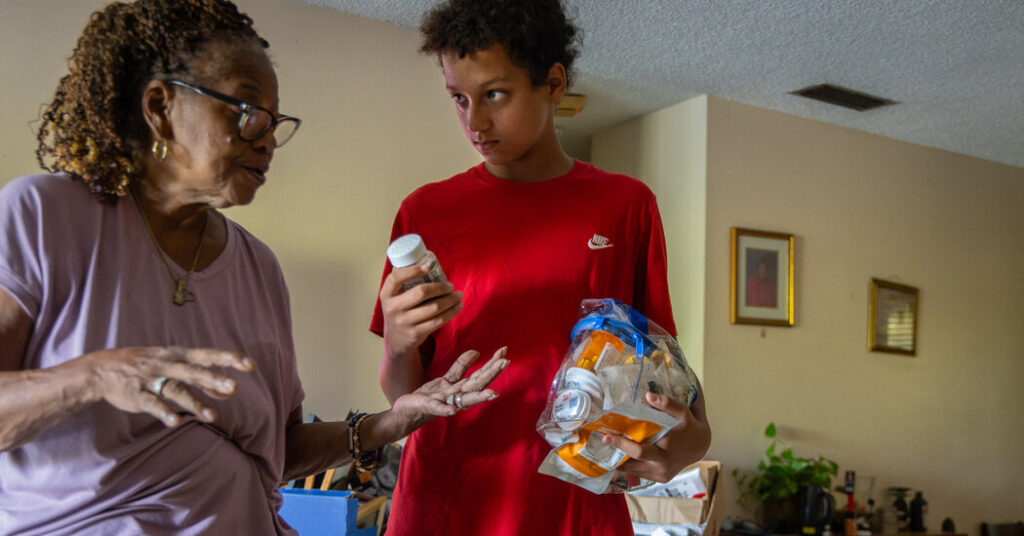
By then, Isabella had already been caring for her mother for a year and a half. “It all went downhill from 14,” she says. After Rosa’s right breast was removed, Isabella would skip school to milk the tube that drained her post-op fluid, even as she feared pulling the tube out. She would change Rosa’s bandages and help her bathe, sort her pills morning and night and spray the bathroom with Lysol so her mother wouldn’t pick up an infection. At Rosa’s medical appointments, where Isabella took notes, she learned how cancer spreads. “I don’t even know how that physically is possible to have cancer in your bloodstream,” Isabella told me. “But that’s what the doctors say.”
In 2024 and 2025, Rosa had two operations on the tumors in her brain, leaving Isabella to tend to new surgical wounds and make sure her mother didn’t fall. Isabella scheduled Rosa’s doctor appointments and filled out medical forms.
Though Isabella’s father slept in their apartment’s living room — her parents had divorced years earlier, but he moved back in after Rosa’s initial diagnosis — he was in poor health himself and away at work much of the time. And because Isabella’s three grown siblings all lived elsewhere (two were in the military), they were unable to come home regularly. The only time she received any sort of outside assistance was after her mother was hospitalized for severe dehydration and near kidney failure. The hospital arranged a month’s worth of weekly visits by a physical therapist to get Rosa walking again.
Isabella, who lives outside Atlanta, is one of an estimated four million children in the United States caring for an adult family member who is sick or disabled or old, according to a 2025 report from AARP and the National Alliance for Caregiving. That figure is an extrapolation from surveys of adult caregivers that include only children who are reported as additional helpers; it doesn’t capture those who provide care by themselves or attend to siblings with medical needs. Sociodemographic shifts will undoubtedly push their numbers higher: Members of the baby boom generation are aging into the years when they are likely to need daily assistance at home, while increased housing costs are packing more families into multigenerational homes.
The health care system is adding to these pressures. Financial incentives are shortening hospital stays, and services that used to be provided on the wards are left to those at home. “People are being discharged without the resources they need to be able to care for their loved ones,” says Michelle Bolden, a nurse who founded the nonprofit Call for Caring. “We send them home to manage Foley catheters or wounds or g-tubes — all types of things. And there’s minimal amount of training that’s done.”
Federal cuts to Medicaid, the country’s main payer for long-term aid at home, will force some people from the program and reduce home care for others. And even for those who remain eligible — or who can pay for it themselves — support may be elusive: Last year, the home care waiting list for Medicaid beneficiaries alone topped 600,000. Nearly one-third of all home care aides, who typically make less than $17 an hour, are immigrants, and the Labor Department projects about 766,000 openings every year. Inevitably the work falls to whoever else lives in the household — even if they’re children.
“Something that has been a detriment to the kids is this whole perception of the ‘sandwich caregiver,’” Melinda S. Kavanaugh, a professor of social work at the University of Wisconsin-Milwaukee, told me. Kavanaugh was referring to an all-too-familiar figure: the middle-aged American woman simultaneously looking after her aging parents and her young kids. But this prevailing image of who counts as a caregiver makes it harder to see those who don’t fit that picture — especially if they’re children.
Children in this role not only have different worries — in Isabella’s case, turning in her algebra homework, making it to practice with her majorette team — they also lack access to the state or federal resources available to their adult counterparts. This invisibility, the result of societal blind spots, leaves them with few places to turn.
Growing up as a caregiver shapes a child’s life in all kinds of ways. But it is at school where this responsibility tends to inflict the greatest toll. At Charles R. Drew High School in Riverdale, Ga., where Isabella is a student, she missed 12 days during her freshman year; as a sophomore, she missed 38 days. By the time I met her, when she was a junior, she had missed 17 days her first semester. The calculation for her was simple: School mattered; her mother mattered more. “I know my grades suffered,” Isabella, who wants to be a veterinarian, told me. “But my mom needed me.” She eventually left the majorette team because rehearsals and games lasted into the evening — and that meant leaving her mother alone for too long.
Isabella’s experience is not atypical for children who have to care for a family member. A 2024 study in Rhode Island found that about 14 percent of the state’s students reported that their absences from school were because they had to look after someone. Nationally, teen caregivers are about 8 percentage points less likely to be enrolled in school at all.
Those caregiving students who remain in school tend to be less engaged and spend about 45 fewer minutes per day on educational activities; not surprisingly, they get worse grades. Caregiving youth also grow up to be adults with lower levels of education, even after controlling for socioeconomic status and other demographics.
Yet in many schools, no one is trained to identify caregiving as something that can add significant stress to a student’s life. Drew High School’s principal, Tangela Benjamin, told me that for years she was unaware of the problem. Then on a September morning in 2024, as she greeted students passing through the lobby metal detector, one girl was pulled aside by a security officer; when she was cited for wearing a midriff-baring top, the girl flung herself to the floor and screamed, “I can’t take it anymore!” Afterward, in Benjamin’s office, the student confided that she was overwhelmed by having to care for her grandmother. Benjamin calls that moment her “awakening.”
The awakening didn’t come with remedies, though. “I felt helpless,” Benjamin says. It’s no mystery to her why students miss school to care for someone at home: “Just straight up poverty,” she says. “My kids are dealing with more poverty than most.” (At Drew High School, all students are eligible for free lunch.)
The rise of remote schooling, spurred by the pandemic, can also make caregiving easier to miss — and harder to relieve. I met an anxious teenage boy who recently switched to virtual school, motivated in part by being able to care for his bedridden mother. Going remote enabled him to help her more, but it also meant that, while at home and not in a school, there was no designated stretch of the day when he was off duty.
Because of the symptoms caused by her brain tumors, Isabella’s mother was no longer able to continue at her warehouse job packing sunglasses. The disability benefits didn’t improve their circumstances much, as Rosa’s private insurance gave way to Medicare. Their food stamps were reduced to $63 a month from $536. (They have since increased to $110.)
Isabella coped, in part, by writing poems in a red notebook:
Speechless, she lost her words out of words, she felt hopeless she doesn’t know what to say what step does she take?
At school, she also turned to her health care sciences teacher, Ericka Collins. “She’s been in the health care field so long that she’s understanding what I’m going through,” Isabella says. After one of Rosa’s surgeries, Isabella sought Collins’s advice. “Is my mom supposed to be in pain this long?” she asked.
Sometimes, Collins says, she went into an empty classroom and screamed in frustration at Isabella’s situation. Other times she cried. Or prayed. Collins, like Benjamin, felt helpless. “Barring getting totally involved in going to their house,” she says, “what can you do?”
Earlier this year, I accompanied Pilar Brugman, a family specialist for the American Association of Caregiving Youth, the only organization in the United States dedicated to directly serving children caring for sick, disabled or elderly family members, to a rusty mobile home in northern Palm Beach County, Fla. Brugman was checking on Kristen Quiroga Rivera, who was 13, and her brother, Jusseth, who was 17. Their mother, Olga Rivera, was on dialysis, suffered from diabetes and had recently had both of her feet partially amputated. (Their father died from a stroke more than a year earlier.)
Olga referred to Kristen as “a little nurse.” She bathed Olga and checked her blood pressure morning and night, giving her an extra pill when it was too high. She disinfected and wrapped her feet. When Jusseth was around, he sometimes cooked for the family.
Brugman arrived at the family’s home with a $25 Walmart gift card. “We are not teachers, we are not police,” Brugman told me. “We never ask, ‘Hey, are you illegal or not?’ We ask, ‘What is it you need?’”
Brugman had been helping complete paperwork for social service agencies for the family and trying to arrange tutoring and therapy for Kristen. On this Thursday in January, Brugman coached Olga through the process of reapplying for the disability benefits Jusseth was supposed to receive for his A.D.H.D.
When I asked Kristen about her caregiving, she replied, “To be honest, I think I’m starting to hate it.” She wanted to confess something else, too: “Sometimes I’m selfish,” she whispered. “Sometimes when my mom calls at night, I pretend I’m asleep, because I just want to go to bed and I want to be left alone.”
A.A.C.Y. contracts with a home aid agency to offer respite from caregiving and organizes events — museum trips, ice-skating outings, overnight camps — so these youngsters can meet one another, take breaks from their duties and just be kids. When it became clear that Olga’s jerry-built wheelchair ramp was too unstable and their home was falling into disrepair, a staff member rallied her church to help: A dozen churchgoers arrived on a Saturday and went about fixing and cleaning.
The program, which was started in 2006, was born out of a set of questions that its founder, Connie Siskowski, a nurse who was working toward a Ph.D., added to a survey distributed throughout Palm Beach County. The responses revealed an entire population of caregiving youth. They weren’t doing well: Two-thirds missed school-related activities, failed to complete their homework or had their studies interrupted. Siskowski recalls that education officials could not easily ignore the findings, so she was welcomed into the school district, the nation’s 10th largest, to try to help.
While A.A.C.Y. works in Palm Beach County schools to identify caregiving students — its direct services are offered only in this district — home visits are central to its operation. A.A.C.Y. has served more than 3,000 children, who typically stay with the program for longer than five years. But not all families let its staff past their front doors. “They don’t want to get in trouble,” says Thamar Mathias, who came to A.A.C.Y. from an agency under Florida’s Department of Children and Families. As a family specialist for A.A.C.Y., though, she can “maybe help avoid it getting to the point where the state has to intervene.”
The state had intervened already once with Zion Zebedee Hedgepeth, when he was born, removing him from his mother because she tested positive for drugs. I met him when he was an eighth grader, and his paternal grandmother, SuSann Forman-Ferreira, who adopted him, was doing her best to keep the state from taking him away again. She saw A.A.C.Y. as an ally in this effort.
These days, Zion is most worried about SuSann’s driving, which is why he has designated himself the passenger-seat “driver” on all her medical appointments. He laughed as he explained to his A.A.C.Y. family specialist, Kayli McBean, that he could “get a fake license” if only he could grow a mustache. McBean knew deeper feelings lurked beneath the jokes. “Zion belittles a lot of the things he does,” she told me — something she discovered after she started visiting his home.
SuSann, who is 74, has suffered five strokes and three heart attacks. During McBean’s visit, while Zion was at school, SuSann mentioned that she had fallen three times in the last month but refused medical attention. “I know if I go to the doctor, they’ll hospitalize me,” she told McBean. Then where would Zion go?
The boy was having problems at school. “The main thing is that he worries about you,” SuSann recalled his pediatrician saying. After that, SuSann promised herself that she would never let Zion see her cry. So she cries to McBean instead.
“Sometimes I don’t even let him know how bad I’m feeling every day before he goes to school,” SuSann said.
“You’re stronger than you think,” McBean said. Then she pointed out how Zion helps her.
“I don’t want that,” SuSann replied, through tears.
“When he talks about you, his face lights up,” McBean said.
Later, a school administrator called about Zion’s makeup courses. “Based on the number of classes he failed, he’s going to be doing it for a long time,” the administrator told SuSann.
Still, if Zion stays in A.A.C.Y.’s program, he is very likely to graduate from high school. Over the past decade or so, A.A.C.Y.’s efforts have produced a 98 percent graduation rate. (In Palm Beach County during this period, it was under 90 percent.) Recently, SuSann, unable to keep up with home payments, has been thinking about moving up the coast, closer to her sister. But that would mean leaving behind the services that A.A.C.Y. provides, which don’t extend beyond the county.
“Family caregivers are not controversial,” says Elizabeth Olson, a leading researcher on young caregivers and a geography professor at the University of North Carolina at Chapel Hill. “But once you talk about kids being involved, all of a sudden it’s a controversy.”
Such controversy exists, in part, because of the complexity of child protection laws in the United States. Currently, 42 states consider a parent’s disability as a reason to terminate parental rights. Lawmakers, says Kavanaugh, of the University of Wisconsin-Milwaukee, “don’t know how to wrap their minds around how to support a kid that’s not part of the foster care system.”
Another factor contributes to keeping these children under the radar: Identifying those who care for family members can also mean having to reckon with child labor laws. “If we are to acknowledge these children as caregivers, then we’re also maybe by default acknowledging that children are working,” Kavanaugh says. “And we don’t want that.”
It’s not as if these children are being routinely screened for in medical settings, either. Julie Belkowitz, a pediatrician and professor at Nova Southeastern University, in Florida, told me that when she shares research on caregiving youth with other doctors, the response, no matter their specialty, is consistent: “Wow, I never really thought about it before.”
“Little is known” about these children, the Government Accountability Office wrote in a report last year. While the report acknowledged this population’s “unique challenges,” it offered just one recommendation, a clarification on a federal government website stating that some resources for adult caregivers could potentially be extended to those under 18. A 17-year-old might count, that website now suggests — “if state law allows.”
This falls short, Olson says, because it doesn’t force people to ask: “What could we do as a country? What should be the minimal expectations for us?” Instead, it just says, as she put it, that if you want to create a program for caregiving youth, “you might be able to come here for resources — good luck.”
In the absence of any meaningful federal framework for these children, Rhode Island is trying to build something of its own. The Rhode Island Department of Education, in partnership with A.A.C.Y. and academic researchers, recently rolled out the country’s first statewide initiative to support caregiving students when it updated graduation requirements for the class of 2028 to focus on student readiness — a shift that allows schools to accommodate students whose home obligations might otherwise hold them back.
This February, RIDE gave recommendations to its educators, like naming a point person, for example, so students aren’t forced to repeatedly explain their situation to a rotating cast of adults. Educators can also offer more flexible schedules and provide credit for work done outside the classroom. And RIDE plans to use a nearly $6 million federal mental-health grant for these students, including training school psychologists on their specific needs. Schools need to serve caregiving students too, says Stephen Osborn, the RIDE official leading the effort. “Not just have kids who are taking eight A.P.s because they don’t have any adult responsibilities.”
Before the initiative, teachers would come into Mary Watkins’s office at Davies Career & Technical High School in Lincoln, R.I., where she’s the superintendent, and say, “I have a situation.” Nobody even had the proper vocabulary to describe it. “Now someone comes in and they’re like, ‘I think I might have a student who may be a caregiving youth,’” Watkins says.
In July, California passed a law recognizing caregiving youth, directing its Department of Education to develop guidance on ways schools may support them. But even with educators’ best efforts, schools still can’t overcome what is, at its core, a larger societal challenge. “There’s only so much schools can do,” says Emma Armstrong-Carter, a developmental psychologist and professor at Tufts University who’s collaborating with RIDE.
Saul Becker, one of the world’s foremost researchers on caregiving youth and a professor at Manchester Metropolitan University, in England, finds it “shocking” that A.A.C.Y. still mostly stands alone in the United States. Elsewhere in the world, caregiving children are formally recognized and met with services. “If you get into any taxi now in the United Kingdom and say, ‘Have you heard of a young carer?’ they will know exactly what I’m talking about,” Becker says. Children who care for family are identified by local authorities, which gives them rights to assistance. Similarly, Australia’s government has set expectations for public service agencies to take young carers into account. And in Sweden, when an adult is sick, health workers are supposed to find out what burdens fall on any children at home.
Experts point out that helping care for family members isn’t necessarily a sign of household pathology. Children in these situations can feel pride and gain resilience; they learn skills and often end up in health-related fields. But such outcomes can sound like a comforting fiction when responsibilities become too heavy, a way of valorizing a burden that American society hasn’t managed to alleviate. In Sweden, by contrast, children might “do small things,” says Pauline Johansson, a health care professor at Linnaeus University, but not at the expense of school, friends or leisure; when that happens, they are relieved of their duties, even if that means sending aides into the home. “If you can’t take care of yourself, public service should take that responsibility,” she says.
This February, Isabella was particularly stressed, but not about Rosa. “My mom is OK,” she texted me. “My dad, on the other hand, not so much.” Her father, who tends to be quiet about his health, went into cardiac arrest outside a grocery store. Bystanders who administered CPR saved him, but his heart stopped several more times in the ambulance and hospital. By the time he was sent home, his heart was so damaged that he had to wear a medical vest that would shock him if he went into an abnormal rhythm — yet another piece of equipment for Isabella to learn. “It is a lot of information,” she told me.
After her father’s hospitalization, Isabella was more exhausted: “I come home and just sleep, mainly, and do my homework when I need to.” Making up assignments was challenging, particularly in her literature class. At one point, she had fallen so far behind that she was running the numbers on whether a C grade was still within reach, but she didn’t feel comfortable opening up to that teacher. She was also unable to practice her majorette skills. “I might pick my dancing career back up, like when I go to college,” she told me, seemingly unfazed.
Then in March, Rosa found out that a new tumor was growing in her skull. So far, radiation has kept it at bay. She hopes to avoid surgery again.
More recently, Isabella switched jobs, going from Chick-fil-A to a shoe store in the mall, her income necessary “to keep the roof over our heads,” a phrase she seems to have borrowed from Rosa. For the past few years, while her classmates looked forward to graduation, she sometimes wondered if her mother would still be around for it. But she didn’t expect to be caring for her father too. “It is the reality that I am living,” Isabella said. “So I basically have to deal with it.”
Helen Ouyang is a physician and an associate professor at Columbia University and a contributing writer for the magazine. She is also a fellow at the Type Media Center.
Stephanie Sinclair is a Pulitzer Prize-winning photographer known for her focus on gender and human rights issues. She founded Too Young to Wed, a charitable organization.
The post The U.S. Relies on Family Caregivers. Millions of Them Are Kids. appeared first on New York Times.