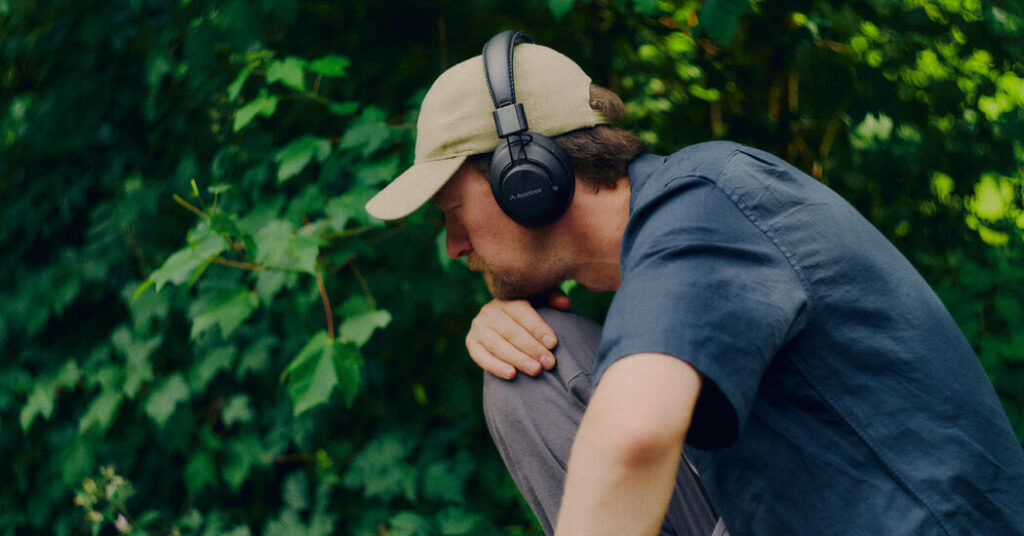
Those seeking the true throbbing pulse of New York City might consider braving ticks and poison ivy to hover over an algae-ridden pond in Central Park while Jacek Smolicki fishes for sound.
Smolicki is an artist, scholar and designer based in Stockholm who has dedicated his practice to the fine art of listening, often recording sounds and vibrations of the city that mere mortals normally can’t hear.
On a recent Sunday, a photographer and I accompanied Smolicki on “soundwalks” around Manhattan and Brooklyn, aided by the sensitive microphones he carries to help people engage with their sonic environments. Our efforts to commune with maple trees, aquatic snails and waterfalls in the park met with some fierce competition, including a saxophonist belting out “My Girl” at the entrance to the Ramble and distant bomba drummers from the Puerto Rican Day parade.
Fresh from completing a Loeb Fellowship at Harvard, Smolicki made an excursion to New York City, where he has taken soundwalks over the years. At a pond in the North Woods of Central Park, near 102nd Street, our sound sherpa gave us headsets as he cast an underwater microphone into the murky deep.
Sound carries faster through water than through air, and soon we heard a plink-plink-plinking. It was followed by what sounded like bacon sizzling in a frying pan, which turned out to be a bubbly photosynthesizing elixir of microbes, decaying muck and insect larvae. Then there was a clicking — possibly aquatic snails, Smolicki said — and the quiet pops of fish mouths opening and closing, a miraculous sound that this lapsed fly fisherman thought she would never hear. Somewhere in the humid thickets a bullfrog croaked.
The term “soundwalking” was coined in the early 1970s by the Canadian composer R. Murray Schafer, who encouraged individual and group walks. He established the World Soundscape Project at Simon Fraser University in Vancouver to draw attention to the increasing intensity of noise and the importance of capturing natural and community soundscapes.
Although much can be discerned with the naked ear, especially with practice, Smolicki’s microphones were portals into the city’s hidden aural universe.
A small stream tumbling over rocks in the park was transformed into Victoria Falls. At the foot of a maple tree, he attached homemade geophones — copper and ceramic discs encased in a plastic Kinder egg and extended with a knitting needle to detect underground vibrations. He set up a second mic swaddled in a fuzzy wind protector known as a “dead cat” — a term he has disliked ever since vultures circled around him in Florida, mistaking the fuzz for a real dead cat.
Sound travels through roots. Smolicki rubbed the maple’s bark, which gave off a rackety scratching sound. He then moved on to a different tree — same intensity. I tried it myself on a tree even farther away, and it was just as loud. “We tend to perceive trees as vertical, but actually they are more horizontal,” Smolicki said. “Sound helps us visualize something that is otherwise imperceptible.”
Imperceptible or not-so, it’s the Summer of Sound in New York and beyond. Crowds have been flocking to “Clinamen: NYC” at the Park Avenue Armory, a “sonic meditation” by the French artist Céleste Boursier-Mougenot in which circular pools hold nearly 800 bobbing ceramic bowls, their rims gently colliding.
At the 2026 Venice Art Biennale, the 17th-century Giardino Mistico, or mystic garden, at the Holy See Pavilion offers a respite in “The Ear Is the Eye of the Soul” (through Nov. 22). It’s an invitation for “slowness and contemplation,” with headsets for visitors to listen to artists’ healing sounds embedded in the paths — Brian Eno beneath the lavender, for instance, or Patti Smith by the rose trellis. The curators, Hans Ulrich Obrist and Ben Vickers, in collaboration with the international Soundwalk Collective, were inspired by a 12th-century mystic, Saint Hildegard of Bingen, for whom listening and sonic awareness was a cosmology.
“A lot of visual artists have experienced an interest in working with sound,” Obrist said. “In this busy and turbulent environment, it’s a concentrated moment.”
FOR SMOLICKI, 43, SOUNDWALKS provide an opportunity to “take a break” from the visually dominant culture — and the incessant text alerts, ringtones, laptop start-up chimes, microwave pings, seatbelt warning beeps, and constant input into Bluetooth earbuds, to name a few. The upshot?
“We may be hearing, but not listening,” he said. Smolecki is the co-founder, with his colleague Tim Shaw, of the Walking Festival of Sound, a biennial event celebrating the role of sound in everyday environments. The Festival debuted in Stockholm and Newcastle upon Tyne, England, in 2019 and has traveled recently to the Boston area. It now also appears online.
Walking with him is a moving meditation, an invitation to awaken the senses.
For years Smolicki has carried around a small audio recorder to keep a sound diary of public places. Walking past Lincoln Center — where his plan to record dancing on the plaza was thwarted by a barrier — he recalled the work of one of his heroes, Tony Schwartz (1923-2008), the so-called King of Sound.
Schwartz modified an early reel-to-reel tape recorder to make it portable and captured the life and songs of his immigrant-rich Lincoln Square neighborhood on the Upper West Side, and recorded its demolition to make way for Lincoln Center. His recordings include the four-minute Sound Picture of New York, among others, in the Library of Congress.
Another revered figure, the soundscape ecologist, musician and naturalist Bernie Krause, has sonically tracked and archived the natural habitats of thousands of creatures over decades. His 2012 book, “The Great Animal Orchestra” is an ode to the world’s natural soundscapes. It’s also a commentary on their disappearance because of human noise, ecological destruction and climate change.
SMOLICKI WAS BORN IN KRAKOW, POLAND, during the period of martial law imposed by the communist government to crack down on the Solidarity movement (both his parents were members). His father, an architect turned stage designer, and mother, an ethnographer turned costume designer, organized listening sessions of banned Western music in the basement, among them Led Zeppelin and Deep Purple.
He recalled a story from his youth in which his mother, Anna, who “sought sanity in nature,” was heartsick to find that a neighbor had cut down a row of beautiful trees. She asked her sons to place candles on the stumps. Several months later the neighbor planted new trees. “It taught me that soft activism can change peoples’ perspectives,” Smolicki said. “I sometimes think of soundwalking as an intimate form of activism.”
Smolecki trained as a product designer but grew disenchanted with “producing yet more things.” He moved to Stockholm in 2007 for a new master’s program in “experience design” founded by the conceptual artist Ronald Jones at Konstfack University, gravitating to sound — what the Hollywood film editor and sound designer Walter Murch has called “the shadow sense,” historically relegated to a secondary role behind visual storytelling.
Since then, Smolicki — who has three master’s degrees and a Ph.D. — has become something of a global sound swashbuckler. In Finnish Lapland, he MacGyvered an antenna using found wood and a spool of copper to listen to electromagnetic energy from lightning strikes. He also recorded Sami reindeer herders and rusted barbed wire from World War II that vibrated eerily in the rain, like Harry Bertoia’s sonic sculptures.
At the Canaveral National Seashore in Florida he led soundwalks for visitors during a monthlong arts residency at the Soundscape Field Station. There, he was struck by the contrast between the park’s teeming wildlife — bobcats, dolphins, manatees, armadillos — and thunderous launches from NASA’s John F. Kennedy Space Center, 45 miles away, “the oxygen exploding, the sonic booms you physically sense” he said.
During the pandemic, he got stuck in Vancouver at the Sonic Research Studio and started listening to tidal pools along the sea walls — hearing nothing at first and then drawn by a “persistent scraping.” It turned out to be limpets: aquatic snails that have teeth stronger than Kevlar to feed on algae and excavate rock. (He said he wouldn’t mind being reincarnated as a limpet.)
But limpets are among the many aquatic species under threat from warming seas. Noise pollution has affected the navigational abilities of whales and other marine mammals, limiting their capacity to detect sounds from predators and prey.
Soundwalking can also carry echoes of the past. Smolicki developed a memorial soundwalk through the former Jewish Ghetto in Krakow commemorating the 70th anniversary of its liquidation. Nearby is the KL Plaszow concentration camp, now a memorial and built on the grounds of two Jewish cemeteries.
The site-specific installation and soundwalk, created with Katarzyna Zimmerer, a Krakow expert, knits together field recordings, readings from survivor diaries and sounds re-created from their memories — ballet slippers tapping on the wooden floor of a children’s ballet school, for instance. It concludes at Plaszow, the sounds growing fainter and then going silent.
To avoid what Smolecki called a “clean, clinically processed sound,” he placed the analog tape of a lullaby in dirt in the vicinity of the camp for an ambient effect — to “allow the site to affect the material,” he said.
But he still feels a genuine affection for New York, where he finds people talk loudly to be heard over the din (at least compared with Stockholm). On our walk, we “ear-witnessed” a Sabrett hot-dog stand’s hot buzzy generator before taking the subway to the Brooklyn Bridge, where he captured its vibrating walkway and staccato of speeding cars clip-clopping over metal plates.
When he applied his homegrown microphones to a leaky pipe beneath the West Side Highway, it seemed like a doctor applying a stethoscope to a quivering and delirious patient.
On Fifth Avenue, he cheekily picked up an orange traffic cone and placed the narrow part on my ear. The cacophony of taxis and garbage trucks was reduced instantly to perfect white noise that could help any of us obliterate insomnia.
We stood before our final Manhattan archetype, an orange and white striped Con Edison stack, funneling plumes of vapor from a manhole cover into the air. Smolicki attached his microphone. The stack hissed like a snake.
It was just another New Yorker blowing off steam.
Audio recordings by Jacek Smolicki. Produced by Rebecca Lieberman and Maridelis Morales Rosado.
The post It’s the Summer of Soundwalking. He Is Your Sherpa. appeared first on New York Times.