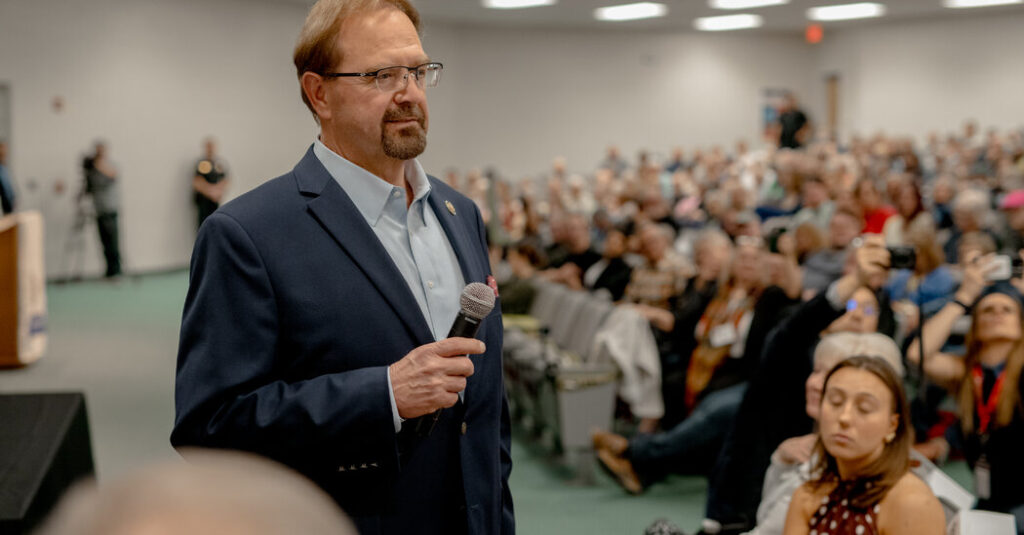
On Monday night, Jim Fulton, the Republican Party chair in Buncombe County, N.C., received a call from an aide for Representative Chuck Edwards, whose re-election campaign was spiraling after the House Ethics Committee documented his troubling conduct toward two young female aides.
Mr. Fulton said he was told that evening it was still “full steam ahead.” He was given campaign signage to put up.
Then at 3:32 a.m. on Wednesday, Mr. Edwards announced he was dropping out.
“There was already a lot of work to do” to get Mr. Edwards back on track, Mr. Fulton said Wednesday. “Now,” he added, “there’s a lot more.”
Even without scandal, the race in western North Carolina’s 11th Congressional District had turned competitive. Jamie Ager, the Democratic candidate, had been making hay of his background as a farmer with deep roots in a region that has been reliably red for decades but has shifted left in recent election cycles.
Now, just over 12 weeks before Election Day, Republicans are scrambling to find a candidate. The Republican executive committee of North Carolina’s 11th district — which includes dozens of members, such as county party chairs — will meet next Monday to pick a new nominee.
Several state legislators are possible replacements, but no clear front-runner has emerged, committee members involved in the process said. There was, however, widespread understanding that the road ahead would be steep.
“I’m not sure who chooses to do this, and if they even have a shot at winning,” said Michele Woodhouse, a former Republican Party chairwoman for the 11th Congressional District. “Which Republican is going to want to get in at this point? Can they win?”
The replacement candidate will need a crush of cash to be able to compete with Mr. Ager, who has raised more than $3 million. (Mr. Edwards had $940,000 in his campaign coffers.)
And whoever is chosen will only have about 80 days to campaign in a large district that stretches across 16 counties, much of them mountainous and rural. For many residents, the central issue continues to be the slow pace of recovery from Hurricane Helene, which killed more than 100 people in 2024 and was the worst natural disaster to strike the state.
Many had aimed their frustration at Mr. Edwards and the Trump administration, especially after Kristi Noem, the former homeland security secretary, delayed federal assistance. Mr. Edwards’s office did not respond to a request for comment.
Others, though, remain disappointed with the immediate response to Helene from former Gov. Roy Cooper, a Democrat. Mr. Cooper is now running for Senate against Michael Whatley, a Republican who has faced his own scrutiny in western North Carolina after President Trump named him the Helene “recovery czar,” a title he has eschewed.
A Democratic super PAC has been airing a television ad with a Buncombe County man explaining why people felt “abandoned” by Mr. Edwards after Helene. Mr. Ager has made Helene recovery central to his stump speeches.
He describes himself as a “Mountain Democrat.” And he has been careful to distance himself from a damaged national brand. For instance, his campaign yard signs, abundant in liberal Asheville, are green.
“Jamie has had over a year to meet to meet the voters, to go out there and make his case,” said Grayson Barnette, Mr. Ager’s campaign manager. The next Republican will not be able to do the same.
Republicans say Mr. Ager is more liberal than he lets on.
“I am confident Republicans will unite behind our nominee and continue our work to expand our majorities in Washington,” Jason Simmons, the chairman of the North Carolina Republican Party, said in a statement.
Still, Mr. Edwards’s announcement left some Carolina conservatives bitter. Perhaps the 11th Congressional District was cursed, they joked, referring to its previous scandal-ridden Republican incumbent, Madison Cawthorn, who gained national notoriety for his personal and political mistakes before Mr. Edwards defeated him in the 2022 Republican primary.
“Have they checked on what Madison Cawthorn is doing?” BJ Neidhardt, a Democratic consultant, asked sardonically, as possible replacements fluttered on social media.
(For the record, Mr. Cawthorne is trying to make a comeback in a Republican House primary in Florida.)
After the 2022 primary, Mr. Edwards was viewed as the adult in the room, bolstered by old-guard Republicans who yearned for scandal-free representation in Washington.
“Edwards’s pitch was that he was going to be a boring, head-down, serious member of Congress who cares about constituency service,” said Chris Cooper, a political science professor at Western Carolina University.
At times, he gained the grudging respect of his critics. In October 2024, he published an 800-word post to debunk conspiracy theories and false claims surrounding the federal response to Hurricane Helene. Last year, he was one of the few Republican members of Congress to attend a vitriolic town hall in person.
For Mr. Fulton, the Republican Party chair in Buncombe County, Mr. Edwards’s downfall felt surprising.
On Tuesday morning, Mr. Fulton had rushed to their office to get an Edwards sign up beside some shrubs. The next day, he was back to remove it, plucking it from the dirt.
The post Scandal Leaves North Carolina G.O.P. With No Candidate and Little Time appeared first on New York Times.