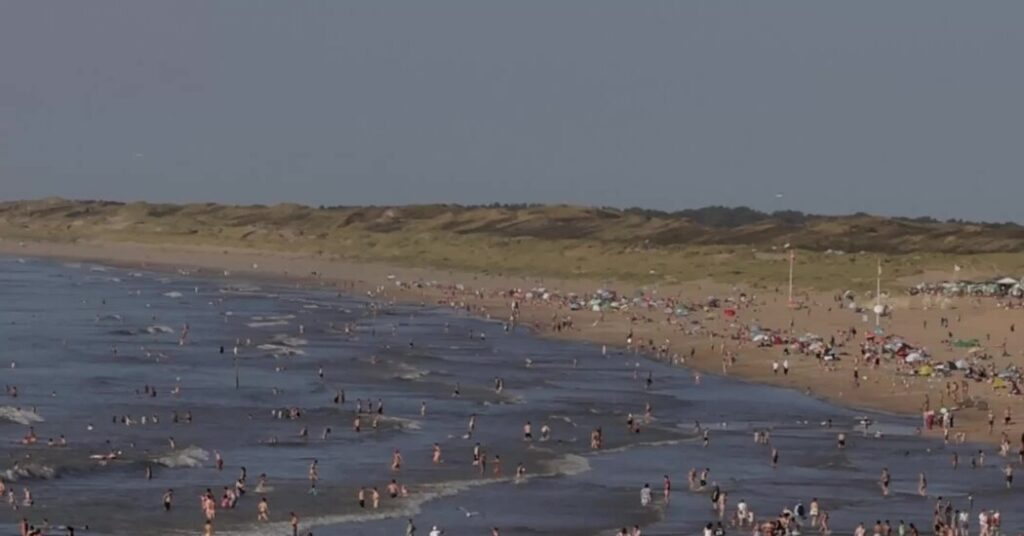
A woman sprawled on a lounger under a beach umbrella sips from a pitcher of sangria. Sailboats dot the bright horizon, and steel drum music streams from a nearby restaurant. The tang of coconut sunscreen lingers on the salty breeze.
Just down the beach, tourists zip-line, sunbathe and eat soft serve on a pier. A surf school attracts visitors from around Europe. The boardwalk is a swirl of languages — Dutch, English, French, German, Spanish.
This vacation hot spot isn’t Mykonos. Nor is it Porto, the Amalfi Coast, Malaga or Mallorca.
It’s The Hague, the seat of government for the Netherlands and the home of the International Criminal Court, and it’s a prime example of where to have a “coolcation” in an increasingly sweaty Europe.
Although perhaps most commonly known as a center of justice and politics, The Hague is home to seven miles of sandy coastline along the North Sea, along with a quaint city center with winding cobbled streets, scenic canals and art galleries. It has long been popular with Dutch and German visitors.
Now the city is also attracting tourists from other parts of Europe who are seeking sandy beaches without sweltering temperatures. Madrid and Paris, for example, eclipsed 100 degrees Fahrenheit during the most recent heat wave, and parts of France and Spain are currently fighting huge wildfires. The Hague usually has summer highs in the 60s or 70s, though the temperature has crept into the 90s some days this summer.
“We don’t go south now because it’s too hot,” said Mathias Streit, 31, who had traveled north from Bern, Switzerland, and was recently taking a guided tour through The Hague with his mother. The mere idea of being on a 100-degree beach in Spain or Italy was “terrible,” he added.
By contrast, the cooler Hague, he said, was “perfect.”
He’s not alone. About 16 percent of people in a recent survey by the European Travel Commission, which promotes tourism on the continent, said they were seeking destinations with milder weather. Those can include beaches on Europe’s northern coastline, like in The Hague, and in Scandinavia.
Visits to The Hague, measured by overnight stays, are up by nearly 60 percent over the past decade, based on data provided by local officials. Visits from Italy and Spain are up 9 percent over the past two years, while visits overall in that period are up 7 percent, the local data show.
Hague officials say they are wary of what increased tourism could bring, particularly the overcrowding that has plagued destinations in southern Europe. They do not want The Hague to become a bachelor party magnet like Amsterdam, a 40-minute train ride to the northeast.
“We have a completely different image, and we cherish that image,” Marco Esser, the director of The Hague & Partners, the city’s marketing agency, said in an interview in the carefully landscaped courtyard of a coffee shop. This city, as he describes it, is “high-class.”
His colleagues say they’re hoping to bring in the “stijlzoekers,” or “style seekers.”
Jasper van der Hoek, the founder of Patagonia Beach, a beach club on the northern part of The Hague’s long line of beaches, said his guests tended to be “elegant.” They are often local or regional regulars seeking sea bass and oysters, not chicken fingers, he noted.
To avoid unchecked tourism, the city has rules to limit Airbnbs. New hotels can gain approval, but city officials said those approvals were limited to avoid expanding the market too much. The city’s marketing agency spends its budget on talking up a surf championship in the autumn and Christmas markets in the winter, rather than on attracting people during the summer.
The goal, several local officials said, is to keep the number of tourists coming during the height of summer fairly steady while driving visitor numbers during the adjacent seasons.
Eliza Bol, a spokeswoman for the municipality, said in an email that the policy would avoid “giving the market free rein and risking overtourism.”
So far, it seems to be working. On a recent weekend, the city’s galleries and shopping streets were bustling, while dozens of surfers caught waves at the beach, and trendy restaurants were fully booked. But you could get a walk-in table at most standard brasseries and sushi spots.
Museums were a hotter ticket. The Mauritshuis, home to Vermeer’s “Girl With a Pearl Earring,” was out of open slots.
Simone Hollen, who manages international sales at the Mauritshuis, said that most visitors were still Dutch or German, but that tourists from France, Italy, Spain and elsewhere were making up a “new market.”
Heena Jethwa, who is from Yorkshire, England, and has lived in The Hague for two decades, was walking on the city’s pier with her daughter and friends visiting from Britain, enjoying the 75-degree weather.
The city, she said, “seems to be more touristy.” She said that during the latest heat wave, the beach had been packed, which she saw as a good thing.
Paul Schuitema, who runs a surf school and shop in the beach area of Scheveningen, said his business had long welcomed a solid number of international guests. But he noted that he increasingly heard people talking about how they had come to northern Europe to avoid the heat.
Higher temperatures and drought are leaving a mark in the Netherlands, too. The nation saw serious wildfires this year. In The Hague, Els ‘t Hooft, a tour guide, was celebrating her 54th birthday by showing tourists from Australia, the Czech Republic, Germany, Romania, Taiwan and the United States around The Hague’s cobbled squares.
She pointed to a patch of yellow grass near a monument to Spinoza, a philosopher from the 1600s.
“To see yellow grass in my country,” she shook her head. “It is not something I grew up with.”
Martin Wörsdörfer, who works to promote the interests of local beach bars, said the area’s growing appeal was obvious.
“Look at our beach,” he said. “It’s Spain” — just without the 100-degree weather.
The post How Being Cool Is Making The Hague a Vacation Hot Spot appeared first on New York Times.