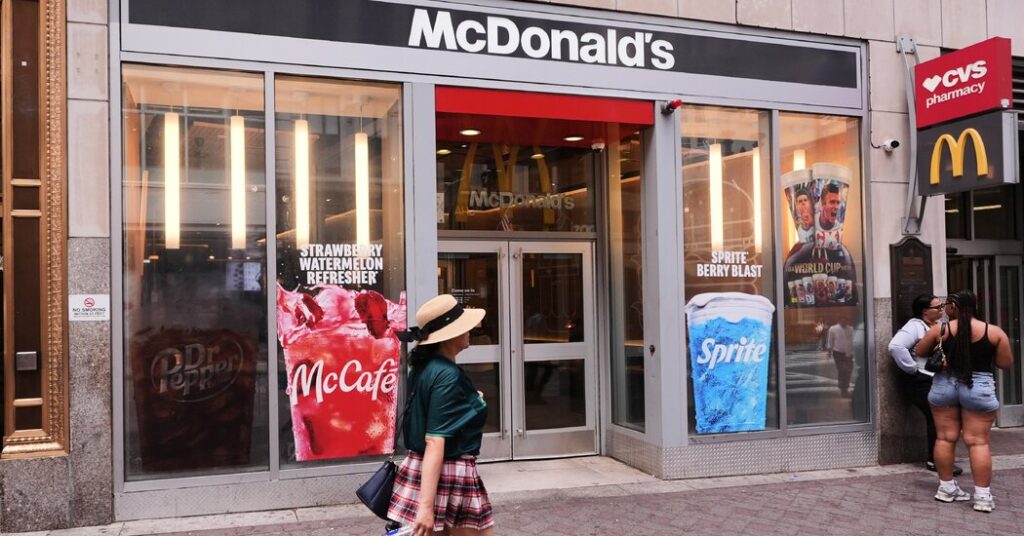
Sales at McDonald’s softened last quarter as traffic to its U.S. restaurants fell, the fast-food giant reported on Tuesday.
Consumers have been squeezed by inflation, especially a jump in gasoline prices since the start of the war in Iran. Sales at McDonald’s stores open for a year or more in the United States rose 0.8 percent in the three months through June, a sharp slowdown from the growth recorded in the same period last year.
The results may reflect increased pressure on spending by lower-income consumers, which make up a big share of McDonald’s customer base.
Aiming to jump start growth, McDonald’s said that Skye Anderson, the company’s chief operating officer, would become president of its U.S. business, effective immediately. She replaces Joe Erlinger, who spent seven years at the helm of the U.S. unit. Mr. Erlinger will remain as an adviser to the company until early 2027, McDonald’s said.
“We see an opportunity to raise the bar in the U.S. and accelerate performance in our largest market,” Chris Kempczinski, the chief executive of McDonald’s, said in a news release. Ms. Anderson “will bring focus and urgency to those efforts,” he added.
Ms. Anderson was promoted in March to chief operating officer of the U.S. unit, a new role, but has spent more than 26 years inside the company, starting from an entry-level finance position in Australia.
The relatively lackluster results in the United States came as the company recently unveiled plans for a new look in its restaurants. The plan would likely require significant investments by its franchisees, which own more than 90 percent of McDonald’s outlets around the world, to remodel buildings and install new technology and equipment.
Analysts have been closely monitoring the effects of higher energy prices on spending by consumers at restaurants. So far, many publicly traded chains, including Chipotle, Starbucks, KFC and Taco Bell, have reported fairly strong growth in their latest quarter.
Same-store sales overall at McDonald’s rose 1.3 percent in the second quarter, with the U.S. weakness offset by stronger results in Australia, Britain, Germany and Japan, the company said. Global revenue for the chain, which includes fees from franchisees, increased 4 percent from a year earlier, to $7 billion in the second quarter. Net profit rose 5 percent, to nearly $2.4 billion.
The post McDonald’s U.S. Sales Slow as Consumers Spend More Cautiously appeared first on New York Times.