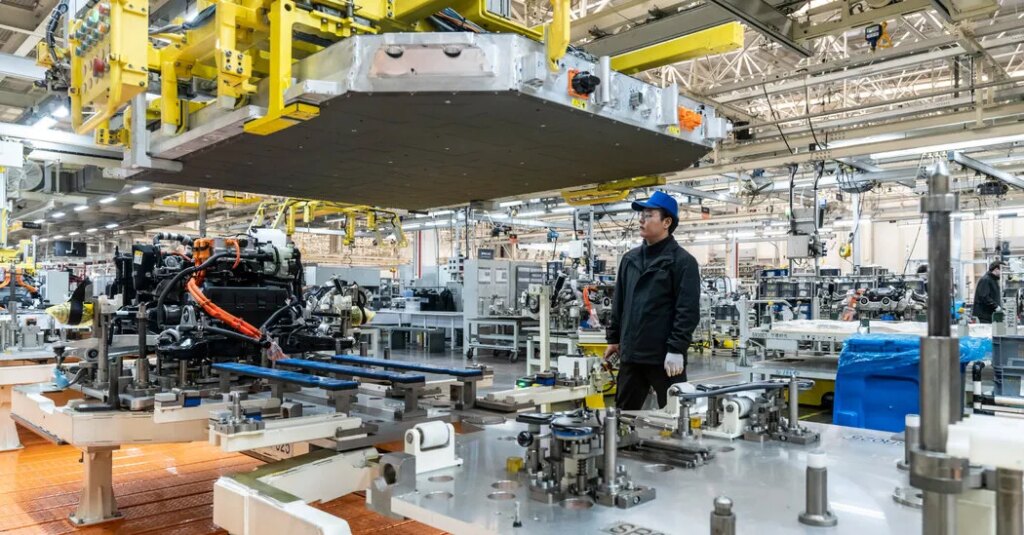
Two leading electric carmakers in China said on Monday they would combine their battery charging subsidiaries, in the latest sign of consolidation in a severely crowded Chinese car industry.
The deal will combine divisions of Nio and Zhejiang Geely Holding Group, with Nio also acquiring 10 percent of a separate Geely business. The transaction comes two weeks after another Chinese automaker, Guangzhou Automobile Group, announced plans for a complex tie-up with First Automotive Works, a large manufacturer.
Last year, two of the Chinese car industry’s giants, Dongfeng Motor and Changan Automobile, were in discussions to merge but did not reach a deal.
China’s car industry has immense overcapacity: enough car factories to build every car sold in China as well as all of the production in the United States and Europe. But its domestic car market has been shrinking since 2017, as Chinese consumer spending has been depressed by a plunge in housing prices.
“There are simply too many automakers in China — mergers, acquisitions and restructuring will be a trend going forward,” said David Zhang, a visiting professor at Huanghe University of Science and Technology in Zhengzhou, China.
Car sales in China shrank 20.8 percent in the first eight months of this year from the same period in 2025. Carmakers have tried to compensate by increasingly shipping their cars overseas. China’s vehicle exports are expected to reach at least 10 million this year, up from one million cars in 2020.
The European Union, concerned about the rapid decline of Europe’s auto sector, has been considering possible restrictions on further Chinese car exports. Volkswagen has struggled to compete with Chinese imports and recently announced plans to cut an additional 50,000 jobs. Senior European officials are scheduled to arrive in Beijing next week for trade talks.
Even with surging exports, the average car factory in China is still operating at slightly over half of capacity. In turn, automakers have cut prices below the cost of building cars, resulting in widespread losses for car manufacturers and delays in their payments to auto parts suppliers.
In Monday’s transaction, Geely agreed to merge its battery-swapping business into Nio’s larger battery-swapping business and pay $95 million in exchange for a 30 percent stake in the combined business, which plans to have 10,000 battery-swapping stations by 2030. Nio also will take a 10 percent stake in Geely’s extensive electric car charging station division, which is expected to have 22,000 charging stations by the end of next year.
In addition, the companies said they would coordinate the designs of their cars related to battery swapping and recharging.
Many Chinese automakers have been talking for more than a decade about coordinating designs for battery swapping, according to Stephen Dyer, head of the Asia automotive practice at Alix Partners, a global consulting firm.
The agreement between Geely and Nio, which together sold 1.3 million battery-electric or plug-in hybrid cars in the first half of this year, represents a step toward standardization in battery manufacturing.
“It’s just really invasive to design your vehicle around a battery-swapping standard,” Mr. Dyer said.
Battery swapping, in which drivers pull up to a roadside facility and an automated shed replaces a depleted battery with a fully charged one, takes three or four minutes. It takes twice as long for an 80 percent charge with even a very fast charger. But battery swapping remains far less popular than plug-in chargers in China and elsewhere, and many auto analysts have questioned whether battery swapping will ever catch up.
BYD, the industry leader in China, has suffered a 34 percent drop in domestic retail sales so far this year, while Geely’s sales have dropped half as much. As a result, Geely has nearly caught up this year to BYD in the Chinese market.
Guangzhou Auto disclosed in a stock market filing on Sept. 15 that it planned to issue shares to First Auto Works, which China’s national government owns directly. In exchange, Guangzhou Auto will gain part ownership of a longtime joint venture between First Auto Works and Toyota. The transaction will turn First Auto Works into the second-largest shareholder in Guangzhou Auto after the Guangzhou municipal government.
Guangzhou Auto has its own joint venture with Toyota that competes with the First Auto Works joint venture with the Japanese giant.
Since the 1980s, China has required foreign automakers to partner with Chinese companies to enter the Chinese market. Chinese automakers learned much from these partnerships.
As part of its response to the flood of Chinese exports, the European Union has been mulling whether to require joint ventures for Chinese electric car manufacturers. China’s Ministry of Commerce said in a statement in March that it strongly opposed any imposition by the E.U. of joint venture requirements, technology sharing mandates and similar rules, describing them as “serious investment barriers and institutional discrimination.”
Ruoxin Zhang contributed research.
The post China’s Crowded Car Industry Moves Toward Consolidation appeared first on New York Times.