Democrats’ nastiest, most expensive Senate primary will culminate on Tuesday in Michigan, a pivotal midterm battleground where an insurgent progressive is looking to defeat an establishment-backed moderate in a contest serving as a referendum on the party’s future.
The race between Representative Haley Stevens and Dr. Abdul El-Sayed, a former public health official, is charged by tensions over Israel, how to fight President Trump and the G.O.P., and what makes a candidate electable. The result will factor into the fight for Senate control in November, and may have ramifications that extend to the next presidential contest.
While polls conducted the last month have shown uncertainty in the competition, several recent public surveys showed Dr. El-Sayed leading, and he is increasingly seen by Democrats as the favorite as voters prepare to make their picks. In the final stretch, the candidates are speaking about each other in sharply critical terms. Their supporters can be even more severe.
“It’s the threats. It’s the ugliness,” said Representative Debbie Dingell of Michigan, a Democrat who is neutral in the Senate primary. “You have to worry about security. You don’t know who could try to disrupt. Events are very scary right now.”
In a recent interview with Amani Al-Khatahtbeh, founder of MuslimGirl.com, Dr. El-Sayed called Ms. Stevens “the least capable candidate in America.” Ms. Stevens responded on social media in part by saying, “Everyone in America understands you want to blame all of your problems on Jewish Americans.”
The race has divided prominent Democrats and drawn a flood of outside money, nearly all of it to help Ms. Stevens, including more than $60 million in pro-Stevens super PAC ads.
For the Democratic Party’s left, the race is a chance to notch its most significant victory yet in a primary season when progressive, anti-establishment candidates have made inroads . For centrists, the race is an opportunity to steer the party toward what it sees as a stronger blueprint for November.
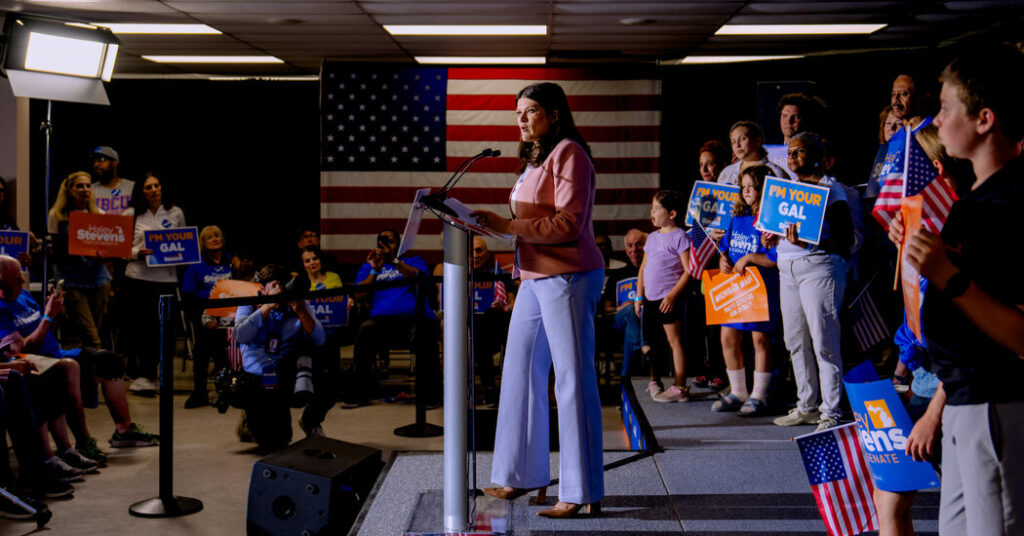
Ms. Stevens, a moderate from the Detroit suburbs who was first elected in the 2018 Democratic wave, says she is best equipped to prevail in November against former Representative Mike Rogers, the Republican candidate who does not face primary opposition. She and her allies are emphasizing her focus on Michigan and casting Dr. El-Sayed as someone more interested in his national image, with views that could alienate swing voters.
Dr. El-Sayed, who would be the first Muslim senator if elected this fall, is a progressive who lost the 2018 primary for governor and in the years since has written a book and hosted a podcast. He is positioning himself as a champion for the working class and as a fighter against corporate interests. He wants to abolish ICE and is sharply critical of the American Israel Public Affairs Committee, which through its main super PAC has spent more than $30 million on ads backing Ms. Stevens.
In the final weekend of campaigning, the candidates traded more blows, with Dr. El-Sayed accusing Ms. Stevens of running a “flailing” campaign and Ms. Stevens arguing that she was the “only candidate who can keep Michigan blue.”
The harsh tenor of the race has the party on edge on the eve of the primary.
“It just strikes me that he’s maybe in a dark spot and throwing shots,” Ms. Stevens said of her rival during a recent interview at a campaign stop in Muskegon.
Stark divisions over Israel
At a moment when Democrats across the country are in a fierce debate over Middle East policy, the two candidates could not be farther apart on what the U.S. relationship with Israel should look like.
Ms. Stevens says she does not believe that Israel and its prime minister, Benjamin Netanyahu, have committed genocide in Gaza. She voted to continue funding Israel’s military without conditions and makes no apology for the millions AIPAC has spent on her behalf.
“If she was running against Benjamin Netanyahu, I wouldn’t even consider her,” said Osama A. Siblani, the publisher of The Arab American News in Dearborn. “Haley Stevens is a miserable person. She is a loser. She should not be in the Senate.”
Dr. El-Sayed said in an interview last month that he did not believe that Israel should exist as a Jewish state. When a suburban Detroit synagogue was attacked in March, he released a video condemning the violence with a caveat noting it was inspired by Israel’s actions in the Middle East, which infuriated some local Jewish officials.
“We can and must condemn the attack on Temple Israel and we can and must condemn the violence 6,000 miles away,” Dr. El-Sayed said then. “And we can and must condemn the broken politics that allows leaders to make war that they pretend has no consequences.”
Jordan Acker, an elected University of Michigan regent who backs Ms. Stevens, said that if Dr. El-Sayed is elected to the Senate, Michigan’s Jewish community will be at risk.
“His language has allowed license for people to act against the Jewish community in this state,” Mr. Acker said. “Abdul has more work to do with reassuring the Jewish community in Michigan that they will be physically safe if Abdul is in government.”
Democrats have become increasingly critical of Israel in recent years, and Michigan’s primary will provide a fresh measure of views in the party.
AIPAC and its allies have flooded the airwaves with ads boasting of Ms. Stevens’s ties to former President Barack Obama (she worked on his rescue of the Detroit automobile industry) and bashing Dr. El-Sayed for once writing a skeptical opinion essay about Michelle Obama.
“The role of AIPAC spending in this race is a symbol of the broader problem,” said Jeremy Ben-Ami, the president of J Street, the center-left Jewish lobby that endorsed a third candidate in the race, Mallory McMorrow, who dropped out in early July. “It’s been really destructive. We think this level of engagement is not in any way good for Israel.”
A bitter contest and divergent strategies
Both sides agree on one thing: Holding the Michigan seat being vacated by Senator Gary Peters, a Democrat who is retiring after two terms, is essential for any hopes of winning a Senate majority in November. Democrats must retain their seats and flip at least four Republican-held ones to take control of the chamber.
The state has swung back and forth in the last three presidential elections. The outcome of the Senate race could begin reverberating in the Democratic nominating contest, with Michigan expected to be one of the first states to vote for a presidential candidate.
Dr. El-Sayed’s campaign is better funded than Ms. Stevens’s, but for weeks he has been swamped by the volume of pro-Stevens advertising. He has hosted campaign rallies with progressive luminaries, including Senator Bernie Sanders, independent of Vermont, and Representative Alexandria Ocasio-Cortez, Democrat of New York.
Dr. El-Sayed is just one of a handful of left-wing candidates challenging establishment Democratic candidates on Tuesday. Democratic socialists are waging competitive campaigns in two House races, and a third is seeking to oust the mayor of Ann Arbor.
To many, the Senate race has felt deeply personal. Ms. Stevens’s Michigan accent has even become a point of dispute, with detractors mocking her or questioning the accent while supporters have used it as a rallying cry. Dr. El-Sayed has urged his backers not to attack her personally.
For Ms. Stevens to defy recent surveys and win, she needs a large turnout from Black voters, with whom polls show she has a clear advantage thanks in part to AIPAC’s ads featuring praise for her from Mr. Obama.
The clip, from a 2018 rally when Ms. Stevens was first running for the House, has featured prominently with Black audiences in Michigan. Branden Snyder, the Michigan state director for the Working Families Party, which has endorsed Dr. El-Sayed, said that his own cousin believed Mr. Obama has endorsed Ms. Stevens. (He has not.)
Dr. El-Sayed, Mr. Snyder said, is the clear favorite with younger white voters and college-educated progressives.
“For the non-college educated and Black voters, he’s got a lot of work to do to make up ground,” Mr. Snyder said.
At a recent campaign rally in Canton Township, a diverse Detroit suburb, Dr. El-Sayed predicted that the super PAC money being spent against him would be for naught.
“You can’t buy enthusiasm,” he said.
Ms. Stevens, for her part, dismissed the notion that the Senate primary is a gauge for the Democratic Party’s direction.
“All of them say, ‘Oh my gosh, it’s the future of the party,’” she told supporters in Muskegon. “I’m like, Well, that’s really nice, but how about the future of my state and my people?”
The post Michigan’s Tense Democratic Senate Race Poses a Big Test for a Divided Party appeared first on New York Times.