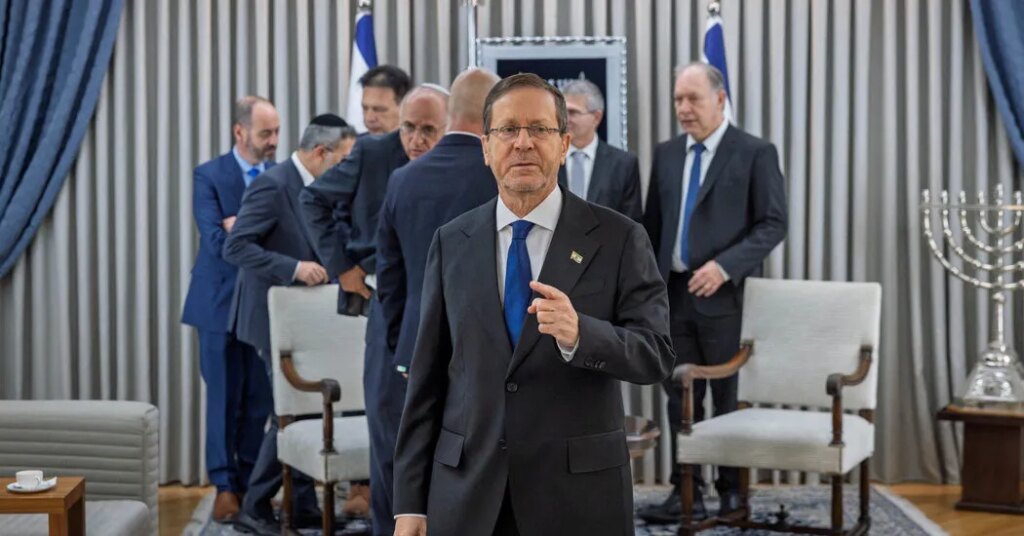
The president of Israel is to meet on Thursday with leaders from larger parties that won parliamentary seats in last week’s election to discuss whom they support for prime minister and determine who has the greatest chance of forming a governing coalition.
Israelis turned out to vote in droves, but no single party or coalition was a clear winner. Likud, the party of the now-caretaker Prime Minister Benjamin Netanyahu, secured more seats than any other. But parties that oppose Mr. Netanyahu won more seats overall than did his far-right alliance of Likud and other factions.
The president, Isaac Herzog, has a mostly symbolic role in Israel, except after elections, when he must select a potential prime minister to try to form a government. The consultations on Thursday continue discussions Mr. Herzog began on Wednesday.
Mr. Netanyahu’s bloc secured 53 seats while the Jewish opposition bloc, led by Gadi Eisenkot of the center-right Yashar party, picked up 48 seats and Arab-led parties secured 19 seats. Mr. Eisenkot is expected to gain the most support, with at least one of the Arab-led parties backing him, but he will have to unify the opposition and overcome resistance among members in the bloc to forming a government with the backing of Arab lawmakers.
The president has until Nov. 11 to make his decision, but may well act sooner.
Here are the parties whose representative Mr. Herzog has met so far, how many seats they won in the Parliament, or Knesset, and where they stand ideologically.
Otzma Yehudit
7 seats
Otzma Yehudit, meaning Jewish Power, is a far-right party led by Itamar Ben-Gvir, an anti-Arab ultranationalist who staunchly opposes a Palestinian state and supports expanding Jewish settlements in the West Bank and Gaza. Mr. Ben-Gvir was viewed as too extreme to serve in the Israeli military and his positions were once considered fringe even among right-wing politicians. Otzma Yehudit, which is part of Mr. Netanyahu’s current coalition, recommended him to lead a new government.
United Torah Judaism
7 seats
U.T.J.’s politics center on protecting the strictly religious way of life of ultra-Orthodox Jews, or haredi. The party has long been allied with Mr. Netanyahu, whose governments have supported U.T.J.’s voters with subsidies. But the party declined to nominate anyone, including Mr. Netanyahu, to form a government this time around. Haredi leaders want to protect a longstanding exemption for ultra-Orthodox religious students from Israeli military service, after Israel’s Supreme Court ordered them to be conscripted. In their view, Mr. Netanyahu has failed to deliver.
OTHER parties
The Israeli president met on Wednesday with representatives from several smaller parties. These included the far-right Religious Zionism alliance, which secured six seats and is part of Mr. Netanyahu’s bloc; the right-wing secular Yisrael Beiteinu party, which picked up seven seats and is part of the opposition bloc; and the ultra-Orthodox Shas party, which won six seats and is part of Mr. Netanyahu’s bloc.
On Wednesday, Mr. Netanyahu secured 12 recommendations and Mr. Eisenkot got seven — but the balance was expected to shift after Thursday’s meetings.
Johnatan Reiss contributed reporting.
The post Here’s Who Is Meeting Israel’s President to Recommend a Prime Minister appeared first on New York Times.