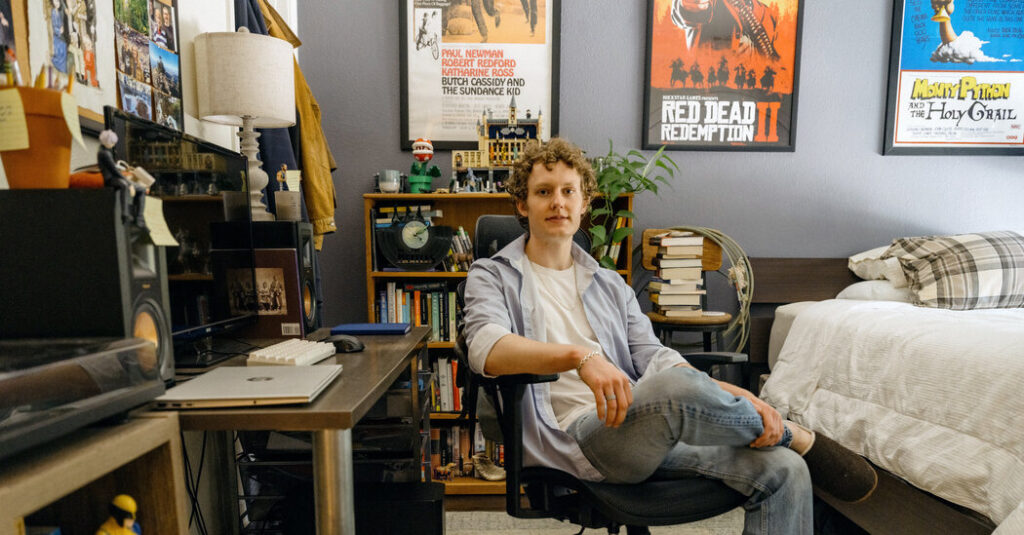
When he hadn’t landed a job a few months after graduating from the University of California, Santa Cruz, two years ago, Tommy Balmat moved back to his childhood home in the San Francisco Bay Area. He figured looking for a job would be easier with fewer expenses to shoulder. And, perhaps no less important, he was still close with his parents, who were keen to have him back.
“I communicate with my parents about every thought that goes through my head,” said Mr. Balmat, who majored in literature and anthropology and had hoped for a job in book publishing. “They honestly really encouraged me to come back home if that’s what I wanted.”
Mr. Balmat is hardly the only recent graduate to have accepted such an invitation lately. Data from the economists Stefania Albanesi, Rania Gihleb and Ning Zhang show that the portion of college graduates ages 23 to 27 living with their parents has returned to the high it reached during the Covid-19 pandemic. More than one-quarter did so as of last year, from a low of about 18 percent in 2001, according to updates to the paper that are not yet online.
The fact that so many young adults are living at home reflects persistent weakness in the job market for recent graduates even as the overall economy remains fairly strong. The weakness may be growing as artificial intelligence affects white-collar jobs.
Still, some experts wonder if it is all bad news. College graduates may be moving home because they recognize the benefits of conducting a job search from the relative comfort of their childhood bedroom and, as in Mr. Balmat’s case, they’re no longer discouraged by social norms from taking advantage of that arrangement.
Smartphones and video calls have meant that going off to college no longer requires cutting the cord with one’s mother or father, making re-entry less jarring to both parent and child. And huge social disruptions like the Great Recession and the pandemic left many young adults with no alternatives, lessening the stigma.
“This recognition of broader influences doesn’t eliminate frustration with one’s current lot,” said Daniel Holland, a therapist in Bloomington, Minn., who works with many recent college graduates living with their parents. “But it has resulted in what I see as less shame and guilt regarding moving back home.”
It’s hard to deny that a shortage of good jobs has helped drive the great graduate homecoming even as other economic forces, like the high cost of housing, have also weighed on those just starting out.
Over the past decade, young adults with bachelor’s degrees have become more likely to live at home while those with only a high school diploma became slightly less likely to do so, Dr. Albanesi has found. Both groups face rising housing costs, but their economic trajectories have diverged. People with less education appear to have made strong gains since the pandemic, while the college-educated have stalled out.
The unemployment rate for recent college graduates has increased much more rapidly than the country’s overall unemployment rate over the past four years, to 5.6 percent in the first quarter of this year, according to the Federal Reserve Bank of New York.
Even graduates in some traditionally lucrative fields have felt the effects. A chemical engineer who had graduated from McGill University in Montreal moved in with her parents in April and said she and many of her classmates had not found jobs in the field. The unemployment rate for chemical engineers who recently graduated more than doubled between 2022 and 2024, to 4.7 percent, while the rate for computer engineers more than tripled, to 7.8 percent, according to data from the bank.
Such challenges may be altering the profile of those who live at home after graduation — from the rudderless to the driven-but-thwarted.
Alison Yoho assumed that an economics degree from the University of Minnesota, along with solid internship experience, would put her in a strong position to line up a job right out of school. And she moved quickly to capitalize on these advantages. During the fall of her senior year, she prepared to apply for an early career program at a clean energy firm where she had worked the previous summer.
But, in a change from past years, the firm did not appear to solicit applications for the program. A few months before graduation in 2025, while having coffee with a former supervisor, she learned that the company had recently gone through layoffs. “That should have been the first clue it would be an uphill battle,” Ms. Yoho recalled.
She moved home to a suburb in the Twin Cities last August and got her first offer in October. She wasn’t thrilled about the job and felt confident enough to keep searching for a better fit, which materialized two months later.
The findings of Dr. Albanesi and her co-authors suggest that Ms. Yoho will be less likely to take an earnings hit by age 27 than others who struggle to find a job out of school because she could afford to be choosier during her search.
Other data suggest that recent graduates are opting to live at home while searching for a job even if they might be able to land a worse job sooner, perhaps because they feel more comfortable doing so. According to the New York Fed, the underemployment rate — the portion of college graduates taking jobs that don’t require a degree — has been relatively low in recent years.
Lawrence Katz, a labor economist at Harvard, cautioned that such data is inexact and difficult to interpret. But Dr. Katz acknowledged that shifting norms might help explain why more young people were living at home.
“Is there some cultural change in the way people are parenting?” he said. “You see kids today and the degree to which they’re interacting with parents, that’s completely different than the world of 50 years ago, 25 years ago.”
The sheer number of people moving home after graduation, and the sense that they are up against economic forces beyond their control, also appears to be normalizing the choice and weakening whatever taboo might have once existed.
Betsy Balmat, Tommy’s mother, said she had observed fewer and fewer recent college graduates living on their own, at least in the Bay Area, where rent is especially high. “I can say from my own social circle of people I work with and know that it is more common than not to have kids moving home,” said Ms. Balmat, an assistant school superintendent.
When Lily Dall’Era moved home to Sacramento last year after graduating from the University of Washington, she found it comforting that many high school friends were in a similar position. They even began meeting on weekends for group activities, like going on a run or to the farmers’ market.
“I don’t feel bad about moving home,” said Ms. Dall’Era, who majored in oceanography and is hoping to become a veterinarian. “All my other friends are doing it.”
The transition is rarely frictionless, of course. A recent graduate of Syracuse University said she was sharing a bunk bed with her younger sister and complained that her mother insisted on tracking her location on her phone, which made her feel like a teenager again.
Mr. Balmat said he felt a little pressure from his parents to get a lot of applications out the door, sometimes to the detriment of their quality. He was applying to jobs “just to say I had done it,” he recalled.
But, overall, the experience has been a positive one, he said, allowing him to save enough money to move in with a college friend in August. He does not appear to have suffered much stigma from living at home, and for several months even dated a woman he had met at a cafe where he worked part time to burn off anxious energy.
“We ended up bonding really hard — we’re both writers,” said Mr. Balmat, who hopes to publish a novel someday. “We were both really passionate about what we were doing, struggling to figure out how to turn it into money.”
When he invited his girlfriend over to hang out, the attention from his parents was sometimes embarrassing. “They would both drop in on us if we’re watching a movie on the couch, to be like, ‘Can I get anybody any snacks?’” But his girlfriend took it in stride. It turned out she had moved back home, too.
The post Moving Back Home After College? All Your Friends Are Doing It. appeared first on New York Times.