A few hours after Levi Fishback died last month, at a nursing home in Kentucky, the funeral director called me. She needed to know whether the family wanted an open casket. What songs would Levi have wanted? What color flowers? Who should give the eulogies?
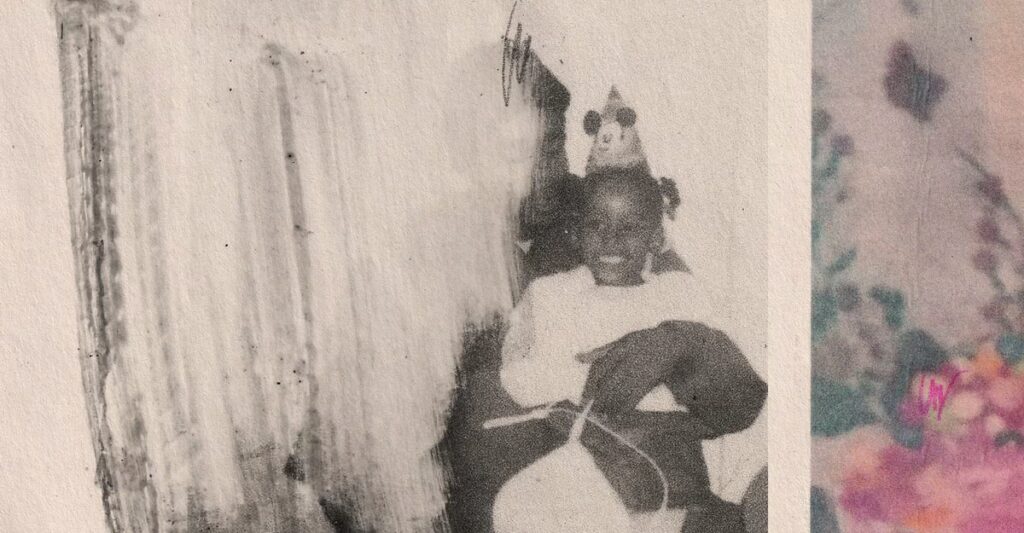
By now I should be used to being asked questions about my father that I don’t know the answers to. I spent the past four years as his medical proxy, the only family member responsible for handling the bills from the nursing home and overseeing his care. But I barely knew the man. I felt uncomfortable deciding whether the nurses should give him a flu shot every fall, let alone choosing what to put in his obituary. I needed to include photos, but I had only one: from my fourth or fifth birthday. I messaged his ex-wife and the stepdaughter he’d raised, along with my half brother’s two children, for more, and they delivered, sending photos of my dad—smiling widely in a suit and tie—alongside them at graduations and family parties. I didn’t know that he’d had that much joy inside of him.
My memories of my dad are like a few scatterplots on the graph of my life. He had lived right across town from me in Lexington, Kentucky, but he would go months without visiting me. From the ages of 10 to 14, I don’t think I saw him a single time. He had his own family—his wife, his stepdaughter, and his son from a previous relationship. When he and his wife got married, his son was the ring bearer and her daughter was the flower girl. I wasn’t a flower girl at the wedding. I didn’t go to the wedding. I didn’t even know about the wedding. They had a piano in their living room that his stepdaughter played. She is a year older than me and went to a rival high school. I would see her sometimes—she was a cheerleader, and she had all the name-brand clothes that the pretty, popular girls wore.
My mom, Trina, was addicted to crack for years and had struggled to take care of me and her four younger kids. Levi must have known it. Once, when I was about 7 or 8, he came to my mom’s door. It had been a bad week, or a bad few weeks. My mom had gone out—I’m not sure when or where—and I was alone with my four little brothers and sisters. Our refrigerator was empty. Dirty plates and clothes lay around, broken toys all over the place. We were untamed children who did what we wanted—my brother Colby was always trying to do backflips off the arm of the couch.
Maybe my dad had heard on the streets that Trina’s kids needed help. Or maybe it was a random visit. I was jittery when we opened the door to him. He was a short man with thick eyebrows that dominated his face, but in our eyes, he was a hero. We knew he would help us, because drugs didn’t control his life; he wasn’t damaged like Trina; he was a man who took care of a wife and children. He would recognize our fear and desperation. He stepped inside but stayed close to the door. He looked around like one of the social workers the government sometimes sent, and we huddled around him, watching him judge the mess with his eyes. And then he left. He said he’d come back for me, but he didn’t.
Plenty of people my age are beginning to take care of sick or aging parents. It’s the natural way; you take care of the people who once took care of you. You don’t resent it, because now you’re the strong one, and they’re the vulnerable one, and you owe them everything. But for me, it wasn’t like that.
When I was 9, I was sent to stay with my aunts. While I was gone, the state took my siblings away from Trina; my sister went to an aunt and my brothers were put in foster care. I moved back to Lexington for the fifth grade, and my grandmother took me in—I don’t remember anyone ever suggesting that I could stay with my father. I have one memory of him from that year I came back: For some reason, he showed up at my school and found me in the lunch line. He handed me some money and then pulled me toward him for a hug. I was embarrassed by his affection and don’t think I embraced him back.
I lived with my grandmother until I graduated from high school. Levi would call sometimes. “Jenisha, get the phone. It’s yo daddy,” she’d shout. I’d rush to the phone—toddler-excited to hear from him. A call from my father was like Christmas. Sometimes he’d ask if I wanted him to pick me up the next day, and so I’d spend hours waiting for him to drive up the driveway. Occasionally he would actually show, but usually he wouldn’t.
Once, in middle school, I spent a weekend with him and his wife. I made up a lie: I told his wife that I’d skipped a grade in elementary school. I wanted her to like me and think I was smart; I didn’t think it was a big deal. But a few hours after he’d dropped me back off at my grandmother’s, he called me. He’d found out about the lie and gave me a long lecture, and then a punishment: “You can’t come over here no more,” he told me. I was surprised he was angry. After all, he lied to me all the time—about being on his way to pick me up, about how he would drop off spending money for my field trip or take me back-to-school shopping. But this time he stuck to his word: I didn’t hear from him for a few years after that.
A month before I graduated from college, in 2008, I was in an evening class when he called my cellphone. He and his wife had gotten divorced by then. I stepped out to the hallway to answer. He was calling to tell me that he had a condition, and his doctor said there was a test I could take to see whether I had the “same gene.” He didn’t say what it was, and I didn’t ask any follow-up questions, because he swiftly changed the subject. “You graduating?” he asked, although he knew the answer. I wasn’t surprised when he didn’t ask about the details of the ceremony. He just spouted some compliments: “Man, you graduating. You good with that English. You gotta be real smart to do English in school.” He hadn’t come to my high-school graduation, and he didn’t come to this one, either.
I graduated, packed my bags, and left Kentucky to move to New York City. I was building a new life, and I thought about him only when a guy dumped me. If my own father thought I was worthless and didn’t want to stay in my life, how could I expect a romantic partner to want me? I measured my value by his absence.
Sometimes he’d send me a corny text, something that I couldn’t imagine him ever actually saying: “I love you like a fat kid loves cake,” he wrote once. I treated it like spam. I didn’t see him again until 2015.
By then he had moved to an assisted-living place and was using a walker to get around. His speech was slurred, and his hands shook. I took him out to the all-you-can-eat buffet at Golden Corral. Most of the time, he just smiled, showing his chipped and missing teeth. Later, I heard that his illness was getting worse and that my half brother was taking care of him.
I never quite knew why my brother had lived with our dad and I hadn’t. Maybe Levi was just proud to have a son, and what he felt about me was shame—shame that he was connected to a woman like my mom, a crack addict. Lexington is a small town, and Levi never smoked or used drugs. He’d always claimed that my mom was a one-night stand.
But my brother had his own problems. He was involved in selling drugs, and then in 2022, he disappeared. He told me one thing before he left: “Now it’s your turn.”
I had questions about Levi’s bills and care, but no one could reach my brother. I understood why last year, when he was apprehended and sent to Blackburn Correctional Complex. He’d been on the run from the Lexington police—wanted for trafficking cocaine, fleeing or evading police, and possessing a firearm.
As far as I know he was in touch with Levi only once in those years, when he texted my dad’s ex-wife a message for our dad, and she shared the message with me: “Tell him I said I love him and miss him.” I read that message over and over again, wondering what it would be like to love our dad and miss him. Obviously, my brother knew a different side of Levi. I wanted to love him, too, but it was like trying to touch the air. Yet if I didn’t take care of him, who would?
[Read: Dear Therapist: I don’t want to take care of my aging, homophobic parents]
At times, I resented my brother for what he’d had in the past, and for not being around now. Like when the nursing home called to say there had been “a little smoke incident with one of our dryers and the fire department came here to evacuate.” Or when a nurse left me a voicemail: “Just checking in for the care-plan meeting.” I resented him, and I resented Levi. But I called the nurse back. I went to the meetings. Whenever I went back to Kentucky, I made a point to visit my father. But I didn’t do any more than I felt I had to.
I thought of Levi sometimes as a stranger sleeping at a bus stop. The idea of walking away from him felt cruel—but also liberating. I once wasn’t able to care for myself, and walked away from me too.
Levi was a professional gambler who shot dice and bet on horses. He spent most of his time at the Red Mile Racetrack wagering on standardbreds galloping around the track, or on the simulcast of races around the country that played inside. He took me a few times when I was little, and I remember him staring at the screen, like an airline traveler scanning for their final destination.
But most of what I know about Levi I know from other people. When people learned that he was my father, they always had a story to tell. His nickname was Sonny, and he earned real money at the track, sometimes leaving with bundles of cash. I’ve heard stories of him handing out crisp $100 bills like Monopoly money, or treating a group to breakfast after winning. He was also known to cheat at dice sometimes, by playing with altered dice.
He was estranged from his brother and sister. Their youngest brother had killed himself when he was 18. He’d used Levi’s pistol to do it, and my surviving uncle, Kenny, never forgave him for it. Kenny has told me a little more over the years. Levi ran track even though he was “a short motherfucker,” he told me—which interested me, because I was a runner too, and I was fast. I always wondered where I’d got it from. The truth is Kenny couldn’t stand him. “Your daddy ain’t shit,” he’d say. “It seems like a man would look out for his daughter.”
More recently, I learned about Levi from his nurses. His favorite soda was Pepsi. He loved soft sweets, such as an oatmeal pie. And last year, during a meeting with his care team, I finally learned what his diagnosis was: a form of cerebellar ataxia, a degenerative neurological condition that can be inherited. I thought back to that call from so many years ago, when he had told me I could take a genetic test to find out whether I was at risk. But I didn’t take the test. I still haven’t. I’m afraid. And the last thing I want to think about is whether we share the same gene.
I saw him in April, when I had to fly back to Kentucky for the funeral of another family member. The drive to the nursing home was long, and I was glad—it gave me time to prepare to see this man who was almost a stranger to me. I passed old gas stations, homes with acres of grass, a fresh eggs for sale sign hanging on a residential mailbox. I thought about how I didn’t know the sound of his laugh, how I wouldn’t have been able to describe his voice.
The woman at the front desk greeted me: “Hi, Jenisha.” The other nurses just called me “Levi’s daughter.” They probably assumed we had a normal relationship, that he was a normal parent, and here I was, their patient’s “loved one,” doing my normal duty.
“You’re the only person who comes to see him,” a nurse told me. Maybe she was trying to make me feel proud. But I just felt sad. His ex-wife and stepdaughter visited now and then, but not regularly. Where were all of the people he’d been close with in Kentucky? How was I the only one there, when he was notorious for breaking my heart?
I walked to his room, which he shared with another man, a curtain dividing the space. The television was on—an old black-and-white cowboy movie—but there was no sound. The person in the bed was nothing like the Levi from my childhood, slick-talking and arrogant. He was fragile and could barely lift his head up. He struggled to drink from a straw, and I watched as his mouth kept missing the hole.
Sitting beside him, I dug for emotion, wanting to feel what another kind of daughter would feel. I felt like I was in a movie myself, an actress in a father-daughter scene. Kisses on my forehead. Talks about my first boyfriend. My daddy—who saw me as the most beautiful girl in the world—always wanted his darling daughter close to him. “Don’t leave,” he’d say. “Stay as long as you want.”
But all I really felt was nervous. Even though my father couldn’t speak or stand, even though he had shrunk to 77 pounds and was smaller than I was, being near him still turned me back into that scared little girl hoping for scraps. At one point I asked: “Do you love me? Nod your head if you do.” He responded by moving his head up and down. Watching him use up all of his strength to answer me filled me with a childlike high. At last, he wasn’t going to reject me anymore.
But only a few minutes later, he lifted his hand and flapped it at me. He made the gesture again. I realized he was shooing me away. I couldn’t believe it. “Are you ready for me to leave?” I asked. He nodded yes.
Even at his most vulnerable, even when he was utterly alone in the world, he was still turning me away.
Last month, the nursing home called at 4:39 a.m. “He died peacefully,” the nurse told me.
The day before, I’d talked to Levi on FaceTime and I saw how sunken he looked. Even as he was transitioning, I had little to say to him. “I love you. Are you ready to see your mom?” He nodded.
[Read: Americans are in denial about elder care]
I arranged for other family members to FaceTime, too, and the prison helped set up a call for my brother. The nurse told me that they both were crying. I kept asking her: “Did you tell him that I made it happen? What did my brother say?” My ego wanted them to know that I had made the call possible. I pictured both of them crying. All I could think was: Damn, I wish I could feel what my brother was feeling.
We scheduled the funeral for July 3, two days after my brother would be released from prison. I decided against the open casket. Levi’s body was twisted into the fetal position. To get him into an open casket, the funeral director told me, she’d have to break his legs, arms, and fingers. “I don’t want to do that to Levi,” she said. For weeks, I couldn’t decide whether or not to go to the funeral. My mom said I shouldn’t feel like I had to: “Levi didn’t show up for a lot of things for you,” she reminded me. Paying my respects seemed like the right thing to do. But more than that, a part of me wanted to prove that I was the bigger person. I wanted others—his family, his stepdaughter—to lay eyes on me, and to see that I’d made something of myself in spite of his absence. I wanted them to know that I’d been his emergency contact, the one who took care of him in the end. But the day before, I stayed home. I decided that I would watch it on Facebook Live.
The truth is that I wasn’t mourning my father; I was grieving the loss of what I’d never had. I didn’t cry when he died. But when I heard the speech that his stepdaughter gave at the funeral, the feelings hit me. Like me, she was a runner, and they used to go on jogs together. Someday, she said, she believed she would see Levi in heaven. “Come on,” he’d tell her, “let’s race,” and off they would go again. She said that Levi left her with many happy moments. And that’s when I cried.
I’ll never understand why he didn’t show up in my life, but I have to stop asking. There was a brief chapter of his life when he needed me, a period when he might have recognized me as someone who was important to him. I still wanted to please him, wanted him to see for himself that he’d made a terrible mistake by not being my father. And now that chapter is over.
The post Taking Care of the Father Who Broke My Heart appeared first on The Atlantic.