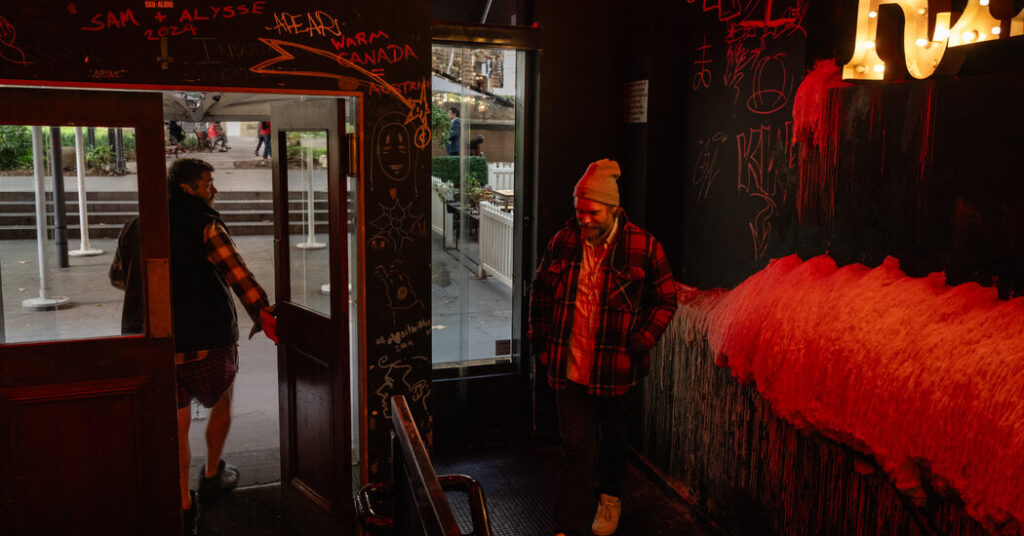
Jake Smyth and Kenny Graham stood in the green room of Mary’s Underground, a live music venue in Sydney, for the final time. The walls were covered in the names of artists who have performed at the venue over the past seven years.
“They want to leave their mark somewhere that they’ve played,” Mr. Smyth said of the 3,000 musicians who have passed through. The venue has hosted more than 1,000 shows since it opened in 2019, including the New Zealand-born pop star Lorde and the Australian punk rock band The Living End.
But faced with declining bar sales and increasing costs, the friends, who own other venues, closed Mary’s Underground on June 30.
“It’s definitely going to leave a hole in Sydney,” Mr. Smyth said, adding, “This is a tough day.”
It is a familiar story across the country, which was once known for producing generations of rock ’n’ roll royalty, from Midnight Oil to INXS. But with the steady closure of pubs, bars and small venues, the future of Australia’s once-mighty live music industry is now on shaky ground.
MoshPit Bar, a rock ’n’ roll dive bar in Sydney, announced this past week that it would also close, saying that “ever-increasing operating costs, combined with declining revenues, have made it financially impossible for us to continue.”
After the coronavirus pandemic, more than 1,300 live music venues closed across Australia, according to a 2024 report from the music rights body, APRA AMCOS. While more recent figures show the number of live music venues nearing prepandemic levels, it represents six years of stalled growth for the sector, said Nicholas Pickard, executive director of public affairs for the group.
He added that the figures did not represent the number of gigs occurring or people attending, both of which are declining. While 28 percent of Australians listened to live music at a pub or club in 2019, that number dropped to 25 percent in 2024, government data shows.
Part of that is because of a change in consumers’ spending habits — patrons are drinking less, splurging on concerts by big-name stars (like Taylor Swift or Oasis) instead, or buying tickets at the last minute, which creates uncertainty for venues. And everything has become more expensive, from rent and insurance to bands’ touring costs.
“That’s really the big question for the nation: How important is it to hear and see our own music?” Mr. Pickard said.
Australia’s once-thriving music festival scene has also suffered from rising costs and unpredictable weather, leading to the cancellation of events like Bluesfest and Splendour in the Grass, both of which were considered a rite of passage for many Australian teenagers.
The pressures have left music venue owners grappling with how to stay open. Some are relying on government grants, but fear this model is not sustainable.
Tam Boakes, the owner and operator of Jive, an alternative venue in Adelaide, said her business would not survive without support.
“I never applied for a grant in my life, pre-Covid,” she said. “Now, I can’t survive without them,.”
Ms. Boakes said she was working more than 70 hours a week: booking bands, promoting them, helping clean the venue, and managing the bar and staff, but the future was precarious.
“We’ve put so much in,” she said. “I don’t want to see this place go.”
The decline of these venues has consequences for Australia’s broader music industry, experts said.
Lachlan Goold, a music producer and senior lecturer in contemporary music at the University of the Sunshine Coast in Queensland, warned that without small and independent venues giving emerging talent a space to be heard, “I just don’t know where the new music will come from.”
Playing a New Way
The federal and local governments have provided millions in funding to keep the music industry going. While many in the industry are thankful, they are calling for tax breaks for people running venues and ticket levies with proceeds going toward supporting local artists — a similar program runs in Britain. (Olivia Dean, a chart-topping British performer, will donate 1.10 Australian dollars, or 76 U.S. cents, of every ticket sale to support local venues during her tour of Australia this year.)
Some venues have taken matters into their own hands. In Sydney, Live Music Venues Alliance, the main body for independent music venues in the state of New South Wales, partnered with 25 venues to create MyGigPass. The scheme, which receives funding from the local government, offers weekly deals, such as free entry or discounted tickets, to people 18 to 25.
In the first five months, 2,100 people signed up and more than 1,750 tickets were made available. Beau Neilson, who helped create the program and runs the music venue the Vanguard, said the scheme gave young people a “gateway into live music” and could ensure the future of the industry.
“People don’t just wake up after having no exposure, or no music and arts education, and suddenly realize that they love it,” she said.
Brian Ritchie, the bassist for the American alternative rock band Violent Femmes, said the decline of live music venues, the rise of streaming and increased costs made it difficult for emerging artists.
He pointed to his first tour of Australia in 1984, which the band did “on the smell of a greasy rag.”
“That’s not possible anymore,” said Mr. Ritchie, who was also the artistic director of Mona Foma, a Tasmanian art and music festival that ended in 2024 because of low attendance.
“Musicians need gigs, and they need to be repetitive,” he said. “Just imagine if you were a football player and you only played a match once every six months; you wouldn’t be skilled. And it’s the same thing for live music.”
Back at Mary’s Underground, Mr. Smyth and Mr. Graham reflected on the years and community they had built —the venue had hosted weddings and a wake, and one former chef even named his daughter “Mary.” Before the duo took over, it was The Basement, one of the country’s first jazz and blues clubs, with legends like Prince and Herbie Hancock performing. The friends hope the venue will find new owners who can honor its heritage.
And they remain determined to give musicians a stage, including at Liberty Hall, another music venue, which is doing well.
“It’s hard to play soothsayer on the future,” Mr. Smyth said. “We will just keep turning up every day and trying to do our best.”
The post Another Australian Music Venue Had Its Last Curtain Call appeared first on New York Times.