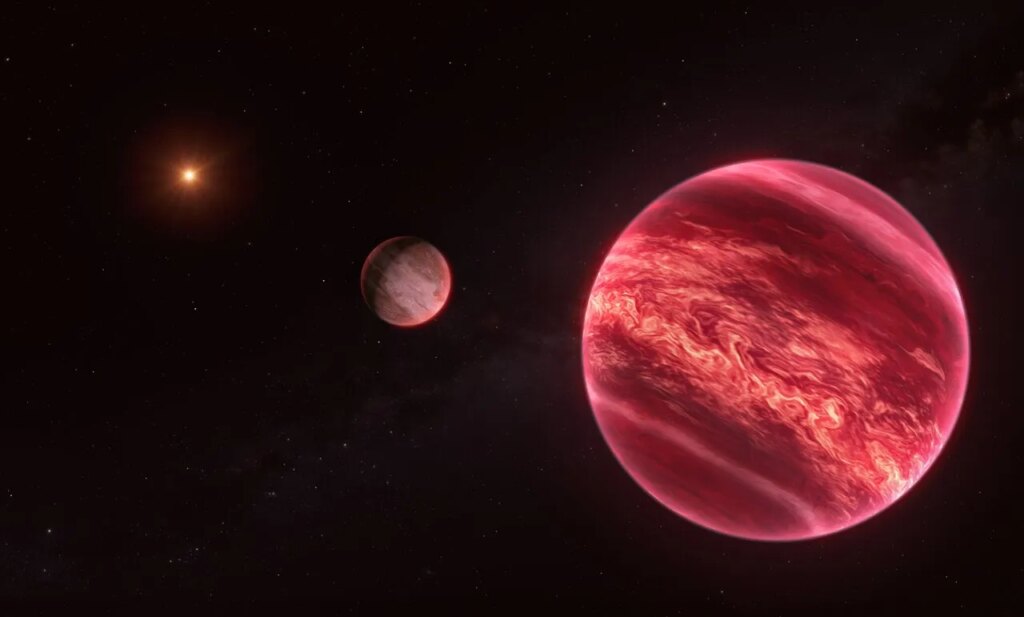
An international research team has discovered evidence of a moonlike body. It marks the first time such an object has been detected outside our solar system—though just how close it comes to being a moon is a question researchers are still grappling with.
Although more than 6,000 exoplanets have been discovered to date, there’s been a lack of definitive evidence of moons in other planetary systems. The new findings challenge that by focusing on an object orbiting the brown dwarf CD-35 2722 B in a system 73 light-years away.
A brown dwarf is a celestial body that lies between a planet and a star that lacks the mass required to become a star. CD-35 2722 B has a mass about 37 times that of Jupiter and orbits the star CD-35 2722, which has about 40 percent of the sun’s mass; they are separated by an apparent distance of about 2.8 arc seconds.
The research team observed CD-35 2722 B over a total of 23 nights between October 2023 and February 2026 using the CRIRES+ infrared spectrograph mounted on the European Southern Observatory’s Very Large Telescope. Using a technique known as the Doppler method, the researchers captured how CD-35 2722 B wobbles as it is slightly pulled by the gravity of another celestial body orbiting nearby.
The technique uses the Doppler effect observed in a celestial body’s spectrum to record changes in radial velocity—essentially looking for those—to estimate an exoplanet’s mass, orbital period, and orbital eccentricity. This method was also used in 1995 when the first exoplanet orbiting a sunlike star was discovered.
Since CD-35 2722 B is sufficiently distant from its host star, it was possible to obtain its spectrum directly with virtually no interference from the host star’s light. Similar attempts have been made with other brown dwarfs and planets. In this study, the combination of an instrument with higher wavelength resolution and minimal spectral contamination enabled measurements that were up to 100 times more precise than previous ones.
The analysis, published in Nature last month, revealed a strong signal indicating the presence of a large moon orbiting over a period of approximately 170 days and having a mass of at least 0.9 times that of Jupiter. In terms of mass ratio, this body accounts for about 2.5 percent of the mass of the brown dwarf it orbits, which is a significantly higher value compared with moons in our solar system. The system with the highest mass ratio among the planets and their moons in the solar system is Earth and the moon (approximately 1.2 percent); the mass ratios of the moons orbiting Jupiter and Saturn are much smaller.
To confirm that the observed signal was indeed caused by a moon, the research team also examined other possible factors. These included apparent periods resulting from errors in corrections for Earth’s orbital motion, seasonal variations in atmospheric conditions, and the effects of the brown dwarf’s own rotation.
Furthermore, calculations of the Roche limit—the boundary beyond which a satellite would be torn apart by the brown dwarf’s tidal forces—and the Hill radius—the radius of the brown dwarf’s gravitational influence—confirmed that the satellite’s orbit falls within a range where it can exist in a physically stable manner.
According to the researchers, this is the first evidence of a satellite orbiting a brown dwarf companion obtained using this method. A few months earlier, another team had gathered clues suggesting the presence of a satellite during observations of the HD 206893 star system using the VLT Interferometer but had not yet achieved a definitive detection.
The object discovered in this study occupies a unique position that cannot be fully understood using the conventional framework for moons in our solar system. “We have a clear delineation between the planets and the Sun in the Solar System, so defining things like moons is simple,” says Alice Zurlo, an astrophysicist at Diego Portales University, in a news release. “In the CD-35 2722 system, where we are blurring the lines between stars, planets, and moons, the whole thing becomes more complicated to describe.”
It remains unclear whether this object should be called a moon. ESO also notes that there is no officially recognized definition for exomoons and the researchers use the term “exosatellite.” The paper itself acknowledges that it is uncertain whether this object will meet future criteria to be considered a moon, but that the discovery is a step toward creating a definitive detection.
Researchers believe this discovery will serve as a catalyst for identifying new directions in future theories of planet formation and celestial mechanics. Furthermore, if there are smaller, rocky moons like the one in the new paper, they could be subjected to tidal heating from brown dwarfs, potentially creating environments suitable for life even at greater distances from their stars—a development that might also have implications for the search for extraterrestrial life.
It’s also possible that once the next-generation Extremely Large Telescope equipped with a 39-meter primary mirror is completed, it will be possible to detect even smaller exomoons.
This story originally appeared on WIRED Japan and has been translated from Japanese.
The post Astronomers Have Detected an Exomoon for the First Time appeared first on Wired.