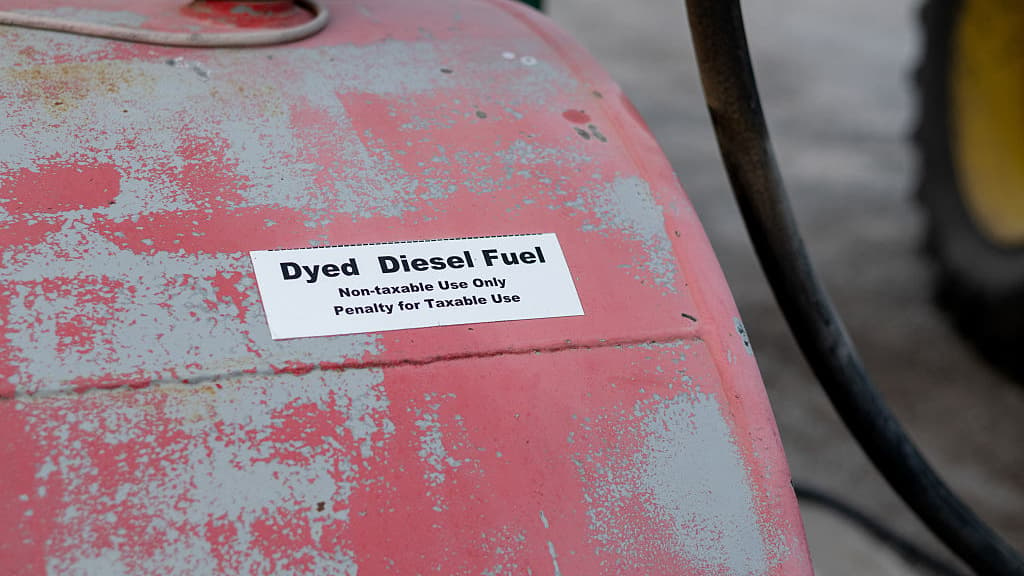
President Donald Trump will allow road vehicles to use untaxed diesel typically used in farm operations as part of an effort to ease rising fuel costs.
Trump signed an executive order on Monday to temporarily allow anyone to pump so-called red-dyed diesel, which is normally not allowed in road vehicles.
“For many years, farm vehicles, construction equipment and other off-road vehicles have used what’s known as red-dyed diesel. You know what that is? I don’t know what the hell it is, but whatever it is, it is supposed to be very good,” Trump said at a campaign rally in Grand Island, Neb., in support of Republican Sen. Pete Ricketts. The order would “officially waive the off-road requirement and allow anyone to purchase tax-free, red-dyed diesel for any reason,” he said.
“This order will also drive down the costs of all goods, including groceries,” he added.
Fuel prices have soared across the country since Iran disrupted shipping through the Strait of Hormuz and attacked Middle Eastern refineries in retaliation for U.S.-Israeli strikes on Feb. 28. Average diesel prices in the U.S. hit $6.32 a gallon on Monday, according to AAA. That’s up from $3.76 a gallon before the U.S. and Israel’s war against Iran began, although below the Sept. 22 peak of $6.53 a gallon.
The spike in diesel has been magnified by Ukrainian attacks on refineries in Russia, one of the world’s top diesel exporters, and export restrictions in China. Diesel has risen 77% this year, putting it on track for the largest year-on-year percentage increase since AAA started tracking the data in 2000.
In recent days, several Midwestern and Southern states have already sought to tamp down the rising diesel costs by increasing access to dyed diesel for use in highway vehicles.
Here’s what to know about the order.
What is dyed diesel?
Dyed diesel is essentially the same as regular diesel, but it is exempt from the federal highway tax of 24.3 cents per gallon, as well as certain state highway taxes. State taxes and fees on diesel, which are typically used to fund road construction and maintenance, averaged 35.5 cents per gallon as of January 2026, according to the U.S. Energy Information Administration.
Dyed diesel is not available at most ordinary gas stations or truck stops, and it is normally prohibited for highway use. Instead, it is used off-road by farm vehicles like tractors. The fuel is marked with a small amount of red dye, so that inspectors can distinguish it from regular diesel.
What does the order say?
The order directs the secretaries of Transportation, Agriculture, Defense, and the Treasury to “temporarily allow off-road ‘dyed’ diesel for highway use and defer the applicable Federal excise tax, lowering costs for Americans.”
That means that vehicles can use dyed diesel fuel on highways without immediately paying federal taxes, while the Administration seeks to eliminate those deferred tax obligations entirely. The order also encourages states to halt inspections and suspend state taxes for on-road use of dyed diesel.
The waiver will last through the end of the year.
“We’re not going to need it long, I hope, we’re not going to need it long because your prices are plummeting and they’re going to really be plummeting,” Trump said.
What does this mean for consumers?
The direct benefit for prices at the pump may be limited because most gas stations don’t sell dyed diesel to standard consumers.
But consumers may see some indirect savings on groceries and consumer goods through lower supply-chain costs, as the exemption seeks to lower costs for farmers and truckers.
Currently, to fill an 18-wheeler with 250 gallons of diesel would cost around $1,580, which is around $700—or 80%—higher than the beginning of the year when diesel averaged about $3.52 a gallon. Waiving federal taxes would save truckers about $60 per fill-up. If states follow suit by waiving state taxes, the White House suggests truckers could save more than $100 per fill-up.
The order also aims to help farmers, historically a key voting bloc for Republicans. Farmers have been squeezed by soaring fuel and fertilizer costs, as well as the fallout from Trump’s trade war with China and lingering tariff-related uncertainty.
Farm Bureau economists argued, before the federal order, that removing highway taxes for dyed diesel could produce meaningful savings across large fuel volumes.
The Michigan Farm Bureau, which called on Gov. Gretchen Whitmer to provide statewide relief on dyed diesel, also said waiving the penalties on highway use of dyed diesel would produce “an immediate, meaningful, and targeted relief from record fuel prices.” The bureau said farmers already have significant stores of dyed diesel for off-road use, making it an easily accessible option for use on highways.
Ten states—Alabama, Arkansas, Indiana, Louisiana, Missouri, Nebraska, North Carolina, North Dakota, Oklahoma, and Texas—already temporarily permitted the use of dyed diesel fuel for some on-road use.
These state measures largely target agricultural and timber haulers by temporarily waiving fines and penalties when dyed diesel is found in the tanks of vehicles on public highways.
“Record-high diesel prices are squeezing our ag producers, and this is a meaningful and timely step we can take to provide temporary relief and help our farmers and ranchers through the harvest season,” Gov. Kelly Armstrong of North Dakota said last week. The state executive order allows farmers to use dyed diesel in highway vehicles engaged in agricultural operations. North Dakota charges 23 cents a gallon in state taxes on regular diesel, as compared to 4 cents a gallon on dyed diesel.
Arkansas, Indiana, Missouri, Nebraska, and North Dakota also offered state tax relief for certain highway use of dyed diesel.
In an Oct. 1 letter to Trump, American Farm Bureau President Zippy Duvall said a waiver of the federal tax on regular diesel would “provide immediate cost relief for farmers, ranchers, and agricultural haulers that continue to rely on taxable clear diesel.” Earlier this year, the Farm Bureau called for suspending fertilizer tariffs and facilitating safe passage through Hormuz.
Some analysts, however, questioned how much relief the waiver can deliver without addressing underlying diesel supply constraints.
Others have said that a large influx of on-road commercial vehicles purchasing dyed diesel could strain dyed diesel inventories, potentially driving up costs for farmers during harvest.
What other measures are on the table?
The Trump Administration has pursued other measures to lower fuel prices. Last week, the Group of 7 countries, which includes the U.S., agreed to release 100 million barrels of diesel and crude oil reserves over four months.
In August, the Administration also extended the Jones Act Waiver, allowing foreign-flagged vessels to transport gasoline, diesel, and other energy products between U.S. ports in an effort to ease shipping bottlenecks and lower fuel costs.
Last month, Trump weighed a ban on U.S. diesel exports, backed by some farm-state Republicans. But the President has not yet followed through on such an action, which would cut off global supplies from the world’s largest diesel exporter and likely worsen shortages around the world.
Analysts warned that any initial relief for Americans from a diesel export ban could eventually come at the expense of higher gasoline and jet fuel prices because U.S. refineries would process less crude in order to store unsold diesel. The global price of diesel would also likely rise, which could “boomerang” back onto American consumers. Some farm economists warned that such a ban could also expose U.S. agricultural exports to retaliation.
Some states have also pursued broader fuel tax relief. Georgia and Ohio temporarily suspended state taxes on gasoline and regular diesel, while Indiana extended its suspension on gasoline sales taxes. Earlier this year, Illinois postponed a scheduled gasoline tax increase, and Kentucky temporarily cut gasoline and diesel taxes by 10 cents a gallon. Massachusetts Governor Maura Healey also proposed a two-month gasoline and diesel tax holiday, which remains pending before the state legislature.
The post Trump Expands Access to Tax-Exempt Dyed Diesel to Try to Lower Fuel Costs appeared first on TIME.