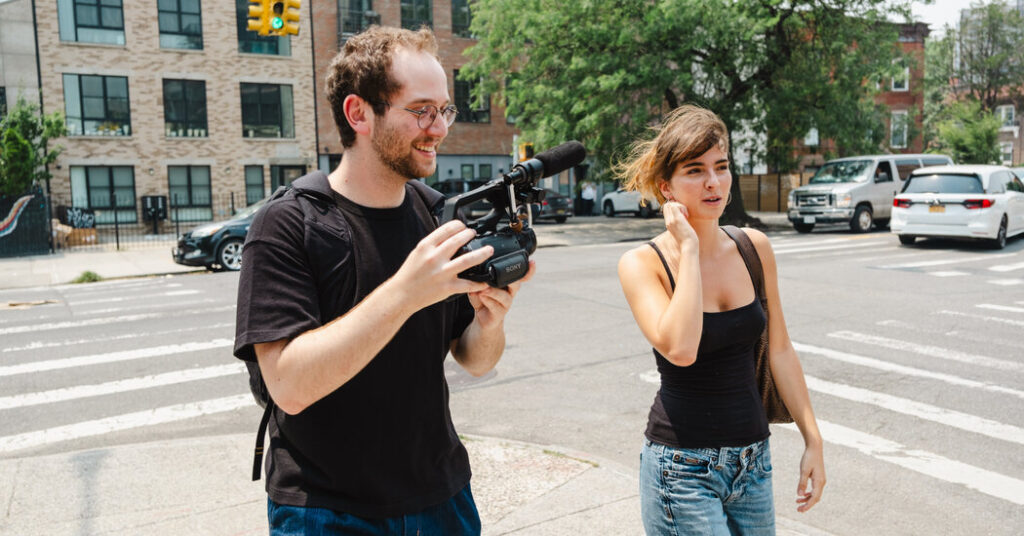
On a dead-end street lined with auto body shops in the Bushwick neighborhood of Brooklyn, a 26-year-old filmmaker named Noah Blau trained his Sony camcorder on Aitana Doyle, an aspiring actress and waitress, as she anxiously practiced for her driver’s test.
Blau was taping an episode for his cult Instagram show, “Errands,” which documents his friends undertaking tasks around New York City with an approach that elevates their mundane missions into hero’s journeys. Episodes have included an excursion to hang a window curtain and a trip to replace a broken skateboard.
Wearing red socks and Tevas, Blau interviewed Doyle outside the rental Chevy she was using to practice parallel parking along the desolate street.
“Aitana, explain to me the situation,” Blau said.
“Today I’m taking my driver’s test,” Doyle, 23, said. “I started lessons two years ago but I kept getting scared and chickening out. But now I need it. Because I keep doing acting jobs where I drive and I keep lying about having my driver’s license.”
“Either I’ve got it in the bag,” she added, “or I’m going to fail miserably.”
Blau handed her the yellow legal pad that serves as the show’s title card. “I  Errands,” it read. He filmed her as she held it up.
Nervously, Doyle got in the car and eased into a spot. She then opened the door and triumphantly evaluated her proximity to the curb.
“Noah’s show helps people appreciate the little wins in life,” Doyle said afterward. “The people on his show aren’t celebrities like on ‘Subway Takes.’ They’re average Joes going about their day. Sometimes you spend your day accomplishing nothing but an errand, and that’s important, too.”
Since Blau posted the first episode of “Errands” nine months ago — it followed a friend named Marta and her quest to find a pink wig — the show has won a small yet feverish following in the post-‘Subway Takes’ era of algorithm-nourishing New York social media content.
Filmed in lo-fi style, and accompanied by trippy jazz flute scores, the show approaches errands like urban odysseys. There’s one about a poet named Bernard who brings his broken CD player to an appliance repair store in Chinatown. Another follows Brittany, an unemployed writer, as she sells her paperbacks at Molasses Books. An actor named Jeremy searches for his lost cat.
Jeremy never ends up finding his cat, and failure is a themes of the show. Another episode follows a D.J. named Declan, who goes to traffic court hoping to contest what he considers an unjust biking ticket, only to encounter an unsympathetic judge. “We won some, we lost some,” Declan says afterward, smoking a cigarette.
“The failure rate is actually really high,” Blau said. “At first I thought that was going to be a problem, but it’s only been great for the show. The show is about: ‘I set out to do something, and did I accomplish it?’ So as mundane as the errand might be, everyone understands that feeling.”
Another element of the show’s appeal, he said, has to do with its glimpses into the banal moments of everyday life.
“All great films are voyeuristic in some way,” Blau said, “and now we’re all voyeuristic online. People get embarrassed when they’re seen carrying toilet paper home. But why is that? We know you use toilet paper. There’s something attractive and illicit about seeing someone do private things in public.”
On a sweltering afternoon in Flatbush, Brooklyn, Blau finished shooting an episode in the apartment of the 21-year-old internet provocateur and comedian, Ivy Wolk, who needed an air-conditioner for her new place. She’d been using her freezer as a way to cool her head — like, as she put it, a “reverse Sylvia Plath” — until Blau documented her buying a unit from a discount store and wheeling it home on a trolley. After a successful installation, she was relishing its breeze.
“Beauty is found in the minutiae, and the things that are banal are often the most interesting,” Wolk said. “It’s those in-between moments of life where growth and realization happen.
“People’s mythology of New York is that it’s so big and consuming,” she continued. “But this show lets people know that, on those days that swerve and consume you, sometimes you just have to go out and get something done — the tedious things you must do to exist as an adult, that we must all endure. There’s a comfort to watching that.”
‘Keep It Pure’
At the Bushwick apartment Blau shares with a roommate, he wore fuzzy slippers in his bedroom as he sat at his computer editing Wolk’s episode. Mementos from “Errands” outings were pinned to a corkboard, such as a gluten-free communion wafer from an episode about a pastor who goes shopping for church supplies. There was also a small poster of Lars von Trier and Jørgen Leth’s “The Five Obstructions.”
He clicked through computer files labeled “Johnny,” “Krystal,” “Drew” and “Uma.”
“I’ve been following people with a camcorder for a long time,” he said. “Really, my whole life.”
Raised in Baltimore, Blau grew up in a journalistic household. His father was an editor at The Baltimore Sun, and his mother was a food writer for The Chicago Tribune. When he was 6, Blau filmed a ladybug with a digital camera and posted the video on YouTube (it got 100 views). At 10, while documenting his sister’s bat mitzvah, he ended up filming her interview with their grandfather about the Holocaust.
As a student at New York University Tisch School of the Arts, Blau grew engrossed in the work of cinéma vérité auteurs like Frederick Wiseman and Ross McElwee while also immersing himself in the New York canon of John Cassavetes and Martin Scorsese.
“Scorsese’s ‘After Hours’ is like the ultimate errand,” he said. “That would be my dream episode — for someone to get so sidetracked on their errand that they get chased through SoHo by an angry mob, like in the film.”
The pandemic halted New York during Blau’s sophomore year. Student productions stopped as classes went virtual. After graduating, Blau struggled to find work in the financially troubled film industry, taking production assistant gigs here and there, but mostly paying his rent by working retail and restaurant jobs.
He was also immersing himself in Bushwick’s creative scene, hanging out at bars like The Narrows and art spaces like Life World with actors, musicians and writers who were all dealt the same post-pandemic hand. Soon he started training his camcorder on them. First came Sophie, whom he documented while she shopped for a Halloween costume. Then came Idene, whom he filmed returning a bottle of perfume to Bloomingdale’s.
“I started thinking, maybe there’s something here,” Blau said. “But I also just wanted people to see my work as a filmmaker.”
Around the time he posted his first episode in 2025, “Subway Takes” was surfacing incessantly on social media algorithms. Its sunglasses-clad host, Kareem Rahma, had started out interviewing young New York creatives on rattling trains. Once the talk show blew up, he began featuring celebrities like Cate Blanchett and Jennifer Lopez, as well as sponsored posts with companies like Google.
When asked if he hoped “Errands” might take off in similar fashion, Blau mulled his answer.
“I love ‘Subway Takes,’ and my show exists in a post-‘Subway Takes’ world, but I don’t want the show to become a press stop,” he said. “If I were to have Taylor Swift on ‘Errands,’ that would probably be the worst thing that could happen to it.”
“I think people like my show because it’s made for no money and makes no money,” he added. “I think that helps keep it pure.”
To the Driving Test
On a recent Wednesday, Blau sat beside Doyle in her rented Chevy, filming her as she drove to take her driver’s test in Flatbush. He reminded her to slow down for speed bumps and quizzed her on the meaning of various road signs.
“Don’t even ask me what the speed limit in New York is,” Doyle said. “Because I don’t know.”
On a quiet road facing a cemetery, she pulled up behind a line of idling student drivers. It was a long wait. Doyle writhed in her seat. Her nerves finally eased when a Department of Motor Vehicles examiner in a yellow vest approached and told her that her test was being rescheduled.
Blau seemed flustered by the prospect of another errand gone awry. But after collecting himself, he turned the camcorder back on and asked Doyle how she felt about the setback. She smoked a cigarette while answering his questions as a golden-hour sun crept over the cemetery.
Finally putting away his camcorder, Blau looked out at the weedy field of tombstones.
“The longer I do this, the more I think of everything as an errand,” he said. “What I’m doing right now is an errand. Decomposing and turning into a tree is an errand. Death is an errand.”
The post ‘Errands’ Should Be the Most Boring Show on the Internet appeared first on New York Times.