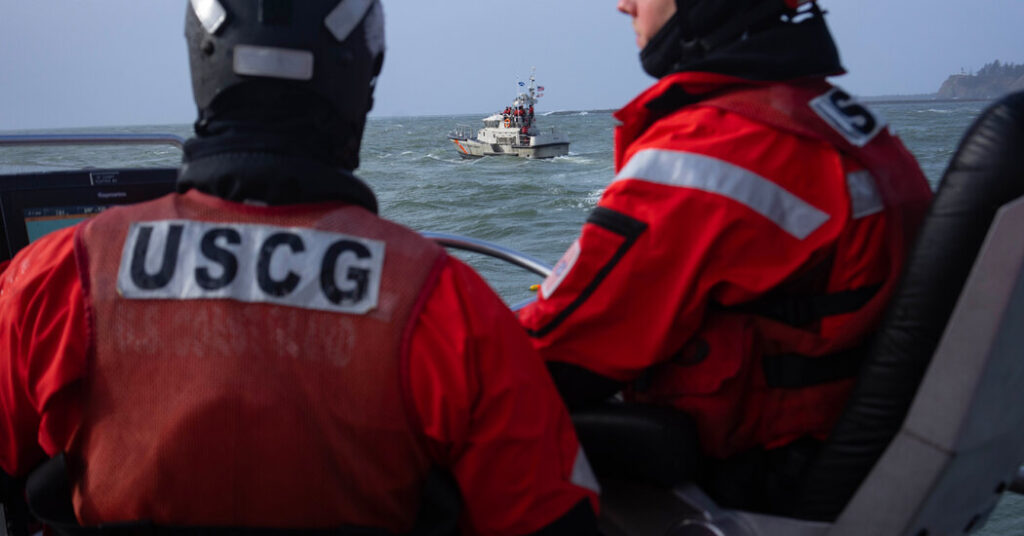
The head of the U.S. Coast Guard told all personnel on Thursday that slamming through rough seas was causing brain injuries to small-boat crews and vowed to take what he called “decisive action” to prevent, recognize and treat the injuries, which have often gone undiagnosed.
“Our crews operate in a dangerous and unforgiving maritime environment. The demands of our missions are immense,” Admiral Kevin Lunday, the commandant of the Coast Guard, wrote in an email sent to the whole force. “We owe it to you to protect your long-term health from the damage caused by relentless wave pounding.”
The email was sent just hours after The New York Times published an article detailing how rescue boat crews working in crashing surf are exposed to thousands of impacts that cause a whiplash motion and seem to cause brain injuries, even if crew members never hit their heads or feel concussed.
After years of exposure, many crew members suffer from headaches, memory lapses, cognitive problems, anxiety attacks, mood swings and a list of other ailments that can be symptomatic of brain injuries. But for years, the root cause went unrecognized, by both crew members and the Coast Guard, because the symptoms often look like normal reactions to traumatic stress.
Many crew members were diagnosed with post-traumatic stress disorder but were never assessed for a physical brain injury.
The Times report detailed how some elite lifeboat drivers — known as surfmen — fall apart in perplexing and sometimes violent ways. It followed the efforts of one high school student, Kayleigh Bonner, who sought to understand why her father, after years of growing increasingly erratic, had died suddenly by suicide.
For a senior project, she surveyed more than 70 surfmen and found widespread signs of undiagnosed brain injuries. Her research became the foundation of the article in The Times.
On Friday she said she hoped the Coast Guard would follow through in making necessary changes to ensure the safety of crews.
“I’m grateful the research and article have had this much influence,” she said. “Seeing people who feel less alone in their struggle, validated in their experience, or have clues to what they may also be dealing with is amazing and made all of the hard work and pain in sharing our story worth it.”
Admiral Lunday told the force that the Coast Guard will begin a servicewide brain health initiative that will train crews on how to recognize brain injuries and encourage members to report symptoms of potential injuries. He said the service will also work with civilian medical experts and other military branches that are dealing with similar issues to create new monitoring protocols and treatment standards for its medical providers.
The Coast Guard partnered with civilian researchers in June to place sensors on some of its small boats to measure impacts. The data could eventually give insight into what levels of wave slamming are dangerous and who is at risk.
The Coast Guard has more than 40,000 active-duty members who do rescue missions as well as law enforcement and drug interdiction. The forcewide message acknowledged that personnel may also be at risk of unseen brain injuries from the blast wave exposure of repeatedly firing weapons, or from being close to explosions.
As part of the initiative, the admiral said the Coast Guard would work to encourage personnel to come forward and report injuries.
“Taking care of your brain health is an operational necessity and a matter of readiness,” he said. “We need leaders at every level to ensure our people are aware of potential brain injury symptoms, get medical attention without hesitation or fear of stigma, and receive proper medical care.”
The post Coast Guard Vows to Protect Crews From Brain Injuries Caused by Rough Seas appeared first on New York Times.