In September the light falls low and golden across my garden, illuminating the panes of the emptying greenhouse and picking out crab apples and the pear tree’s turning leaves.
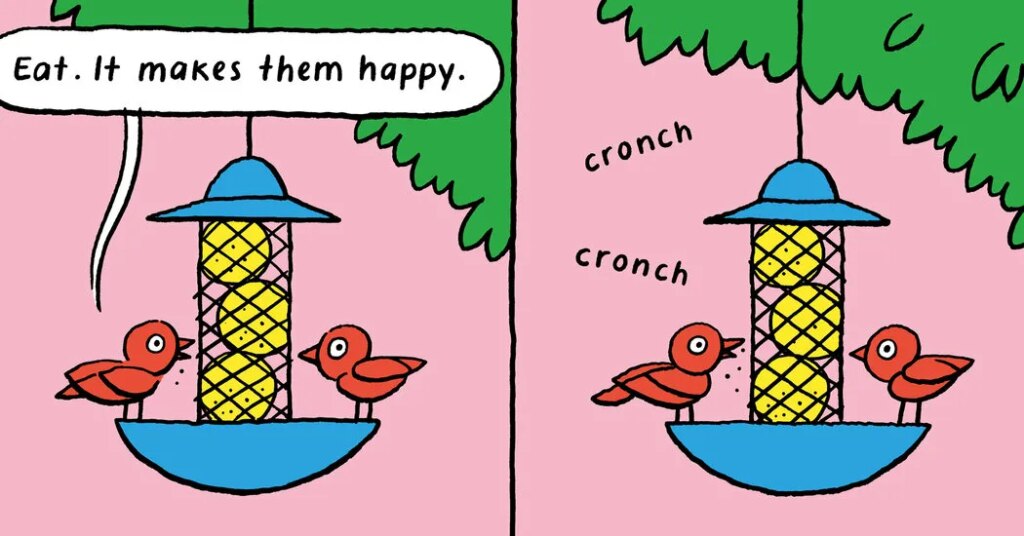
It would normally be time for me to get the bird feeders out and fill them with goodness: fatty peanuts and nutritious seeds to keep tiny bird bodies warm and healthy through the cold autumn and winter days and nights. Most years my garden becomes a theater of delicate, fluttering wings on frosty mornings, squabbles at the feeder in the snow, and an ever-changing roll call of avian visitors through the dark months. They provide endless entertainment and the warm glow of feeling like I am saving little lives.
This year, however, I am thinking twice. It has become apparent that one of Britain’s favorite national pastimes may actually be hurting as well as helping. An epidemic of the parasite that causes the disease trichomonosis, which thrives on damp birdbaths and feeders and is deadly to birds, has devastated the population of certain species in Britain by more than 60 percent. This year the Royal Society for the Protection of Birds released new guidance asking people to restrict feeding between May and October, and to take steps to contain the spread, like regular cleaning and not using flat feeders, if feeding in winter.
The guidance prompted some soul-searching in a country in which more than half of households feed garden birds. Estimates vary widely, but between us we put out between 50,000 and 150,000 tonnes (up to about 170,000 tons) of seeds, nuts and fat, spending an estimated 334 million pounds, about $440 million, a year — about twice as much as the rest of Europe combined.
We do this for the birds, but also, of course, for ourselves. For those quiet moments with nature in our busy, distracted lives. But how hard would it be to drop the habit if it turned out to be harmful? If we are truly a nation of bird lovers, shouldn’t we be able to put their welfare above our enjoyment of them?
It began with hats. In the Victorian era, large, brightly colored exotic feathers and even whole birds were so sought after as hat decorations that several birds of paradise were driven to the edge of extinction. Emily Williamson, a 34-year-old solicitor’s wife and, it turned out, pioneer of ethical consumerism, fought back. Apparently ignored by the all-male British Ornithologists’ Union, she founded an all-female Society for the Protection of Birds from her home in Didsbury, Manchester, in 1889 (the royal charter came later, in 1904).
From the beginning, the R.S.P.B. was practical, caring and hands-on — initial members signed a declaration that they would not participate in the exotic plumage trade. Victorian society was to be asked to consider birds as something they should consider as deserving of care, rather than merely decorative. The winter of 1890-91 was unusually severe, with temperatures as low as 1 degree Fahrenheit. Letters and articles in newspapers urged readers to put out food for the birds to help them survive the freeze, and they did. Britons found they could save birds through their actions, and enjoy the tiny beneficiaries that thrived in their gardens. It was irresistible. A national pastime was born.
By some measures, this feeding has been a triumph. The average bird feeder is visited by a wide variety of species. Goldfinches — lively birds with yellow wing patches and bright red faces — were once rare garden visitors but have become more common. Great-spotted woodpeckers come to peanut feeders in the suburbs. This proximity to nature is at least partly responsible for creating a nation of bird lovers that signs petitions, funds reserves and notices absences when they occur. More than half a million Britons contribute to the annual Big Garden Birdwatch, a survey of garden wildlife, and the R.S.P.B. is still one of the largest nature conservation charities in Europe.
But much like elsewhere, the bigger picture remains grim. Habitat loss, mainly driven by agriculture, has meant that the farmland bird population has declined by around two-thirds since 1970 and woodland birds by about a third. Certain species, like willow tit and spotted flycatcher, have declined by more than 90 percent. We have built what might be the most successful bird-feeding culture on earth, while presiding over a decline in the overall population. (In the United States and Canada, almost 30 percent of birds have disappeared since 1970.)
The scientists Jack Shutt and Alexander Lees, in a 2021 review “Killing with Kindness,” argued that dumping thousands of tonnes of non-natural food into a country the size of Britain is likely to have had profound consequences that we have never measured. Mr. Shutt’s own fieldwork found garden food to be the commonest item in the diets of blue tits, even those nesting inside woodland and well away from gardens. Blue tits that were eating from garden feeders were more likely to lay five days earlier and lay close to four times the number of eggs.
Success, you might think, but not if you are one of the shyer woodland birds that doesn’t visit gardens. Magpies, blue tits and great tits are not villains, but they are winners: adaptable, aggressive and abundant, evicting woodland birds from nest holes and outcompeting in the fight for food, resources and nest sites. A study that compared British great tits with those in the Netherlands found that the British bird appears to be evolving a longer beak, perhaps the better to use bird feeders.
The wildlife writer Kate Bradbury has also pointed out how little we consider the environmental impact of importing and consuming enormous amounts of bird food. “What about the land used to grow that food?” she wrote in her newsletter. “How many birds and other wildlife lost a habitat so a pesticide-laden monoculture could exist in its place? How many air miles and how much plastic packaging are involved in our consumption of this product?”
It seems we have been running a Great British Bird Ecological Experiment for over a century with no control and no plan. We have been helping birds to survive harsh winters, but in the process, we may have exported wild bird decline to our own woodlands, farmlands and to countries that supply our vast appetite for bird seed.
We have all — or at least, surely most of us — moved on from hats garnished with the plumage of exotic birds and that very Victorian idea of birds and the natural world in general as a resource for our own amusement. But I am struck by the parallels of that era with our enjoyment of “our” garden birds, and our curation of our own pretty private theaters in our gardens, while the damage happens out of sight. We still have work to do to think of nature as something that can and must exist for its own sake, and fight the urge to hold on to it.
For me, this winter, that will certainly mean regularly scrubbing the bird feeder, and I am trying to steel myself to not feed at all. But it is hard to resist. Maybe I will put my energies into planting a living bird buffet of echinacea, with its spent flower heads packed with seeds; sedums that will overwinter insects that the birds can grub out; hawthorn for berries.
So many of us want to be genuine stewards of the world around us, but if our relationship with nature is to really change, then we have to think about the impact of our actions as a whole, not just the view from our window.
Lia Leendertz is the author, most recently, of “The Almanac: A Seasonal Guide to 2027.”
The Times is committed to publishing a diversity of letters to the editor. We’d like to hear what you think about this or any of our articles. Here are some tips. And here’s our email: [email protected].
Follow the New York Times Opinion section on Facebook, Instagram, TikTok, Bluesky, WhatsApp and Threads.
The post To Feed or Not to Feed the Birds? appeared first on New York Times.