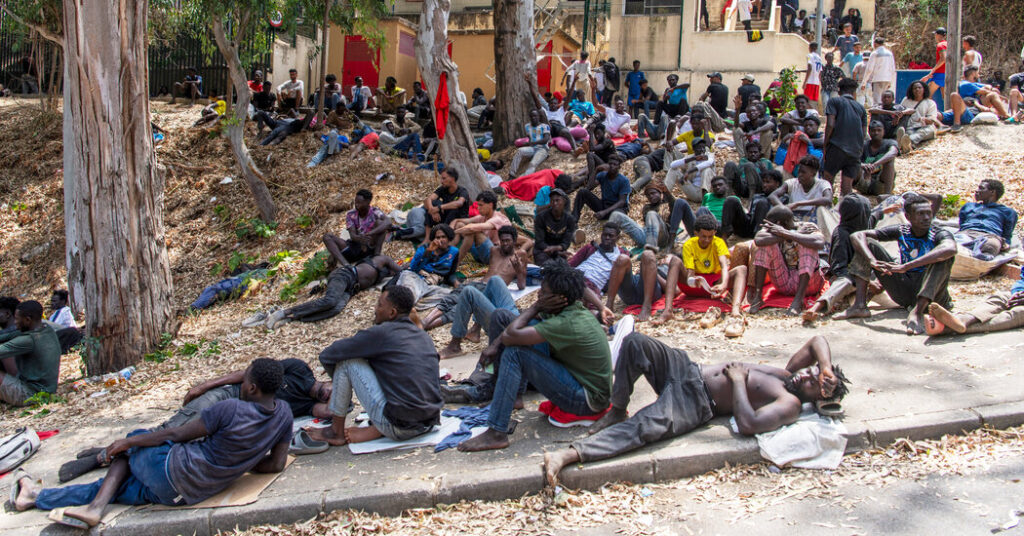
Friday’s images of desperate people pouring across the Moroccan border into a small Spanish territory in North Africa conjure up memories of Europe’s migrant crisis in 2015.
Then, more than a million people, many fleeing a brutal civil war in Syria, swept across the continent searching for safety but often finding economic hardship, discrimination and sometimes death as they made dangerous treks across land and sea.
Over the last 36 hours, officials say as many as 60,000 people have surged into Ceuta, a six-mile-long peninsula on Morocco’s coast that Spain has governed for centuries. At least three dozen people have died. Although the authorities said many of those who entered had returned to Morocco by Friday evening, the mass migration has created a political crisis for Spain’s government, much like the 2015 wave of migrants did for leaders across Europe.
But much has changed.
In the last decade, almost all of Europe’s governments have cracked down on migration, making it harder for asylum seekers to cross borders and changing the way laws are enforced to discourage migrants from seeking entry in the first place. Migration by sea has plummeted.
In Greece, officials have moved to shut down overcrowded migrant camps on the Aegean Islands and replace them with more restrictive facilities. The country’s Parliament passed a law imposing prison terms for those who remain in the country after they are rejected for asylum. In 2023, videos showed the Greek Coast Guard placing captured migrants onto a black inflatable life raft and leaving them adrift.
Other European countries also passed tough new laws and stepped up immigration enforcement. Germany led efforts to persuade Turkey to do more to prevent migrants leaving for Europe, and expanded its own border patrols in 2024. In Italy, Prime Minister Giorgia Meloni tightened citizenship rules last year and wants to send migrants to Albania while their asylum applications are being processed. In 2023, France’s Parliament approved an immigration overhaul that makes it harder for immigrants to legally bring over family members.
The tough new rules across Europe have not eliminated the movement of desperate people entirely, and the presence of immigrants continues to help fuel right-wing movements across the continent. Britain’s Reform U.K. party, Germany’s Alternative for Germany party and France’s National Rally all continue to use anger about migration as a centerpiece of their political agendas.
To avoid being outflanked by the far-right, centrist governments have often taken stances on immigration that are as tough as the policies of their right-wing rivals.
In Denmark, the country’s center-left government has imposed some of the strictest migration rules on the continent, helping to drastically drive down asylum flows into the small country.
In Britain, the Labour Party government has sought to make it much tougher for asylum seekers to win the right to stay in the country. In the last six months, the number of crossings across the English Channel has dropped by 45 percent.
Spain’s center-left government has been one of the exceptions in Europe. Prime Minister Pedro Sánchez announced a plan in January to allow undocumented migrants to legalize their status. By June, more than 1 million people had applied.
Critics of Mr. Sánchez seized on the events in Ceuta as evidence that his policies had created the wrong incentives. The Trump administration, which has clashed with Spain on other issues, on Friday blamed the events at Ceuta on “far-left, globalist policies, including enabling mass migration.”
The post Ceuta Evokes Europe’s 2015 Migration Crisis. But Much Has Changed Since. appeared first on New York Times.