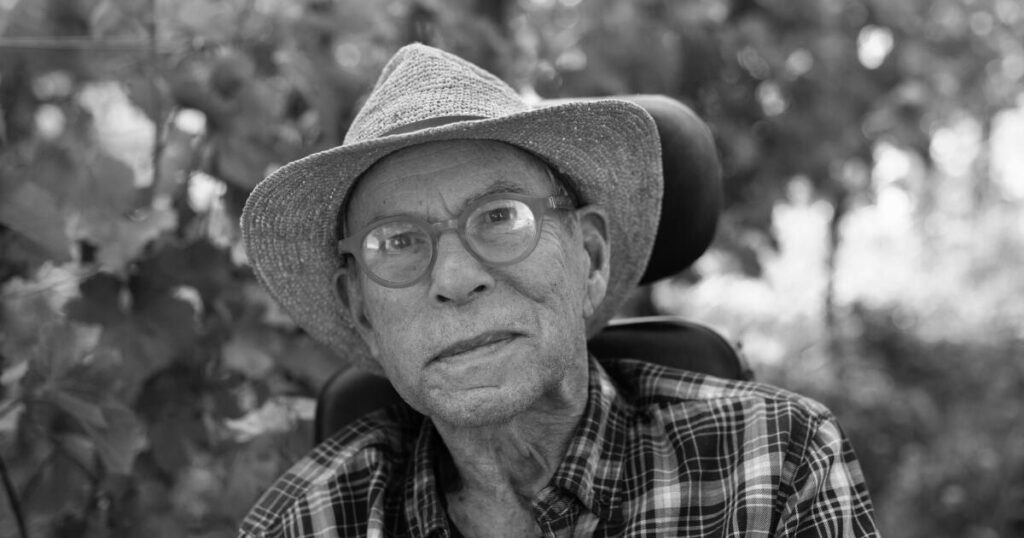
David Hirsch, proprietor of Hirsch Vineyards, winemaker, autodidact, practical geologist, practicing Buddhist and thinking man’s farmer, died Tuesday of respiratory failure in Santa Rosa, Calif., according to his family. He was 81.
Over a 45-year second career as a vineyard owner in west Sonoma County, David Hirsch plumbed the mysteries of California vine-growing and its terroir (the ways in which a vineyard site expresses the vicissitudes of climate and soil in the wine) with zeal and attentiveness, transforming a remote corner of a windswept coastland into one of the great sources for Pinot Noir in California, and perhaps the world.
Hirsch was born in 1944 in New York. (He retained his thick Bronx accent throughout his life.) In an interview in June, he credited his father for a life marked by insatiable curiosity. Hirsch’s father was a bookseller, and when the family moved to a new home in New Rochelle, N.Y., his father brought his collection of books, some 30,000 volumes. “After school,” Hirsch said, “my job, my homework, was to alphabetize those books, room by room.” The task took him three years, “but I came away immersed in reading,” he says.
He attended classes at Columbia, chasing Coltrane at night, which put an end to his formal education. After a few semesters he left school, hitchhiking across the country, slaking his curiosity on the road. “I got to explore towns all over, in maybe 40 states,” he said. “That, to me, was what America was really about, what it stood for. It inspired me to fill in the empty spaces in my knowledge.”
After a career in the garment business that took him all over the world, in 1978 Hirsch purchased an 860-acre sheep ranch on a ridgetop less than three miles from the Pacific near Fort Ross, Calif., in the outer reaches of Sonoma County, a stone’s throw from the San Andreas fault. According to his daughter Jasmine Hirsch, he bought the property not to plant grapes, but to “hear himself think.”
He began exploring the history of the property and eventually devised a grand ecological project to restore it to something like its original state, reclaiming the pasture-land and reforesting a portion. “My dad always talked about a 200-year plan for this place,” said Jasmine. (Her last “business” meeting with him was with a forest management expert, to lay down a regenerative course of action for the property.)
Such grand plans need income, though, and on the advice of friends, Hirsch planted a small test plot of Pinot Noir and Riesling vines. So began a lifelong exploration of the relationship between wine and place that amounts to one of the more comprehensive explorations of terroir of any grape producer in California.
The west Sonoma coast is, by and large, a forbidding place, even for grapes. Over the course of nearly 50 years David Hirsch took its measure. He watched the daily incursions of fog and wind interact with his property, noted its advances and retreats, the way it pushed the atmosphere across his hillsides, the way the vines took in sunlight. He began to explore the property’s soils, known as the Franciscan Mélange and among the most complex in California, with the meticulousness of a geologist.
He began referring to his soils, derived from the churnings of the San Andreas fault, as “earthquake terroir.” He drew in other winemakers, including Burt Williams and Ed Selyem of Williams Selyem, Ted Lemon of Littorai Vineyards and Steve Kistler of Kistler Vineyards, with his intensity.
“The diversity of his interests and passions was incredible,” says Lemon, who has purchased fruit from Hirsch for a quarter century. “He hoovered up culture and science and philosophy like few people I know. When you’re like that it’s easy to get lost in your ideas, but David never got lost in the minutiae. He taught himself to become a great farmer.” Eventually, says Lemon, the only way for Hirsch to go further was to start a winery. Hirsch Vineyards was founded in 2002.
Hirsch tasked a series of winemakers, including Vanessa Wong, Mark Dougherty, Ross Cobb, Anthony Filiberti, Michael Cruse and his daughter Jasmine, to make wines from the estate, drawing from no less than 60 subdivided parcels of the vineyard. Jasmine Hirsch now makes the property’s wines, eight estate bottlings from five designated sections known for their subtlety, clarity and distinctiveness.
According to Jasmine, her father’s goal became the estate’s goal, to forgo their own stylistic preferences and provide a lens into the vineyard. “It’s not about any individual person or style,” Hirsch told me recently. “It’s not on Jasmine, not on David, not on any particular winemaking style. It’s all about place.”
Jasmine says that her father’s persistence, and peskiness, earned him the title around the winery as “Chief Bug.”
Hirsch continued to plant, replant and reorient his vine rows for many years, parsing and isolating his mélange of soils. In 2014 he was on a tractor moving compost piles when the tractor tipped, leaving him with a critically injured spine. He’d been in a wheelchair since, but in recent years patrolled the grounds on an ATV with hand controls. It allowed him to keep watch over his vines and to be even closer to the ground that had fascinated and confounded him for nearly half a century.
In our last Zoom call, Hirsch looked wan but peaceful. A man who practiced meditation for most of his adult life, he exuded the serenity found in such pursuits. In his time on the Coast several Buddhist temples and retreat centers had sprung up near and around his property. The closest was Odiyan, a refuge north of the property in Cazadero.
He concluded our virtual visit with this story: “I was down in Fort Ross, talking to a fisherman,” he said. “He said that the monks had just come down from Odiyan. He watched them cast food out into the waters. When he asked them why, they told him it was ‘to feed the hungry dragon.’” This somehow gave Hirsch comfort. “It really was a great coincidence to know that Odiyan was sitting up there, doing the same thing behind their gates and fences as I had been doing here.”
David Hirsch is survived by his wife, Marie; his children Jessica, Jasmine and Joseph; and his siblings Adam, Betty, Susan and Daniel.
The post Visionary wine grower who transformed Sonoma coast dies at 81 appeared first on Los Angeles Times.