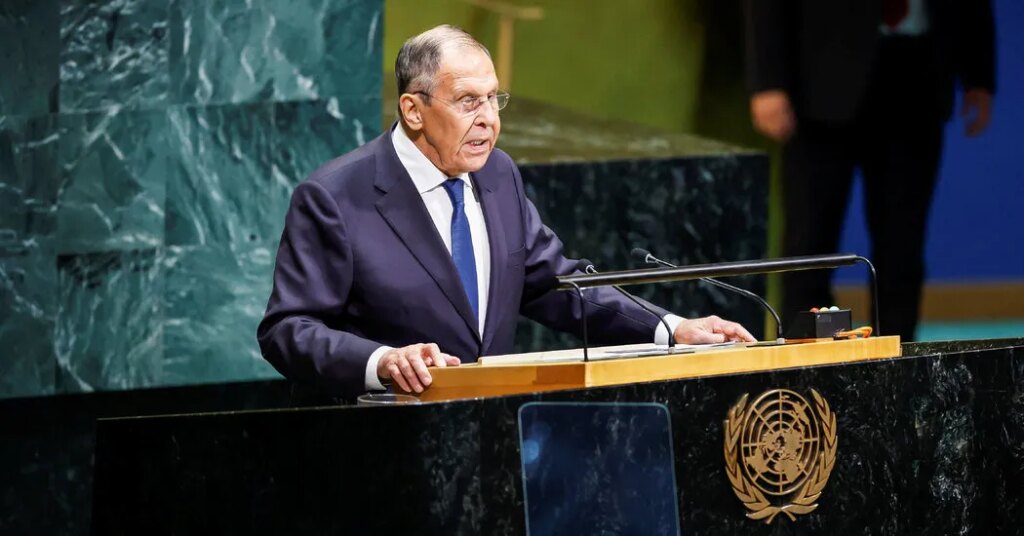
Russia’s foreign minister, Sergey V. Lavrov, met with his German counterpart on Saturday on the sidelines of the U.N. General Assembly. It was the first meeting between the two countries at this level since Russia launched its full-scale invasion of Ukraine over four years ago.
Mr. Lavrov said the German foreign minister, Johann Wadephul, had requested the meeting a day earlier.
According to the Russian minister, Mr. Wadephul reiterated Berlin’s positions on Ukraine and requested that Russia make some concessions on the Ukraine front and on the safe passage of ships and tankers in the Black Sea.
Mr. Wadephul said on social media that he had conveyed to Mr. Lavrov when they met that Russia “must end its war of aggression against Ukraine and cease its hostile actions against Germany and its allies.”
The meeting came as Europe has grown increasingly anxious about Russia launching a new wave of attacks on Ukraine, and as European leaders are stepping up their warnings about Moscow’s shadow war and threats against NATO nations. The United States has also raised concerns about Russia’s alliance with Iran and how it has provided Tehran intelligence and satellite imagery for its attacks targeting American bases in the Middle East.
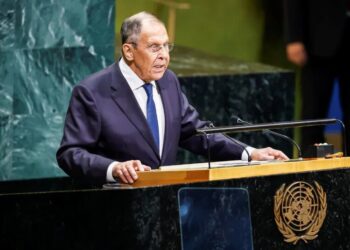
President Vladimir V. Putin of Russia has not attended the annual gathering of world leaders at the U.N. General Assembly since his country invaded Ukraine in 2022. Mr. Lavrov has represented Russia instead, and spoke on Saturday. (Because the order of speeches is based in part on speakers’ ranks, countries represented by a minister typically take their turn at the end of the weeklong event.)
Mr. Lavrov addressed the Assembly after his meeting with Mr. Wadephul, in a speech filled with familiar attacks on the West and defenses of his country’s war on Ukraine. He said that Russia’s fight would be “seen through to the end” and until it eliminated what he said were threats to its security.
At a news conference at the United Nations afterward, Mr. Lavrov said that in prior meetings with U.S. officials, including the secretary of state, Marco Rubio, the special envoy Steve Witkoff and President Trump’s son-in-law Jared Kushner, the officials had described the Ukraine war as “Biden’s war, not our war.”
Mr. Trump has blamed former President Joseph R. Biden Jr. for the war between Russia and Ukraine and said that if he had been in office, the war would not have happened. But Mr. Lavrov added that some of Washington’s actions, such as enforcing new sanctions on Russian oil companies, contradicted the diplomatic messaging.
Still, Mr. Lavrov said at the news conference, Russia and the United States have regular diplomatic engagements and should work together on cases where their interests coincide and prevent a confrontational approach when they diverge.
During his speech to the Assembly, he said there was a new multipolar world order taking shape and the influence of the United States as the world’s lone superpower was diminishing.
“The Western minority, which dominated for 500 years, thanks to others’ resources, continues to try to maintain its privileges and to impose its own rules on everyone else,” Mr. Lavrov said.
Mr. Lavrov criticized the United Nations and its leadership, and said the Security Council should expand its number of permanent members to include India, Brazil and countries from Africa.
Mr. Lavrov also denounced the United States, without mentioning Mr. Trump, for capturing Venezuela’s former leader, Nicolás Maduro. He also criticized it for launching the war on Iran, bombing the country’s nuclear sites and killing its former supreme leader, Ayatollah Ali Khamenei, which he called “another unacceptable manifestation of coercive diktat.”
Mr. Lavrov announced Russia and Belarus and countries aligned with their global views had adopted a declaration in New York on Friday to develop a framework based on new geopolitical realities called the “Eurasian Charter of Diversity and Multipolarity in the 21st Century,” and called on other countries to join them.
China’s vice president, Han Zheng, also addressed the Assembly on Saturday and, without mentioning the United States or Mr. Trump, sharply condemned the war in Iran and the Trump administration’s pressure campaign against Cuba. Referring to the United States as the “relevant country,” he said it must immediately lift its blockade on Cuba.
The post Russian Foreign Minister Vows Russia Will See Ukraine War Through appeared first on New York Times.