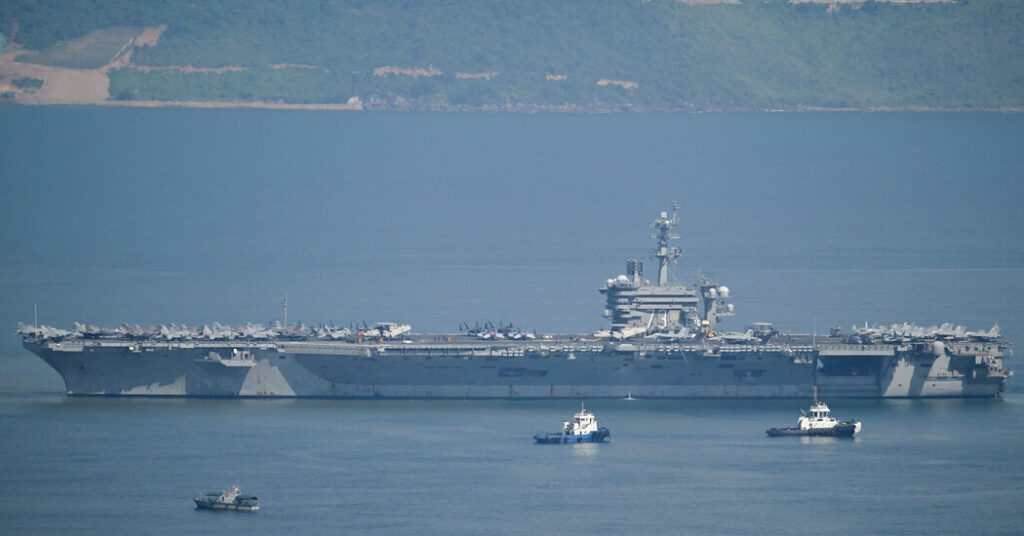
For the fourth time since the end of the Vietnam War, a United States aircraft carrier made a port call in Vietnam on Thursday, promoting joint security ties at a time when tariffs and the war in Iran have hurt American influence across Asia.
The carrier George Washington pulled into the quiet waters near Da Nang on day 70 of its deployment — not far from the beaches where U.S. Marines first landed in 1965, accelerating a war that killed around 58,000 Americans and 2 million Vietnamese.
Both countries celebrated the 7-day port call, the longest stay in Vietnam for an American warship since the two countries restored relations in 1995, as a sign of how far the former enemies have come.
“We consider this to be an extremely important visit for a variety of reasons,” said Capt. Nicholas DeLeo, the ship’s commander. He added that the 5,000 sailors making a stop in Da Nang, including a few Vietnamese Americans, were there “to build on this great relationship with the Vietnamese people.”
Why Now?
Vietnam has made itself an especially popular naval stopover for many countries as its foreign policy has shifted toward multi-alignment — seeking bonds beyond the superpower binary of the United States and China.
So far this year, Vietnam has also hosted naval vessels from Russia, China, India, Indonesia, Australia and Japan.
For the United States, Vietnam occupies a strategic position, geographically close to China and geopolitically important for any effort to keep Beijing from dramatically expanding its control over Asia’s disputed islands and vital commercial waterways.
American officials view the port visit as a way to signal reassurance to Vietnam, and strength to China.
The George Washington, a nuclear-powered aircraft carrier, is a hard steel embodiment of an idea Adm. Samuel J. Paparo, the U.S. Indo-Pacific Commander, often emphasizes: Presence produces deterrence.
“Credible, prompt, and sustained combat power, visible across the Indo-Pacific region, will deter acts of military aggression that destabilize the region,” he told Congress in April.
How Well do Vietnam and the U.S. Get Along?
The United States and Vietnam are not formal allies and they differ in how strong they want their message of partnership to be.
American officials are often effusive about the potential for security collaboration with Vietnam. In contrast, Vietnam’s propaganda commission recently issued guidance to local media outlets covering the port visit, warning them not to make too much of the carrier’s arrival.
“Emphasize that this is a routine friendship and exchange activity; do not glorify U.S. power,” it said.
Nguyen Khac Giang, a visiting fellow at the ISEAS-Yusof Ishak Institute in Singapore, said Vietnam is seeking a careful balance.
The country’s leaders want to show China that they have options if stronger partners are needed in the waters of the South China Sea that both countries claim. “But Hanoi doesn’t want to send the wrong signal to Beijing that it is becoming a part of U.S. containment or denial strategy against China,” Mr. Giang said.
The bonds between Hanoi and Washington have also been undermined by conflicts over trade.
Vietnam exports far more to the United States than it imports, and the gap keeps widening. The latest round of tariff negotiations has stalled without producing an agreement, according to officials close to the discussions, over the role of Chinese products made in or moving through Vietnam.
“The U.S. might think these are two separate issues, but I doubt the Vietnamese will agree,” Mr. Giang said. “Trade problems will not prevent defense cooperation, but will definitely set the limit of how far both can go.”
The post U.S. Aircraft Carrier Makes a Rare Port Call in Vietnam appeared first on New York Times.