Faced with weak consumer spending, persistently high youth unemployment and a tumbling stock market, China’s ruling Politburo signaled the need for stronger fiscal support and directed authorities to do more to tackle joblessness.
In a broadly worded statement issued on Thursday after its annual midyear review of the economy, China’s Communist Party leadership urged the government to pursue “more proactive” tax and spending policies, and increase employment support.
Politburo statements rarely detail specific policy measures, instead setting the broad direction for government action. Even by those standards, however, the statement offered few signs of urgency or a major policy shift, reinforcing expectations that Beijing will continue to rely on gradual stimulus rather than sweeping reforms.
The Politburo said it would “fully leverage the effectiveness of existing policies, promptly plan and introduce practical and effective incremental policies.”
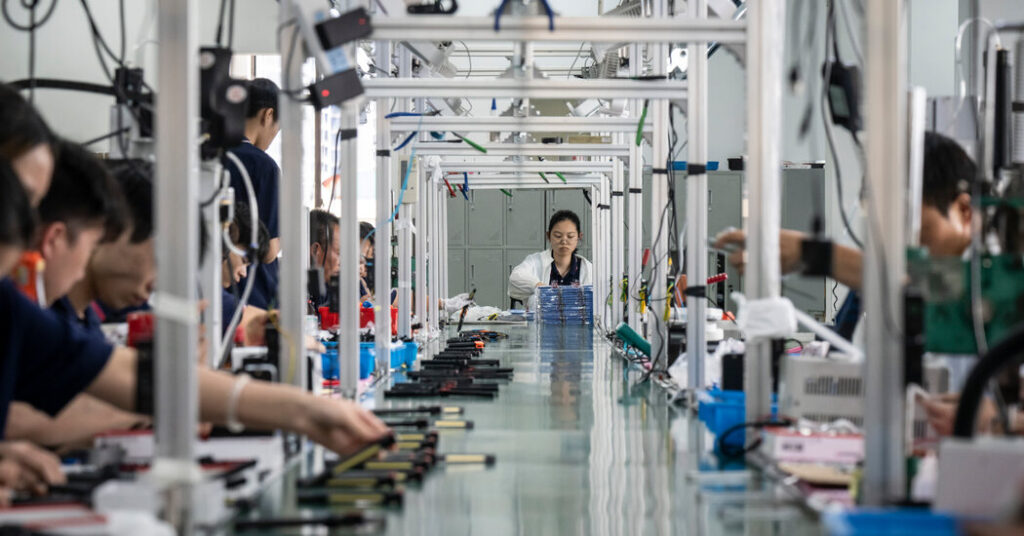
China’s domestic economy has faltered and is being sustained largely by a record trade surplus and strong exports from the technology and clean energy sectors.
“The Politburo continues to rely on incremental steps to pull the economy along,” said Eswar Prasad, a Cornell University economics professor and former head of the China division at the International Monetary Fund. “But revving household consumption will require substantial direct financial assistance as well as confidence-building measures, perhaps coupled with some tax relief.”
Even many of China’s electric vehicle and solar panel manufacturers are losing money, while some tech companies are also beginning to encounter difficulties. The CSI 300 index of major Chinese companies has fallen 8.6 percent in July after months of strong gains, putting it on track for its worst monthly performance since January 2016. It remains up nearly 10 percent over the past year.
Unemployment among urban residents aged 16 to 25 has hovered around 15 percent. Youth joblessness has created particular social stress for families because almost everyone in this age bracket is an only child, born when China’s “one child” policy was most strictly enforced.
Youth unemployment has remained stubbornly high even after Beijing changed its methodology in January 2024 to exclude many young people previously counted as unemployed.
China’s National Bureau of Statistics has yet to release July data for investment, retail sales and industrial production, but June data were very weak, and private surveys point to further deterioration since then.
With the exception of semiconductor and data-center equipment manufacturers, businesses across a wide range of industries are suffering from weak sales this summer, prompting cuts to overtime, hiring and borrowing.
“Every key indicator from revenue and profits to sales prices and hiring weakened from a year ago,” said the China Beige Book, a New York-based data service, in a report released on Thursday based on a survey of 1,436 businesses conducted in the last two weeks.
Consumer spending remains weak, while much of the housing market is still in crisis. A five-year nationwide decline in apartment prices has wiped out much of the middle class’s savings in a country where households typically hold about three-quarters of their assets in real estate.
Economists inside and outside China have urged the government and the state-controlled banking system to devote fewer resources to industrial policies supporting exporters and high-tech industries, and instead provide more financial support to households, particularly lower-income rural families.
In a speech last month, Liu Shijin, a former vice minister at the Development Research Center, an influential government think tank, said China’s manufacturing sector is globally competitive, but many industries face overcapacity while the needs of some people “remain unmet.” The East is Read, a Beijing newsletter, distributed a text of the speech this week.
Chinese leaders have been reluctant to take more aggressive action as China’s debt, relative to the size of its economy, already exceeds that of the United States and most other countries. The Politburo statement offered no sign of a fundamental shift in policy toward supporting Chinese households.
There have been tentative signs recently that housing prices are stabilizing in technology hubs such as Shanghai, Hangzhou and Shenzhen. But the housing market remains deeply weak across hundreds of other cities, particularly in the country’s interior, far from coastal export centers.
According to official data, China’s economy grew 4.3 percent in the second quarter from a year earlier, the slowest pace of expansion Beijing has reported in three years. Many Western economists believe actual growth may have been considerably weaker.
Retail sales fell in May for the first time since China emerged from Covid-19 lockdowns in late 2022, before recovering modestly in June, according to the National Bureau of Statistics. But the government has stopped publishing many detailed data series that once helped analysts assess the reliability of its official statistics.
The China Beige Book said its survey pointed to such broad weakness that official retail figures appeared to paint a stronger picture than conditions on the ground.
Ruoxin Zhang contributed research.
The post China, Its Economy Stumbling, Signals Only Cautious Support appeared first on New York Times.