

Cheap cars typically suck.
Consider the Mitsubishi Mirage. During its final decade in the US, the roughly $17,000 hatchback achieved its low price through obvious trade-offs: an engine that whined at highway speeds, a punishing suspension, and an interior so cramped that occupants rubbed shoulders.
Its 2024 discontinuation helped usher in the first period in modern US automotive history without a new car priced below $20,000.
So, when Slate announced a $24,950 starting price for a 2027 model, I assumed the low cost would come with plenty of compromises.
Building an affordable EV is difficult enough. Building one profitably — without making it miserable to drive — seemed even harder.
Then, on Tuesday, I became one of only a handful of people in the world who have driven a Slate prototype. I sat behind the wheel of the base truck for about 45 minutes and guided it through the windy, oceanfront roads of Newport, Rhode Island.
My skepticism didn’t survive the experience.
Impressions behind the wheel

I’ve driven plenty of different kinds of trucks in my career — everything from the Chevrolet Silverado EV Trail Boss to the Honda Ridgeline to the Ford Ranger Raptor.
The Slate is smaller and far less powerful than any of them. It still feels plenty truck-ish from behind the wheel.
Its big-nosed hood — which covers a seven-cubic-foot frunk, enough to fit roughly two medium-sized check-in bags — gives the driver the commanding view Americans expect from a pickup. It took me a moment to judge where the bumper ended, but it also made the Slate feel more substantial than its toy-like exterior suggests.
The two-person cabin gives both occupants more than enough room. At an aggressively average 5 feet 9 inches tall, I had what felt like a mile of space above my head. Slate says one of its 6-foot-8 engineers fits comfortably, though he wasn’t around for me to verify that claim.
The truck also drives better than its specifications suggest. Slate says it takes more than eight seconds to reach 60 mph, but the electric motor’s immediate punch keeps it from feeling slow. With the battery mounted beneath the floor, it also felt balanced and impressively composed when accelerating through high-degree corners.
Its aggressive, Tesla-like regenerative braking initially made my inputs jerky. Once I learned to feather the accelerator, however, the one-pedal driving felt natural, and I rarely touched the brake.
That is, until we stopped on an incline. The prototype rolled backward before its hill-hold system caught it, an awkward behavior Slate says it is still refining.
I also heard a few rattles over larger bumps, and the range display wasn’t fully functional. Slate attributed both issues to the truck’s prototype status.
Should those rough edges disappear before deliveries begin later this year, the Slate will be an impressive truck for the money. Its handling, space, and genuine truck-like feel frequently made me forget that affordability is its main pitch.
Who is the Slate for? We will see soon.
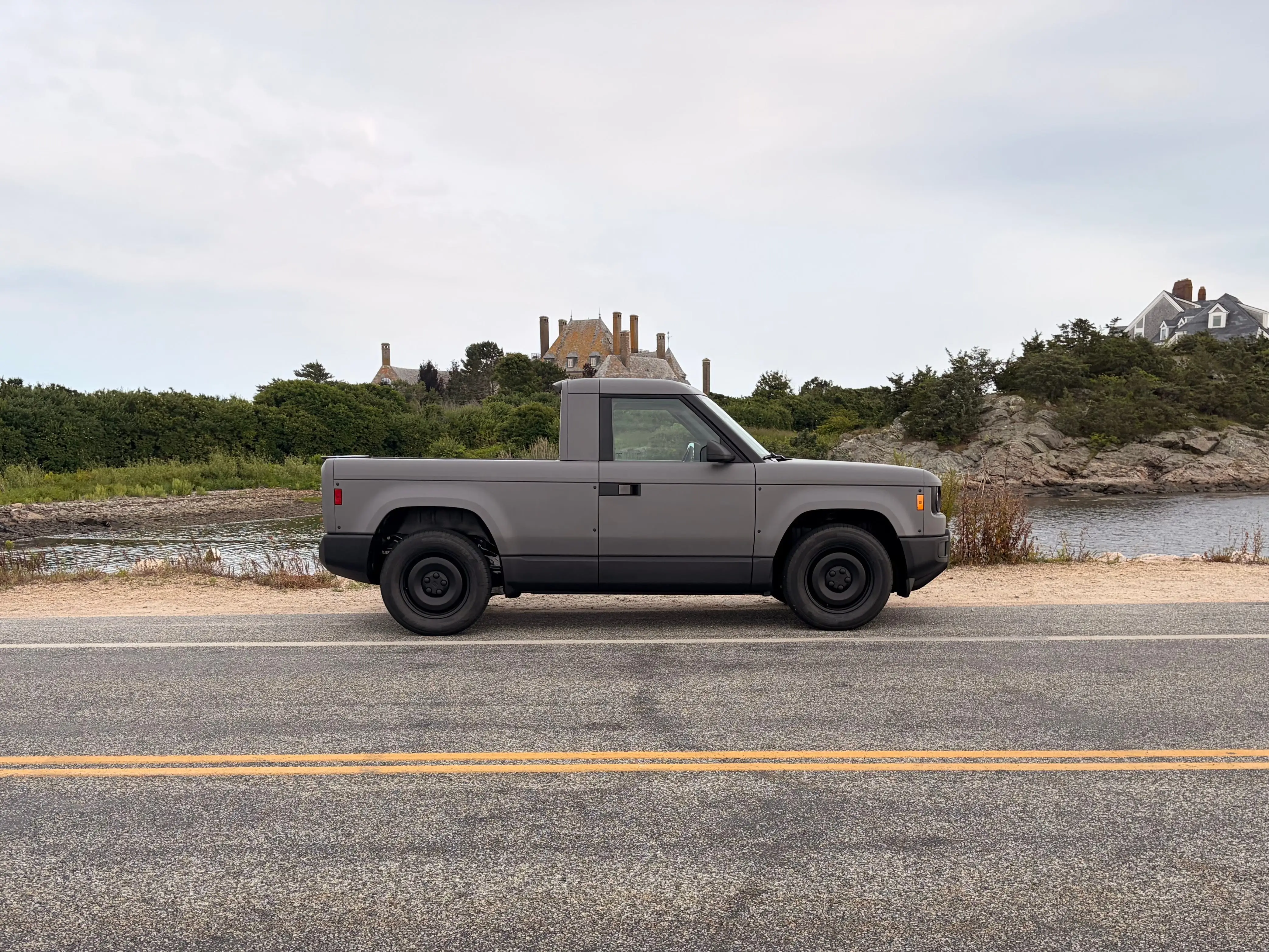
Slate is making a series of wagers that the rest of the auto industry has largely abandoned.
It bet Americans want a smaller truck, can live with two doors, and that drivers are tired of touchscreens, subscriptions, and paying for self-driving options.
Most importantly, it is betting that enough people want a new vehicle starting at $24,950 — roughly half the average price Americans now pay at a new-car dealership.
That makes the Slate easy to explain but strangely difficult to place.
Detroit has spent years prioritizing enormous four-door pickups. Two-door trucks have largely disappeared from the US market, and even Slate buyers who add the company’s SUV conversion and rear seats will have to climb through the front doors to reach them.
Its business model is equally unconventional. Slate hopes customers will keep spending after buying the truck, but not through the monthly software subscriptions that Detroit has recently fallen in love with.
Instead, owners can add speakers, new upholstery, storage accessories, body wraps, and the parts needed to turn the pickup into an SUV. The pitch is less “pay to unlock this software feature” and more “physically build the vehicle you want.”
Slate is applying the same less-is-more philosophy to its cabin presentation. A company representative told me modern, screen-heavy cars have become too distracting, even at the cheaper end of the market.
Perhaps some buyers really are ready for a car that does less in our increasingly AI-ified world — and costs less because of it.
My drive largely resolves one of my biggest questions about the truck’s composure. The Slate is fun, roomy, and far more convincing behind the wheel than its appearance suggests. I could imagine it appealing to fleet operators, small businesses, and buyers who want an inexpensive vehicle they will not feel precious about.
The harder question is whether those groups add up to a mass market.
Slate says its factory will eventually be capable of producing 150,000 trucks a year. Reaching anything close to that number would require the startup to survive an EV market that has already buried Fisker, Lordstown Motors, and Nikola, strained Lucid and Rivian, and cost Detroit automakers billions. Only one automaker — Tesla — has successfully traversed America’s so-called “EV valley of death” to consistent, visible profitability.
Slate believes the industry left several openings that it can follow Tesla’s lead in.
Whether those were genuine gaps — or warnings that other automakers already noticed — will determine what happens next.
Read the original article on Business Insider
The post I drove the Slate truck. Its toy-like looks hide a surprisingly serious pickup. appeared first on Business Insider.