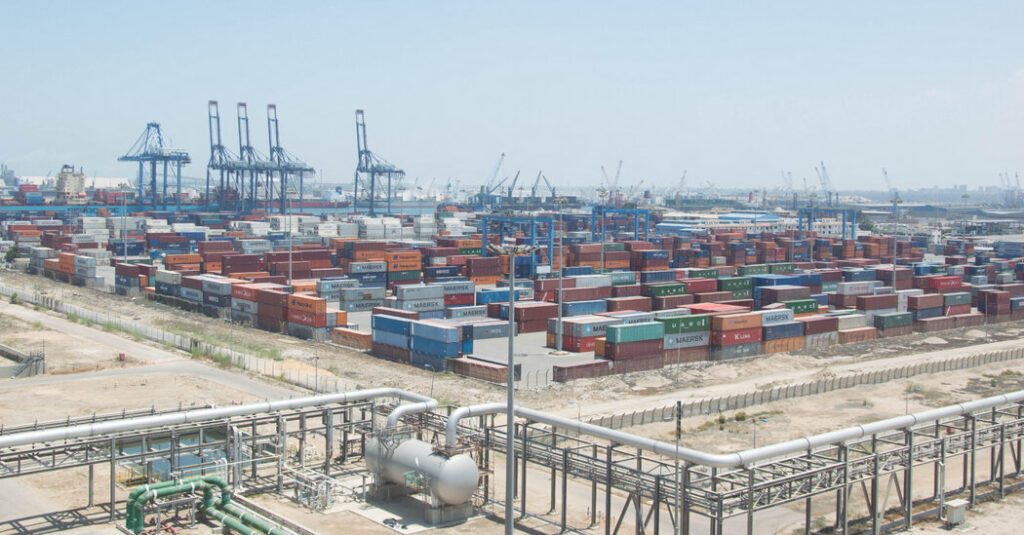
Two ships, one of them a U.S.-owned natural gas storage tanker, caught fire after an explosion at an Egyptian port on Wednesday, broadening the conflict in the Middle East.
Three marine tracking companies reported the incident. One of the companies said the explosion, in the Egyptian Mediterranean port of Damietta, had been caused by a drone attack, though there was no official confirmation from Egyptian authorities or the ships’ owners.
The attack isn’t likely to affect global energy markets as much as those elsewhere in the Middle East because Egypt is not a big exporter of natural gas.
Kpler, a maritime tracking firm, said both vessels had been moved away from the Damietta Port, which is near the Suez Canal on Egypt’s Mediterranean coast. There were no confirmed injuries or deaths, Egypt’s ministry of petroleum said on social media.
Joshua Hutchinson, the chief commercial officer of Ambrey, another maritime tracking firm, said in an interview that the explosion was believed to be caused by a drone attack, which hit at least one of the ships. Ambrey has not identified the source of the attack.
Two Iranians, who asked not to be named to discuss security matters, said the explosion was a drone attack designed to show that global shipping and energy supplies could be more deeply disrupted if Iran chose to escalate. The individuals did not say whether Iran or a Iran-allied militia in the region had launched the attack, or from where.
President Trump told reporters in the Oval Office on Wednesday that he had been briefed on the explosion and implied that Iran was responsible, without offering details. He said the incident was “more of the same” and that the United States was “going to be hitting them very hard, because it’s our turn to hit them.”
By attacking ships in the Mediterranean, Iran could further disrupt trade. Shipping companies would have to assess the risks of using Egyptian ports. Since the Iran war began at the end of February, many ship operators have avoided the Red Sea and the Persian Gulf.
The Energos Winter, the U.S. storage tanker that caught fire, belongs to Energos Infrastructure, a U.S. company based in Stamford, Conn. Jonathan Chia, a representative for Energos Infrastructure, said the company had not been able to determine whether Energos Winter had been hit by a drone. Mr. Chia said that all the crew members had been accounted for, and that none of them had been injured.
Footage circulating on social media and verified by The New York Times showed tugboats hosing down the Energos Winter with water at the Damietta Port.
Energos Infrastructure’s website says the company is owned by investment funds managed by Apollo Global Management, a large Wall Street firm. Apollo declined to comment. The Energos Winter is being leased by Egyptian Natural Gas Holding Company, Egypt’s government-owned gas company.
The other ship, a liquefied natural gas carrier operated by a Greek shipping company, was struck by at least one drone, according to Ambrey.
The vessel, the GasLog Salem, caught fire after an explosion, said Marina Leonidhopoulos, a spokeswoman for GasLog, the operator of the vessel. Ms. Leonidhopoulos said the cause of the explosion was being investigated.
Attacks on ships in two crucial Middle Eastern shipping routes — the Persian Gulf and the Red Sea — have disrupted the passage of oil tankers, jolting global energy markets.
Since March, the war has made it much more dangerous to travel through the Strait of Hormuz, the narrow portal to the Persian Gulf. That has forced Saudi Arabia, one of the world’s largest oil exporters, to rely more heavily on exporting oil through the Red Sea, which was also recently threatened with a blockade by the Iranian-backed Houthi militant group in Yemen.
Those attacks and threats have deterred shipping companies from sending vessels through the region’s waters. The number of vessels passing through Bab al-Mandab in the Red Sea has decreased by one-fifth since July 20, according to Windward, a maritime data agency. Traffic through the Strait of Hormuz remains at less than one-tenth of prewar levels.
Rebecca F. Elliott and Erica L. Green contributed reporting.
The post Two Ships Hit in Apparent Drone Strike at Egyptian Port appeared first on New York Times.