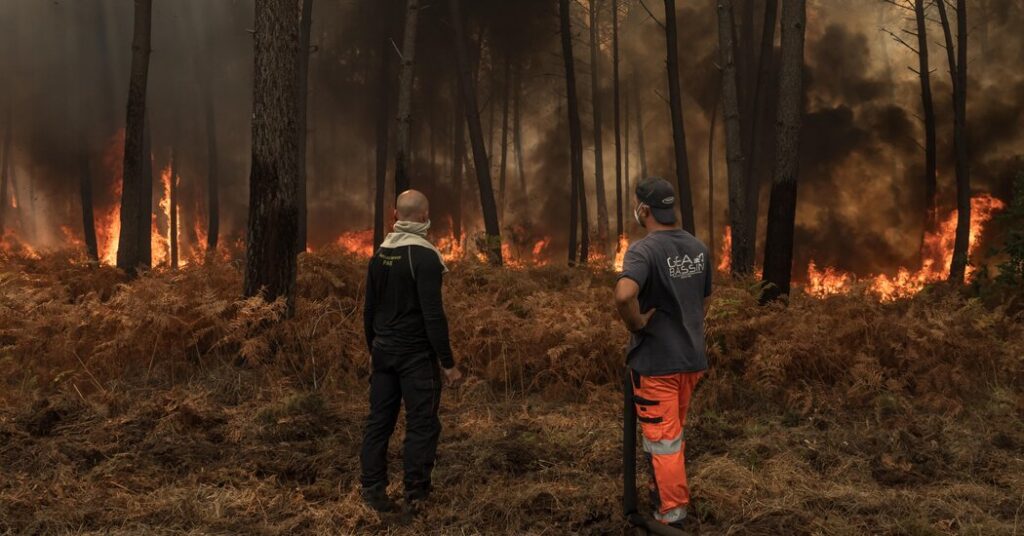
I’m writing this on another sweltering 33-degree day in London; at this point, they’ve almost started to feel routine. We’re watching wildfires consume hundreds of thousands of hectares across France and Spain. This year’s fire season is already breaking records, and it’s not over yet.
Europe has had a rough summer. A season that not so long ago was associated with holidays and relaxation doesn’t feel quite the same when thousands of excess deaths are being attributed to heat. Today, my colleagues Mark Landler, our Paris bureau chief, who’s been covering the fires in France, and Chico Harlan, our global climate correspondent, write about whether we’re witnessing a moment of reckoning for the continent and climate change.
A very bad summer
By Mark Landler and Chico Harlan
Ravenous fires. Searing heat waves. Freakish storms. The summer of 2026 has already shattered meteorological records in several European countries. On a continent that has weathered centuries of upheaval — ruinous wars, deadly pandemics — it’s the weather that now has Europe feeling close to a breaking point.
It has displaced more than 300,000 people in France and Spain, where the largest fires in those countries’ modern histories have led to their largest peacetime evacuations. It has left millions desperate for relief from temperatures that routinely soar above 40 degrees Celsius.
It has forced the cancellation of concerts and festivals, curtailed the final stage of the Tour de France, and closed the Louvre Museum and the Eiffel Tower early. It has brought wildfires to the Scottish Highlands. And it has caused at least 10,000 heat-related deaths across Europe in June alone — a number that may turn out to be an undercount.
The most frightening aspect of Europe’s terrible summer? Scientists say it’s just the beginning.
“It will inevitably get worse,” said Johan Rockström, a Swedish scientist who is a director of the Potsdam Institute for Climate Impact Research in Germany. “It will get worse and worse and worse, to the point where, I’m afraid, we’ll be passing the limits of adaptation.”
The fastest-warming continent
Europe is not alone, of course. Heat waves gripped Australia and Japan this year. Floods devastated Kenya and Angola. A snowstorm paralyzed the Eastern United States. Developing countries in the Southern Hemisphere are still more vulnerable than wealthy European ones to the effects of a changing climate.
Yet no other continent has warmed as rapidly as Europe, which has been heating up at nearly twice the global average since the mid-1990s.
Europe’s status as the fastest-warming continent is a consequence of both changing weather patterns and its proximity to the Arctic, where reduced snow and ice lead to more dark surfaces that absorb heat.
The continent is more than 1.6 degrees Celsius warmer than it was three decades ago, and the rise in temperature is swift enough to be noticeable over a single generation. By the start of this week, France had recorded 53 heat waves since 1947; 28 of them occurred in the last 15 years.
Bordeaux, which is currently being threatened by wildfire, never experienced a day with temperatures at or above 39 degrees Celsius between 1921 and 2000, according to Météo-France, the national climate and weather service. This summer, though, it has happened eight times, and the season is not even half over.
While it is still cooler than other parts of the world, Europe is less able to cope with heat. Its buildings often lack air-conditioning and were built to retain heat. And the homogeneity of the trees on its hillsides and coastal plains makes them dangerously flammable.
All this has forced Europeans to confront, more starkly than others, the harsh realities of a changed climate. But whether this leads to drastic new measures — either to mitigate the effects of a warmer climate or to adapt to them — is another question.
Great urgency — and yet
In Spain, Prime Minister Pedro Sánchez declared a “climate emergency,” which he said would necessitate a state pact to “attack the root of the problem in a structural way.” In France, President Emmanuel Macron vowed to replant the vast pine forests that were burned in the Gironde region over the last week with different species of trees that are better suited to a dry, hot climate.
“The situation we’re in today is the most difficult we’ve ever recorded, the most difficult since World War II,” Macron said.
But for all the urgency, Europe’s commitment to reducing carbon dioxide emissions is in danger of being watered down. This month, the European Union proposed to adjust rules so that some industries could pollute at slightly higher levels, further into the future.
“Net zero” policies, which aim to balance the amount of greenhouse gases released into the atmosphere with that removed, have become targets for critics, particularly those on the right, who condemn them as a luxury that Europe can’t afford during a period of weak economic growth and energy insecurity.
And no matter what Europe does, the global trajectory of climate change depends on China and the U.S. — whose president has called climate change a “con job” — as well as on energy-hungry developing countries.
The planet is already on course to miss the central target of the Paris Agreement of 2015: to hold global warming well below two degrees Celsius compared with preindustrial levels. France’s weather and climate service has said that, by 2050, heat waves could be five times more frequent.
The past few months have been the summer that broke Europe. But they could, in retrospect, come to seem tame.
The latest: Wildfires slowed near Bordeaux and Madrid, but winds are high and temperatures are rising. Spain’s prime minister called the next 12 hours “decisive.”
IRAN WAR
More countries are being dragged into the war
Saudi Arabia entered the U.S.-Iran war yesterday with airstrikes in Iraq that targeted Iranian-linked militias. Iran launched an attack on sites in Jordan, and Iran-allied groups in Iraq and Yemen joined the fighting.
A U.S. official said that U.S.-Saudi strikes in Iraq had killed about 20 Iranian advisers and diminished the ability of Iran-backed militias to launch missiles and drones. This week, Saudi Arabia has faced dozens of drone attacks against its oil facilities, and the Iranian-allied Houthi militia in Yemen said it had targeted a Saudi oil tanker in the Red Sea on Tuesday.
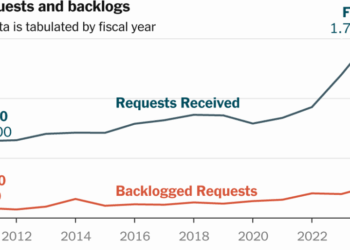
Whiplash war: The image above shows how the U.S. and Iran have gone back and forth between war and cease-fire.
LIFE INSIDE CUBA
Jack Nicas reports on how Cubans are getting by during the U.S. oil blockade. Watch the video.
MORE TOP NEWS
-
At least 13 people were killed in the earthquake that struck Japan on Tuesday. More than 200 aftershocks jolted some areas as rescue teams worked to free people trapped in collapsed buildings.
-
Russia charged Pavel Durov, the founder of Telegram, with facilitating terrorism.
-
Israel bombed a mosque in Gaza, accusing Hamas of using it to store weapons. Hamas denied the claim.
-
In an interview with The Times, Mark Zuckerberg blasted Anthropic and OpenAI, which are pushing to control A.I. development.
-
President Trump’s tariffs are sending some U.S. factories back to China.
-
U.S. immigration agents in plain clothes are arresting foreigners with expired visas at U.S. airports.
WHAT ELSE IS HAPPENING
-
Glen Hansard, the frontman of the Irish band the Frames, died in a motorcycle crash. He was 56.
-
BTS is boycotting the Grammys after a new category for best Asian pop performance was introduced.
-
Qantas plans to debut Project Sunrise, the world’s longest commercial flight, next year from Sydney to London. Here’s what it takes.
TOP OF THE WORLD
The most clicked link in your newsletter yesterday was about food monotony.
SPORTS
Football: Sidny Lopes Cabral of Cape Verde won the 2026 World Cup goal of the tournament for his equalizer against Argentina.
Swimming: Adam Ramsay-Peaty is at the center of a family feud after his marriage to the daughter of Gordon Ramsay, the celebrity chef.
BICEPS OF THE DAY
Matt Damon’s stunt double
You might be surprised to learn that the strong arms holding up a sword and ready to attack giants in a pivotal scene from “The Odyssey” aren’t Damon’s, but rather those of his stunt double — and that his stunt double is a woman. She’s Devyn Dalton, a Canadian who is much shorter than the actor. In an interview, Damon praised her work and said she had “the greatest arms I have ever seen.”
MORNING READ
Many children’s books have been published in Ukraine since the war began, all aimed at helping children and their parents cope with its trauma. Their subjects include the anguish of family separation and the terror of bombardments.
“Through books, we can live through it,” said Iryna Bilan, whose two sons have read the war stories. “So my children don’t store it deep inside, so it doesn’t linger in the background and keep them from living, from being children.” Read more and see the gentle illustrations.
AROUND THE WORLD
Building better cities, one block at a time
In the blocky, 3-D world of Minecraft, players can build and destroy structures as they like. But they can also reimagine real ones. And that’s getting players, especially younger ones, involved in redesigning urban areas.
When the 2020 port explosion in Beirut damaged a historic outdoor stairway, for example, a Minecraft workshop helped redesign it with new features like a slide and shaded seating areas. “The stairs are no longer a place just connecting two places,” one design student said. The area became “a destination in itself.” Read more about how young people are getting involved.
RECOMMENDATIONS
Travel: Here are six canal cities to consider, beyond touristy Amsterdam and Venice.
Shade: Statement sunglasses are the accessory of the moment. Take this quiz to find the pair that best suits your personality.
Swoon: Sam Smith rose to fame with songs about heartbreak. On their upcoming album, they give love a try.
Care: How you treat your body in your midlife years can influence how you age. Experts say these small habits can make a big difference.
RECIPE
Pastel Azteca, sometimes called budín Azteca, is a baked casserole that’s similar to lasagna, but made with corn tortillas. Every Mexican home has its own version shaped by region, budget and family tradition. The dish is warm, saucy and comforting.
WHERE IS THIS?
Where is this waterfall?
TIME TO PLAY
Here are today’s Spelling Bee, Mini Crossword, Wordle and Sudoku. Find all our games here.
That’s it for today. See you tomorrow! — Alicia
Mark Landler and Chico Harlan were our guest writers today.
We welcome your feedback. Send us your suggestions at [email protected].
The post The Summer That Broke Europe appeared first on New York Times.