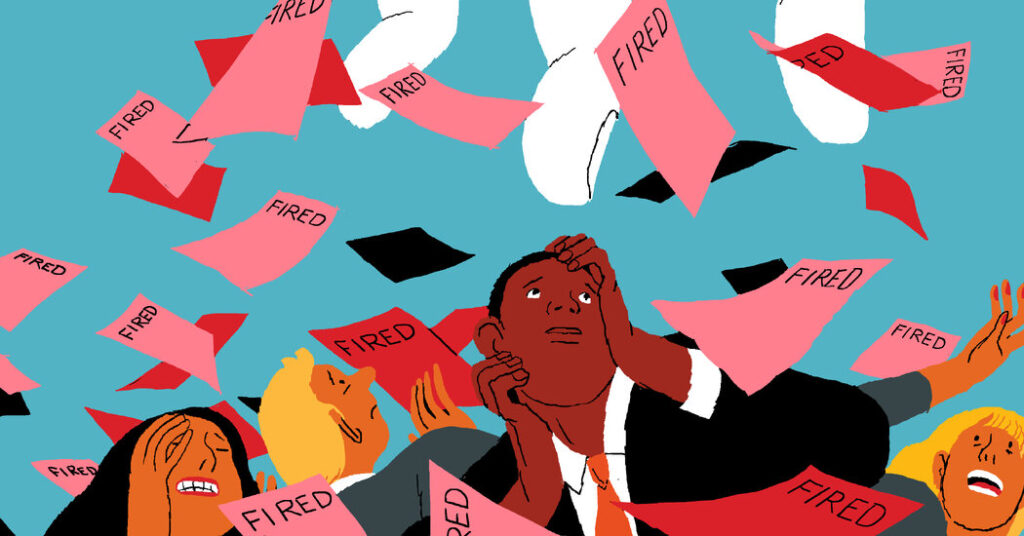
Since I began a series on the painful hunt for a job in 2026, I have been collecting examples of Trump administration decisions that may be putting a damper on hiring. Uncertainty creates a level of fear and paralysis among employers that is difficult to fully quantify. But the following stories, collected over just a few weeks, provide some recent examples of how President Trump’s arbitrary and vindictive leadership style has negatively affected the job market since he came back in office.
First, there’s the baffling 50 percent tariff on some Canadian goods that the president announced on July 20, which comes after analysis from both the right and the left that found last year’s tariffs to be a disaster for job creation, particularly in manufacturing and construction.
Then there are the cuts to federal funding, which tend to affect higher education, scientific research and nonprofit work. Proposed or reported cuts to grants are putting groups that are fighting H.I.V. and trying to prevent teen pregnancy through sex education at risk of closure. And if you wonder whether there are political motivations at work here, the Trump administration admitted that it canceled grants to blue states for clean energy projects just because those states voted for Kamala Harris in the 2024 election.
The administration’s war on civil society is not stopping. There is also a proposal to make all federal grants subject to political review by Trump appointees, which is getting pushback from a wide range of professionals from law enforcement to civil engineering.
The left-leaning Center for American Progress estimated in April that “labor demand, proxied by job growth, suffered greatly from the Trump administration’s policies, down about 1.2 million jobs last year and two million jobs this year.” The low hire, low fire state of the job market and the general sense of economic instability is not entirely the administration’s fault — the uncertain future impact of artificial intelligence sure isn’t helping, for example — but Trump’s choices create fresh pain and disarray that are largely unnecessary.
The economic impacts of federal layoffs have been felt most acutely in the Washington, D.C., metro area, but Trump’s capriciousness is extending to other parts of the country. Even if you believe that the federal government should be smaller, these cuts have often been carried out in a maximally unpredictable way that leaves people on edge.
The Philadelphia Inquirer’s Kayla Yup published a story on July 22 that perfectly illustrates the harm that Trump has wrought. Multiple Philadelphia-based medical researchers had their grants from the Agency for Healthcare Research and Quality, which sits under the Department of Health and Human Services, cut with very little explanation. The total cuts are estimated at over $200 million, and Dr. Scott Halpern, who is the founding director of the Palliative and Advanced Illness Research Center at the University of Pennsylvania, is one of the grantees affected.
Halpern’s grant was funding research that trained clinicians on how to better care for patients so that their medical care can be more efficient, safe and equitable. “We look at ways to ensure that people, regardless of the color of their skin or the size of their pocketbooks, are appropriately referred for specialty services. For example, if they’re showing early signs of dementia,” he told me over the phone. Dr. Halpern said that PAIR also studies physician communication and burnout and quality of hospital care, so that it can ensure patients don’t get woken up in the middle of the night for no good reason or have other unnecessary and unpleasant experiences while they’re in the hospital.
This sounds like pretty important research to me, but earlier this month, Halpern received a notice that his $5 million grant, which was supposed to be paid out through 2028, was canceled, because it was no longer in “the best interest of the federal government.” He was not given any additional information. But the way the department of Health and Human Services has been operating under Robert F. Kennedy Jr. was affecting PAIR’s hiring practices long before this latest blow. The center stopped creating new positions months ago, and put a pause on backfilling empty jobs. But now they’re starting to talk about layoffs, too.
Halpern described the experience to me as “soul-crushing.” It doesn’t just mean that people currently employed might lose their jobs, but it’s also preventing him from mentoring the next generation of research scientists. The loss of the work those young scientists might have done and the jobs they might have created is immeasurable, even if there have been attempts to quantify it. “For every dollar that comes in to an investigator at Penn, we’ve estimated that the impact on the Philadelphia economy is a bare minimum of $3 and could be as high as $5.”
Researchers at the University of Maryland created the Science & Community Impacts Mapping Project, which attempts to quantify the knock-on economic damage from the Trump administration’s proposed scientific funding cuts for the next fiscal year. The map can be broken down by congressional district, but these funding cuts aren’t restricted to blue states or districts represented by Democrats. Florida’s Third Congressional District, which is in the northern part of the state and includes the University of Florida, would jettison an estimated 1,000 jobs, and the total economic loss would be over $240 million.
That’s just projected future loss. So many job seekers are in a painful limbo now because of the administration’s choices. Steve Falbo, who is trained as an emergency medical technician for those with severe mental health and substance abuse issues, was laid off from his job working at a nonprofit in the Bay Area.
Falbo, who is a single dad to a high-school-age daughter, would like to keep working in mental health crisis response. But he told me that the federal funding cuts happened on “such a grand scale” that finding a new role has been challenging. Funding for mental health services was already in a fragile state, and cutting Medicaid and health-related grants only makes it worse. Falbo told me that he’s considering moving into becoming an emergency dispatcher, so he can still help people who are struggling, even if it’s in a less hands-on way.
The concentric circles of ruin keep rippling out from Trump’s disastrous policies. They might start with cutting line items from a spreadsheet and sending jargon-filled notices to scientists, but they extend to families who can’t pay their mortgages because their entire professions feel as if they have been hacksawed, patients who will receive worse care because their clinicians won’t receive the information that might have helped them and people in acute crisis who will be left to suffer for hours because expert E.M.T.s are no longer employed.
But don’t worry, Trump’s taking some of that money that could have saved or changed lives and offering to plow it into artificial intelligence, robots and space exploration. Maybe they’ll offer employment on the moon.
End Notes
-
I laughed out loud multiple times at “The Invite,” the star-studded dark comedy about a dinner party gone awry. Angela (Olivia Wilde, who also directed it) and Joe (Seth Rogen) are an unhappily married San Francisco couple stewing in their own shared disappointments when they invite their upstairs neighbors, Piña (Penélope Cruz) and Hawk (Edward Norton), to dinner. It has the energy of a 1930s screwball with some very 21st-century details. I would try to catch the movie in theaters while it’s still there, because it was a very fun movie to watch with a similarly appreciative crowd, and some of the slapstick moments play best on the big screen.
Feel free to drop me a line about anything here.
The post Trump’s Chaos Is a Job Killer appeared first on New York Times.