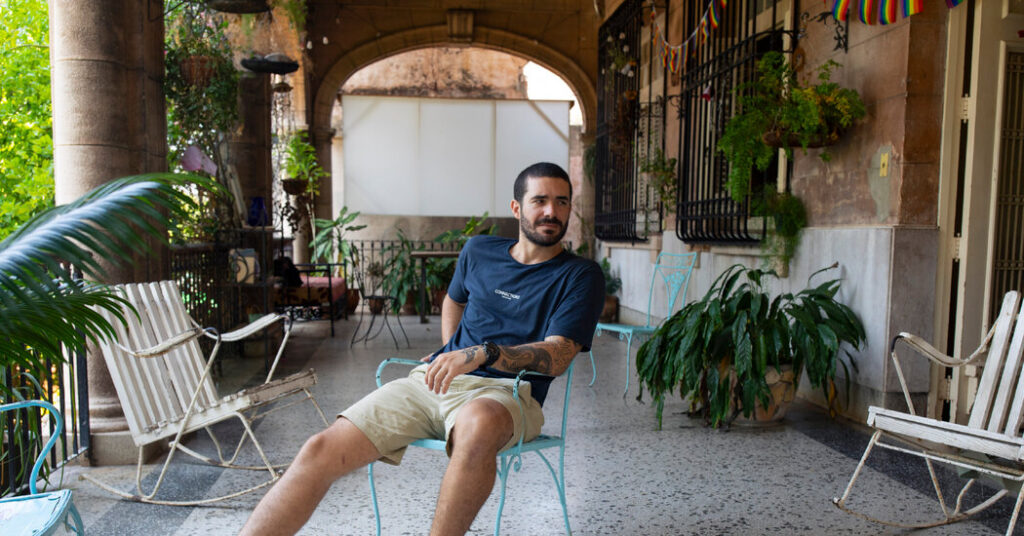
The power in Havana was out again and the neighborhood was pitch dark, save for the vine-covered home on the corner with the bikes out front, a bar in the back and an eight-piece band playing on the wraparound porch.
The 29-year-old host, David González, squeezed through the crowded dance floor in his family’s former living room, past the mural that asked “How much longer?” and headed down to the basement to check on the beating heart of the party.
The single 10,000-kilowatt-hour battery he had imported from Spain was powering everything — the lights, refrigerators, speakers and amps — and still had 43 percent left. It was only midnight. “Without this guy, we’d be lost,” he said.
It is that battery, and Mr. González’s spunk, that has turned his childhood home into one of Havana’s hottest venues amid Cuba’s worst-ever energy crisis, as well as the petri dish for a budding political movement.
Over the past six months, as the Trump administration’s oil blockade has helped plunge Cuba into darkness, Havana’s nights have been lit up by Mr. González’s weekend parties. Every night from Friday through Sunday, his home has become the go-to gathering place for the city’s young artists, activists and intellectuals, part of a larger cultural initiative he calls El Proyecto, or The Project.
In Cuba — where citizens are monitored, criticism of the government is punished and political movements are repressed — the events themselves are a form of resistance.
“There’s no better way of being against this government than being happy,” he said. “They want you to be frustrated, they want you to be angry. But actually the less hate, the less anger you have inside, the better to confront them.”
“So that’s the way we fight,” he added. “All good mood and all good vibes.”
Washington’s pressure campaign is pushing the Cuban government to the brink, leading it to shut off power to most of the country for all but a few hours a day, if that.
That has snuffed out Havana’s famously bright nightlife scene, including the closure last month of its most revered cultural institution, the Fábrica de Arte Cubano, or Cuban Art Factory, an art and music venue in a converted factory.
In its place has arrived El Proyecto. What began as film screenings last August has now grown into concerts, art exhibitions, lectures, dance parties and, increasingly, political debates and protests against the Cuban government. Amid the blackouts, there is virtually no other place like it in Havana.
“Imagine living in a desert: The sand burns you, you’re lacking water and you really don’t know which way to go,” said Fito del Rio, 31, a musician who got married on Mr. González’s porch in April. “And then there’s a place that represents all the rest that you need — where you can arrive, drink water and suddenly feel like the sand isn’t burning you.”
“That’s this space,” he added. “It’s an oasis.”
At the front of the movement — and sometimes charging the 50-cent admission at the party’s front gate — is Mr. González. Gregarious and laid-back, he moves around the overwhelmingly Gen Z crowd with intense positivity, hugging regulars, welcoming newcomers and taking turns on the Ping-Pong table on the porch. As the night drags on, the topic often turns to politics.
“There’s a Cuba that’s dying at the same time a new Cuba is being born,” he said. “Their symbols, their culture, their slogans, their older hatred and violence. It’s dying. And they can’t stop the new Cuba, because there are so many people resisting and creating and dreaming.”
In some ways, Mr. González was trained for this. He left Cuba for London in 2022 to get a master’s in political communication, and said he has long studied nonviolent political movements and how they succeed.
Now that it has gained momentum this year, Mr. González wants to transition El Proyecto into a more politically active phase. On July 11, the fifth anniversary of the last mass protest against the Cuban government, he and his girlfriend curated an event with the theme of creating change in Cuba. The word “freedom” hung from the ceiling as a performer held knives to another’s throat and a graffiti artist wrote on the wall, “The feeling of collapse is part of the system.”
Attendees banged pots and pans — the most common form of protest in Cuba — and shouted, “Down with the dictatorship.” Mr. González said a government agent eventually arrived and warned him that he had better be careful.
“I know I’m taking risks,” he said. “But I’m not going to self-censor the things I dream and the things I want to do because of fear.”
The Cuban government has long selectively enforced its rules, which restrict most gatherings. This year, the government has tolerated and even acknowledged the frequent banging of pots and pans across Cuba’s cities, but it has also arrested some people who have protested on the street. Cuban officials have said the protests should be aimed at the United States, not at them.
Mr. González acknowledged that after this article, he would likely attract more attention from the government. “I believe fearing them would be letting them win,” he said. “And I’m tired of them winning.”
Attendees at his parties described Mr. González as an inspiration.
“David is a dreamer. He’s a person who doesn’t just stay on the couch and suffers with the rest of us. He wants to be part of the change,” said Charlie Barreras, 27, a Havana tour guide who has become a regular at El Proyecto. “He’s a leader, and all of us, we follow him.”
Mr. González bristles at the idea of formally leading a movement. “I don’t want power,” he said. “I just want to be useful.”
But he admitted that El Proyecto’s success has given him an opportunity. “I want to capitalize on that,” he said. “To turn that happiness into change, I believe we have to learn to articulate ourselves, how to organize ourselves and how to transform.”
Still, he lacks concrete plans on next steps. He said he has had small partnerships with the British and French Embassies but has no interest in working with the U.S. government, which frequently supports Cuban activists. He questioned President Trump’s intentions toward Cuba, believing the president would exploit the island for himself and not empower the Cuban people.
“People are so desperate for a change that they believe Donald Trump is going to be their savior,” he added. “They haven’t realized yet that the saviors are themselves.”
A White House spokeswoman called Cuba a national security threat and said the Trump administration wants to help the country, but the Cuban government is standing in the way.
Carlos Fernández de Cossío, Cuba’s deputy foreign minister, said in an interview: “There’s one aggressor, which is the United States, and one country under aggression, which is Cuba.”
Mr. González, and many attendees at one of his recent parties, thought both sides were to blame.
El Proyecto’s headquarters is a nearly century-old home that once belonged to a rich family, Mr. González said. It was confiscated by the government after Fidel Castro’s revolution in 1959, he said. Mr. González’s grandmother, who was a teacher and fierce revolutionary, then bought the first floor from the government over 20 years.
Mr. González said that about a decade ago, two Florida women who said they were descendants of the home’s original owners came to take photos of the property, suggesting their family was the rightful owner and could one day reclaim the house.
After Mr. González’s grandmother died in 2021 and left the house to his mother, the family considered selling it. Nearly all of them had fled Cuba.
But Mr. González persuaded his mother to keep it, and then, in 2024, he returned from London to move back in. He said that he felt abandoning his country seemed like submitting to the government. “I wanted to send a message that you can live in Cuba and do things in Cuba if you really want to,” he said.
Although many young Cubans have left the island, Mr. González said any event at his home shows that plenty also remain — and are ready for change.
“We don’t know yet how we’re going to be a part of that change, but something inside of us is telling us not to leave,” he said. “They want to witness what’s about to come.”
The post The Cuban Throwing Parties to Fight for Political Change appeared first on New York Times.