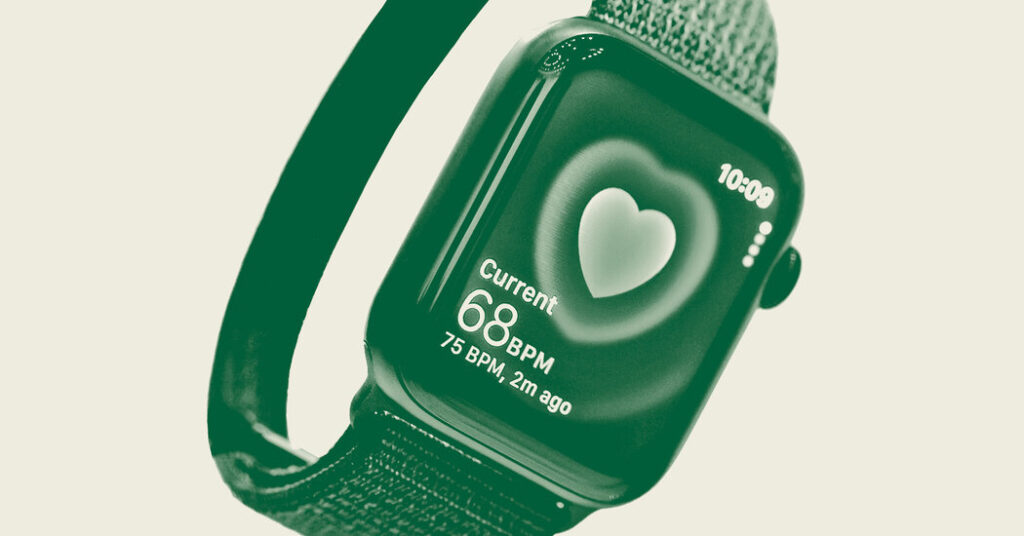
Americans have spent billions of dollars tracking themselves: their steps, their blood oxygen saturation, their sleep cycles, their glucose levels. Is any of this data making us healthier?
That’s the question the Opinion writer David Wallace-Wells poses to Dr. Rachael Bedard, an Opinion contributor and primary care doctor. In this episode, they explore what tracking ourselves, versus the population at large, can teach us and our doctors, and whether artificial intelligence might one day make sense of all of this data.
Below is a transcript of an episode of “The Opinions.” We recommend listening to it in its original form for the full effect. You can do so using the player above or on the NYTimes app, Apple, Spotify, Amazon Music, YouTube, iHeartRadio or wherever you get your podcasts.
The transcript has been lightly edited for length and clarity.
David Wallace-Wells: So, Rachael, a little while ago, you got into a little spat online. Tell me what that was about.
Rachael Bedard: Yeah. So a few weeks ago, a start-up in San Francisco announced that it was going to launch a new product, which is a whole-body imaging technique. It led to this really interesting, kind of nasty at times, discourse between medical doctors like me and folks in tech. And that conversation came down to doctors being very wary that this kind of data can sometimes cause more harm than good, and folks on the tech side saying basically, how can more data ever be bad? Isn’t more data always helpful in informing decisions, research, etc., etc.? And it led to this conversation between you and I — is more data about your body always good?
Wallace-Wells: That’s the question that we’re going to be talking about today in a bunch of different ways. It’s not entirely new. People have been trying to track data about their body and their health forever, in more systematic ways, maybe, over the last 10 years. But the prospect of A.I. really changes the landscape here, and makes us think again about what the future holds.
Clip of Dr. Peter Attia: Is it science fiction to imagine that there will be a day when an A.I. can predict 20 years in advance when the person is staring down the barrel of a neurodegenerative disease and act at a time when we could actually reverse it?
We’re now looking at a future where many people are telling us that machine learning can process huge amounts of data much more quickly, much more intelligently than anyone has before, and essentially learn things about how we are living, what health is, what illness is, and how we might be able to do better to manage our health going forward.
So before we talk about the very now and the distant future, let’s talk a little bit just about the recent past. Over a couple of decades, doctors have become a little bit more skeptical than I think the average layperson about the possibility that knowing more is always good. Tell me about where that came from, what that suspicion arises around, and what normies like me don’t understand.
Bedard: Yeah. So I think there are a few factors here. One is, over the last several decades, our ability to collect data about the body has taken off radically, right? So imaging techniques, blood tests, tracking devices — all of these things can provide so, so much information that may or may not correlate in any meaningful way to what people feel in their bodies, how they’re functioning, their clinical outcomes. When you’re talking about studying people who feel healthy, to see if actually they might be sick, you’re talking about screening a healthy population for hidden pathologies. And there have been lots and lots of studies over time to try to do this, and what we have found is that the results are really mixed.
So the most famous cautionary tale is, in South Korea, in the early part of this century, they instituted a policy where they were screening universally for thyroid cancer with thyroid ultrasounds. Thyroid ultrasounds — noninvasive. They don’t cause any harm. Fine. What they found, though, when they followed that experiment over time was that the incidence of finding thyroid cancer went up 15 times, and it made no difference to mortality from thyroid cancers. Which means that you’re basically finding 15 times more cancers that weren’t actually clinically significant, that weren’t going to hurt people. And that’s ——
Wallace-Wells: Well, let me just pause there. Like, how is that?
Bedard: Like, how can that be?
Wallace-Wells: How can that be? I mean, I understand that there are some things that are below a clinical threshold, which maybe we don’t want to worry about. But how can it be that when we see so many more cases of something, it doesn’t have any population-level benefit?
Bedard: It could be in two ways: One thing is that there are just absolutely indolent cancers that can sort of exist in small, very, very, very slow-growing ways that are just not going to ever become clinically significant in a person’s lifetime, like prostate cancer. There’s this old adage that more men die with undiagnosed prostate cancer than get diagnosed with it in their lifetime.
Wallace-Wells: Yeah, I’ve heard people say that we shouldn’t even talk about it as a cancer. We should treat it as something else.
Bedard: Right.
Wallace-Wells: Because the word “cancer” scares people into treatment.
Bedard: So that’s one thing. The other thing is whether or not screening, when somebody is asymptomatic, is actually useful, right? So it may be that if you wait until people’s thyroid cancer becomes clinically significant — until it’s found because they have symptoms or on an exam of their neck — if you wait until then and intervene at that point, it’s fine. The vast majority of thyroid cancers are caught pretty early, and when they’re caught, they’re very treatable, and people do really well. And so there may be no additional benefit to catching them way earlier.
That example, that cautionary tale, does not mean that we’ve closed the case on how we should look for thyroid cancer forever, right? But it means, given the screening technique that we know how to use now, applying it at the population level to asymptomatic people seems to have no clinical benefit, and instead causes a fair amount of harm. Because that fifteenfold increase in cases means follow-up surgery, biopsies, surgeries and all of those things.
Wallace-Wells: One big question that I have about this is — not just about thyroid cancer, but the question of what we can learn about the body in general — if we look at the state of play now and we say, given the treatment techniques we have, given the screening techniques we have now, expanding our screening to the whole population isn’t going to have a benefit, is that because we already know everything there is to know that is useful about such a disease or other diseases, or is it something about the limits of our screening? In a future where we could zoom down, have much more information about particular cancers, presumably, more data would be good, right?
Bedard: It really matters if you know what you’re going to do with the data. So let me give you an example, that’s a more live question, which is screening for Alzheimer’s disease.
Alzheimer’s disease, incredibly prevalent, clinically devastating, on the rise, right? And until relatively recently, we had very few interventions to offer people if you knew that they were at increased risk for Alzheimer’s. We didn’t have anything that made the disease slow down or reverse its course.
In the last 10 years, we have found both new screening techniques, blood tests that can find evidence of early plaques in the brain, basically, that are developing well before you have any clinical symptoms. And the other thing that’s happened in the last 10 years is that for the first time, there have been new approved treatments for people who are in very early stages of Alzheimer’s.
That’s a total game changer, because in that case, if you’d had that blood test 20 years ago and you didn’t really have anything to offer people, the rationale for screening would be really low, right? Because you would say, you’re just going to tell people this. They don’t know that for sure it means they’re going to get Alzheimer’s, but it maybe freaks them out for the rest of their lives.
Alzheimer’s is in my family. I would never have gotten the screening test 20 years ago. It’s really different if you have an intervention to offer people that may be meaningfully disease-modifying. And so the question of whether screening is useful and the data is useful also goes in tandem with what are you going to do with the result when you get it.
Wallace-Wells: So what’s the big problem with this particular full-body scan that we’re talking about today? Why is this an example of something that is going to give us information that is not useful — maybe counterproductive as opposed to helpful — to the people who are getting it?
Bedard: Yeah. So embedded in that question is the whole thing.
Wallace-Wells: Yeah. OK. So let’s unpack it.
Bedard: Let’s unpack it. So the first thing is, when you talk about it being helpful to the people who get it, it really depends on what the person’s getting it for, right? If you are like, I don’t know, Joe Rogan, and you’re a fitness-obsessed gym bro, who is working out several hours a day and really obsessively tracking your diet and all of these metrics about yourself, and you want to collect these images because you want to be able to see the relative proportions of muscle to body fat in your body — a whole-body ultrasound’s probably OK for that.
And if that’s something that Joe Rogan finds meaningful on a personal level to himself — he’s like, this makes me feel better about the way that I’m taking care of myself — then go with God, Joe Rogan. Enjoy. You know? And that’s what the company is saying right now.
The company’s saying that this is not for medical use — this is a general wellness thing that people can use in order to track their body composition. That’s a really different prospect than the way in which this conversation about it online was extrapolating the potential benefits of such a technique, which were like: You’re going to be able to get a monthly scan that will track the appearance of abnormalities in the body that may or may not be clinically significant and make sense of them.
And that becomes a problem for a few reasons. The first is that we know, when we scan people, that we’re finding stuff in their bodies all the time that we don’t know what it means. We call them “incidentalomas” because they’re incidental findings that are of totally indeterminate significance.
We’re always finding schmutz on people’s adrenal glands. And there are guidelines about how big the schmutz has to be for you to decide that you’re going to scan again, and at which interval, etc., etc. But that stuff’s meaningfully costly and potentially harmful because, again, you have to pay for scans with time and money, you get biopsies, all of these things that are potentially harmful without any benefit.
So that’s one reason that it makes doctors really nervous. The other reason, I think, that it makes me really nervous is because this is part of this larger trend of direct-to-consumer access to medical testing, or what is sort of medical testing adjacent, right? There are also companies where you can be ordering your own lab panels and then getting back all of this blood work. And whether or not that’s meaningful data about your health is hard to say. And once you get it back, when there are abnormal values, your next step is that you’re taking it to your doctor and saying, “This seems to say that these values are off. Like, what am I going to do about it?”
Wallace-Wells: Well, some people go to a doctor, but also a lot of people are just monitoring it themselves, right?
Bedard: Well, monitoring or taking action on it themselves.
Wallace-Wells: Yeah.
Bedard: What’s that, right? Like, what are they doing?
Wallace-Wells: And there’s a conceptual shift that’s happened, where previously they had assumed that they were in relatively good health. They start to see some indicators that may or may not mean anything, but they’ve already stopped thinking of themselves as being in good health and started thinking of themselves, if not unhealthy, then on some spectrum of wellness and performance in which ——
Bedard: Totally.
Wallace-Wells: They maybe should be doing better, they should be addressing this or that. And whether or not those improvements will actually help their well-being in the long run, they’re already mindful of what they could or should be doing. So they’ve already redefined their measure of wellness from “How am I feeling?” to “What does my watch say about how I’m feeling?”
Bedard: Totally. Totally. So in preparation for our conversation today, I have been wearing — for the first time in my life — a fitness tracker, a sort of watch-type device, for the past week.
Wallace-Wells: You’re really a late adopter.
Bedard: I’m a really late adopter, and I’m also ——
Wallace-Wells: Although I’m a Luddite. I don’t have anything. You don’t have anything. So ——
Bedard: You don’t have anything. Yeah. You’re just vibes in David Wallace-Wells’s body.
Wallace-Wells: I’m doing great.
Bedard: Not me. I’ve been tracking my data for a week, and I cannot make any sense of it. Last night, it told me that I had a bad sleep, but I felt I had a great sleep. And I really did look at the data this morning, and I was like, “Well, what does it know that I don’t know about what was happening?”
Wallace-Wells: You did have that feeling. You didn’t have the feeling of like, “I know better than this watch.”
Bedard: Well, I was like, “I feel pretty good. Two nights ago I slept terribly.” And the watch thought it went fine. And then, this morning, the device thinks that I slept badly, and I woke up feeling much better. And mostly I’m going to defer to my own experience, but I did look at the graph to be like, “What does it know that I don’t know?”
I mean, there’s data that’s come out of this, saying that there’s a placebo effect and a nocebo effect to all of it, right? Which is, if the device suggests to you that you had a bad sleep, people experience more tiredness that day, whether or not it’s true.
Wallace-Wells: Yeah. It reminds me a little bit of some of the conversation around mental health and diagnostic inflation — the idea that once we have supplied the public with knowledge about what constitutes depression or anxiety, once we’ve lowered the taboos against those diagnoses, probably that’s all to the good. But there are also some people who would have thought of themselves as healthy previously, who now understand themselves as struggling or mentally ill, and the effect that it has on their lives is ambiguous.
Bedard: Yeah, I mean, and that gets to, I think, the benefit and the peril of the wearable phenomenon. A study in The Journal of the American Medical Association found that 40 percent of Americans reported wearing a wearable in 2024.
Wallace-Wells: That’s so much.
Bedard: And the promise and the peril of it is that mindfulness is actually pretty important. The peril is what you just described, or what I just described about my sleep: It gives you data that says, “Actually, you don’t feel that good. Actually, your resting heart rate’s kind of high,” and you’re sitting there thinking, “But I don’t feel anxious. I feel fine.” And it gets you worrying. And that can obviously get into a pretty vicious circle pretty quickly. On the other hand, the benefit of wearing something like this is that it can offer you data that then does the opposite — that puts you into a virtuous cycle.
So, like step counters: There’s data for step counters that says that it does encourage people to walk more when they’re tracking because ——
Wallace-Wells: Right.
Bedard: It gamifies getting exercise. I mean, the thing that I have found most useful about this past week’s experiment has been tracking my steps and thinking, “Well, I really do want to hit a certain number every day,” and like, “I’m going to get one more walk in to get there.” And that obviously is the benefit.
Wallace-Wells: So there’s a lot of stuff going on here. There’s a sociological story about the people who are drawn to this. Why are people drawn to these measures of self-optimization, and why are they starting to see their body in terms of data that can be extracted?
Also, to what extent is that really a phenomenon of achievement culture among the well-off, versus something that might be extended profitably through the rest of the population? There’s that whole bucket, like a kind of cartoon Bryan Johnson; like, I’m going to ——
Bedard: Do you want to say who Bryan Johnson is?
Wallace-Wells: Bryan Johnson — I mean, it’s amazing — he’s a tech entrepreneur who has devoted himself to the pursuit of longevity and maybe even living forever.
Bedard: Yeah, never dying.
Clip of Bryan Johnson: The thing I care about the most is what my heart rate is before bed. Your goal in life now is to lower your heart rate. And so, the way you do that is, one, you have your final meal of the day four hours before bed.
Wallace-Wells: And he started out as, like, a cartoon character who everybody was comfortable mocking for being so outlandishly committed to self-monitoring, self-optimization at the expense of all other human pleasure.
But he’s, I think in the last year, become lovable as a completely unapologetic embodiment of something that, I guess, so many more of us are doing anyway. And we’re glad that he’s doing it in a cartoonish way, so uninhibited, maybe so that we can feel better doing it in a slightly more neurotic way ourselves.
Bedard: The other thing about Bryan Johnson is — I mean, he’s definitely so like the ur-example of this n-of-1 experimentation that, I think, goes on with this data collection, which is, you know, “I am going to track all of these things about myself and then make these modifications and then track what the modifications do.”
And the fact that there’s data around it, like it’s supposed to make it not anecdotal evidence, but like n-of-1 is n-of-1, right? And you can’t actually tease apart causation and what is just placebo effect in all of these things, when it’s just your one body, right? Like we have randomized control trials exactly because one person’s experience is not enough to extrapolate to know things about the human body as a universal phenomenon.
Wallace-Wells: Pulling back from the n-of-1 problem, I struggle to understand how to make sense of statistics at the population level, too. Like, if I’m reading about my father’s cancer or whatever, or I’m talking to his doctor and his doctor’s like, “This person has a 20 percent chance of surviving this year,” I’m wondering to myself, does that 20 percent describe a matter of chance? Does it describe something fundamental to his biology which we don’t understand, which we’re choosing to describe by treating it as a matter of chance?
And theoretically, if we could know more about this cancer, and this man and his history, would we be able to produce an n-of-1 assessment of what will happen with a particular cancer treatment over time? In other words, are we dealing with the irreducible epistemological mystery of the body, or is it conceivable that, perhaps even in the relatively near future, better data, better screening, better information about genes and etc. — we could put all that into some system and actually get a reliable assessment of when Rachael’s going to die, you know, or whatever?
Bedard: I don’t want to know. OK, so two things about that: The first is, the 20 percent is not a matter of chance, right? And that kind of broad statistic — in some ways, I think, the problems with it are why the tech folks are so bullish on the data revolution that we’re talking about today. Because among other things, that 20 percent chance is retrospective, right? It’s looking at meta-analyses from studies done sometime in the last decade, or the last 15 years, and it may or may not reflect what we know about Ben Sasse, right? The senator, or the ex-senator, who has pancreatic cancer, who got this devastating diagnosis and was told he had months to live, and then was put on this experimental therapy, and he’s doing really well.
Wallace-Wells: And has told the world that it looks as though the cancer has significantly receded in his body. So that’s not reflected in those statistics, because the science being used to treat Ben Sasse did not exist when those statistics were derived, right?
And part of what the data folks are saying is, basically, if we collect so much data, we’re just going to like iterate knowledge so fast, and when we give it to the robot overlords, the A.I. is going to read that data, and it’s going to see stuff that we could not possibly see.
Wallace-Wells: Yeah.
Bedard: And it’s going to see it so quickly, and it’s going to suggest thousands of new ways to experiment on it, to intervene, whatever. And a lot of that may lead nowhere, but some of it’s going to lead somewhere. And if we just participate in that process, we’re going to have this explosion of useful knowledge that will come out of collecting so much noisy data.
Wallace-Wells: I hear you saying that, and I find that persuasive on an intuitive level. I also then think about, you know, this is not the first time that we’ve been sold promises about what Big Data will do to us and how it will improve our lives. I think about 23andMe, which told us that we were going to not just learn about our ancestry, but also learn a lot about our health and getting it analyzed in some centralized way.
And now, here we are a decade or two later, we all spit into those tubes, we got some information about where our families come from — which turns out not to be all that reliable — and the company went under. And did we actually learn anything about our health from that? And I understand that the future is big, and we shouldn’t always impose short timelines on promises and say, “If they said it was going to happen in five years and it didn’t happen by 10, that means it’s a hopeless cause.”
But I do wonder, just in a really big picture, when we hear the A.I. leaders say casually that this is going to help us cure cancer, or that this will help us cure all disease, I think to myself, “How should we assess that claim in a world where data has improved medical treatment but not really solved anything quite yet?”
Bedard: So the best-case scenario is that it creates a new productive tension with clinical research. There are lots of extremely valid critiques that I share about how the clinical research enterprise is broken or inadequate to our moment. Too slow, driven by the wrong profit motives and the wrong questions and all of these things. And along comes this new way of being able to collect and make sense of data that is currently largely being pursued outside the clinical research framework. Like, when I talk about n-of-1 experiments, I mean that there are thousands, maybe millions of people who are tracking things about themselves and then making changes to their lifestyle, and then learning things theoretically about their own health that in aggregate might be really useful for everyone to know.
But the problem with that is, there are lots of different points at which things go wrong. You mentioned 23andMe. It says you are 2 percent from sub-Saharan Africa, and it’s like, no you’re not. You know what I mean? Yeah. And that’s because there’s ——
Wallace-Wells: My wife was sure that her dad was from India, which he definitely was not.
Bedard: Exactly. So that goes to the reliability of the assessment tool, right? And Theranos was proposed as like, you’ll be able to go and prick your finger and get all of this data back; and then the problem with Theranos was that the tool isn’t that good, right?
Wallace-Wells: But I’ve also had a lot of people say to me that they were just too early, overpromised, and then felt forced to come to market. And if we fast-forward 10 years, we’re probably going to have something like Theranos that’s quite useful.
Bedard: And I think that that’s not wrong, actually. I mean, the promise of Theranos is alive; there are companies that are getting F.D.A. approval to basically do the 2026 version of Theranos.
Wallace-Wells: There’s no conceptual reason why that would not be possible.
Bedard: No. I don’t think that we should think of any of it as having conceptual limitations, so much as questions about how you’re building in rigor to figure out how you know what you know.
Wallace-Wells: But then, in the present tense, that just makes me think, OK, so maybe the info that we get from this full-body scan isn’t so great. Maybe even the info that we’re getting directly from our little wearables isn’t so great. And maybe certain kinds of people are putting too much faith in that information and reorganizing their lives in ways that may not ultimately benefit them, or may even cause them some harm.
Nevertheless, we’re talking about a huge amount of new information being generated, at the very least, for some robots to chew through to make some hypotheses about correlations and things we may do to improve our health. And I just think, I don’t know, isn’t that good?
Bedard: I think it’s potentially really exciting and good if — again, for me it’s about the rigor. There are lots of things that you can imagine being helpful to you on an individual level, like disease screening tools or other kinds of tracking. And as a physician, I would be so thrilled if we figured out how to detect pancreatic cancer — one of the most deadly cancers. We don’t have a reliable screening tool for that cancer, and if we figured one out, that would be really exciting. So it’s not that I’m either anti-scientific progress or anti-Big Data as a way of potentially driving hypothesis formation.
Wallace-Wells: But it does seem — at least the way that you’re sketching it out — then theoretically concerning that so much of this self-monitoring is taking place in a sociological context in which people are skeptical of doctors. They may not be actually even providing that information to any centralized source that could make use of it in a meaningful way. They’re also doing a lot of stuff — I don’t mean to stereotype all of Silicon Valley Twitter or whatever, but they’re doing a lot of gray-market peptides. They’re doing biohacking of various kinds, and they are doing so thinking that they are outmaneuvering, outsmarting the slow-moving scientific establishment, not that they are serving some collective good. And that raises a couple of big questions. One of which is, to what extent are we aggregating this data in a way that will be made useful to the population as a whole?
But it’s also like, who are the people making sense of it? Is it somebody who thinks he feels really great, after having adjusted his sleep schedule in X way, and is broadcasting that on social media; or is it being processed through someone who can meaningfully make sense of that data for people who aren’t already drinking the Kool-Aid?
Bedard: Yeah, I think it’s really in vogue right now to say that basically all regulation is just in the way. And actually a lot of regulation and a lot of this slow, iterative deliberate nature of traditional biomedical research reflects hard-won lessons about what happens when you make too many assumptions and leaps from correlations to causations.
The other thing is that the population of study really matters, right? So when we’re talking about the most avid fitness tracker users, you’re talking predominantly about a mostly healthy population, maybe a population that’s more invested in its health than even the regular general population.
Wallace-Wells: You could even say that they’re not even worried about illness, they’re focused on wellness.
Bedard: They’re interested in optimization.
Wallace-Wells: Yeah.
Bedard: Right? That’s a population that potentially has different physiology than, you know, the average person.
Wallace-Wells: And almost certainly different diet and ——
Bedard: Different habits, all of those things. Your population of interest really defines so much about the data that you’re going to get, right? If you’re collecting all of the, I don’t know, the lab values from a population at a heart failure clinic, like, those people are sick. They have heart failure. What that tells you is something about the heart failure population. It’s not going to tell you something about someone who doesn’t have heart failure.
The other thing that I’ve been wearing for a week is a continuous glucose monitor. So MAHA culture is very into the continuous glucose monitor, which is a sensor in my arm that is continuously monitoring my blood sugar. And it’s a tool that was developed for diabetics, so that they could get continuous feedback.
Wallace-Wells: Yeah, my mom has one. As does my mother-in-law, who’s not diabetic.
Bedard: And the idea there, for diabetics, is that it gives them feedback that’s really important about how what they eat correlates to their blood sugar levels — and that’s because they have impaired glucose metabolism. But the MAHA-verse, especially Casey Means, who was nominated for surgeon general, who wrote this book called “Good Energy.” She and her brother are big MAHA influencers, and she said something like, continuous glucose monitors are the foundation of the health revolution, or something; encourage people who are not diabetic to use it as a way of getting critical feedback about how what you eat corresponds to your glucose metabolism and how you feel. I don’t have diabetes, and I don’t have pre-diabetes, and I don’t have glucose intolerance. And I’ve been wearing this for a week, and my glucose has just been in a normal range the entire time, and it’s higher when I eat ice cream.
Wallace-Wells: Surprise, surprise.
Bedard: And it’s lower when I wake up in the morning and haven’t eaten in a while. And even still, it’s within a range of normal, and those higher values are not necessarily problematic. They just reflect that I’m taking calories in. And the lower values aren’t either. So whether that data is meaningful or will ever be meaningful, like, I don’t really know.
Wallace-Wells: But what do you make of the broader impulse here, of people like the Means siblings, asking us all, suggesting that we all start monitoring our glucose levels as though we are diabetics, recommending that the population as a whole treat our bodies as a source of constant anxiety, and really like a patient would as opposed to someone who is well?
I mean, so much of the promise of MAHA is to extract people from chronic illness and from obesity, and dozens of other things that they think we can do relatively painlessly. And yet, the process by which they’re asking us to do that really asks us all to treat ourselves as ill; and think a lot about how we’re staying on the right side of that dividing line and what might push us over it. I know you’ve thought a lot about MAHA in general — bodily autonomy, which is also tied up in here because we’re talking about a kind of health surveillance. What is going on here?
Bedard: Yeah. OK, so I would say that the Means siblings — Casey’s brother is named Calley. He works for the administration. What do I think it’s about for them? I mean, I think that they are emblematic in two ways: One, there’s a profit motive, right? She sells wearables directly to consumers, and tells them that this is the way that you’re going to revolutionize your health. The profit motive drives a ton about what products are released, how they’re marketed, all of those things. The second is that it’s very consistent with a MAHA ethos, that your lifestyle is the primary determinant of your ——
Wallace-Wells: Yeah.
Bedard: Health, right? And that ——
Wallace-Wells: And so it’s your responsibility.
Bedard: And it’s individual. So if you take responsibility and you live correctly, and you do not allow yourself to ever be exposed to the toxic substances in tap water that might make you sick, etc., etc., right? If you read Casey Means’s book, which I have, it has this really wild list of things that she claims she does around her own health, and that she encourages everyone to do, around optimizing their lifestyle and their environment and their home for wellness. And it’s very, very much like, you have to do this, and if you don’t do this, then you are putting yourself at risk. And so, I do think this is all of a piece with this very lifestyle-oriented way of thinking about — it’s wellness, not health, really. And the corollary, which is like, if you get sick, maybe you were eating the wrong things, not getting enough sleep, etc., etc.
Wallace-Wells: It’s your fault.
Bedard: Yeah.
Wallace-Wells: Yeah. So we’ve been talking a lot about this phenomenon that I think is visible, to a lot of people, as a wealthy, elite enterprise. I wonder how that looks to you as a clinician; whether your patients are engaging with this kind of stuff, and to what extent we can think about it as a universal phenomenon of 2026, or something that is just happening over in Silicon Valley that we can treat with the skepticism that we treat a lot of stuff coming out of there.
Bedard: So I think we know from that 40 percent statistic — it’s escaped containment, right? Like, this isn’t Bryan Johnson testing the composition of his tears or whatever. Many, many Americans are wearing some kind of tracking device. My particular patients are not, however.
I work in a homeless clinic, and my patients cannot afford this kind of device right now. Secretary Robert F. Kennedy has said that wearables are something that he thinks are really important, and that, I think, he and Dr. Mehmet Oz have worked toward Medicare plans and things being able to cover them. So they absolutely may become more accessible with even public insurance in the next couple of years.
But for my patient population, the challenges to their health and their lifestyle are not things that are going to be responsive to knowing a ton more about what this data says, right? They’re living in circumstances where things are so out of their control that this is not useful to them. And I think that that’s an important point, which is that for the data to become meaningful, you have to have a high degree of control, both interest ——
Wallace-Wells: Agency?
Bedard: Agency, interest in it. You have to be very agentic about your life, and have a lot of control over your lifestyle. You need to be able to say, “I’m not going to eat this anymore. I’m going to pay for the more expensive this instead.” That having been said, there are lots of clinical wearable tools that we prescribe for the short term for folks. Most importantly, we prescribe people with heart monitors, that we think that they may be having abnormal heart rhythms — they’re on and off, we don’t pick them up when they come into the clinic. And I prescribe those to my patients all the time and find them really useful. That’s like a really clear clinical use.
And actually the best clinical data that we have about wearables being useful is around exactly that. There’s something called the Apple Heart Study, which looked at hundreds of thousands of people wearing Apple watches, and picked up abnormal heart rhythms that were clinically significant, and the watch helped pick those up. And probably it does absolutely help prevent strokes and other things like that. So there’s definitely clinical utility here.
Wallace-Wells: Even at the moment.
Bedard: Even at the moment. But the distinction there, I think, is whether we’re talking about this lifestyle-wellness idea, which I do still think of as basically being in the purview of people who have enough stability in their lives, and enough opportunity and resources, to do this optimization stuff versus the “I’m asking you to wear this because I’m looking for X, because I’m concerned about this clinical question.” That’s a really different proposition.
Wallace-Wells: So, just to end, are you going to keep wearing that watch?
Bedard: I think I’m probably not going to continue to wear this particular tracking device after ——
Wallace-Wells: Exiting the surveillance state.
Bedard: Exactly, after the next 10 minutes. But I will say that, even before I wore this, I looked at my step count on my phone, which is a cruder way of trying to gauge it every day, and I have found that useful.
And in general, I do think that everybody has to decide for themselves a little bit what degree of mindfulness and how much data to inform that mindfulness is helpful. For me, it’s helpful to have a gross sense of like, have I moved today or not, in some kind of quantified way. So I’m just going to go back to doing that.
But, no, I don’t want the sleep score anymore. It introduces confusion before I’ve even had a coffee.
Wallace-Wells: Rachael, thank you very much.
Bedard: Thank you, David.
Thoughts? Email us at [email protected].
This episode of “The Opinions” was produced by Jillian Weinberger. It was edited by Kaari Pitkin. Mixing by Carole Sabouraud. Video editing by Brandon Belk-Yee and Julian Hackney. The postproduction manager is Mike Puretz. Original music by Isaac Jones. Fact-checking by Mary Marge Locker. Audience strategy by Shannon Busta and Kristina Samulewski. The director of Opinion Video is Jonah M. Kessel. The deputy director of Opinion Shows is Alison Bruzek. The director of Opinion Shows is Annie-Rose Strasser.
The Times is committed to publishing a diversity of letters to the editor. We’d like to hear what you think about this or any of our articles. Here are some tips. And here’s our email: [email protected].
Follow the New York Times Opinion section on Facebook, Instagram, TikTok, Bluesky, WhatsApp and Threads.
The post The Silicon Valley Health Trend Making Doctors Nervous appeared first on New York Times.