Arne Duncan was U.S. education secretary from 2009 to 2015. David Pressman was U.S. ambassador to Hungary from 2022 to 2025.
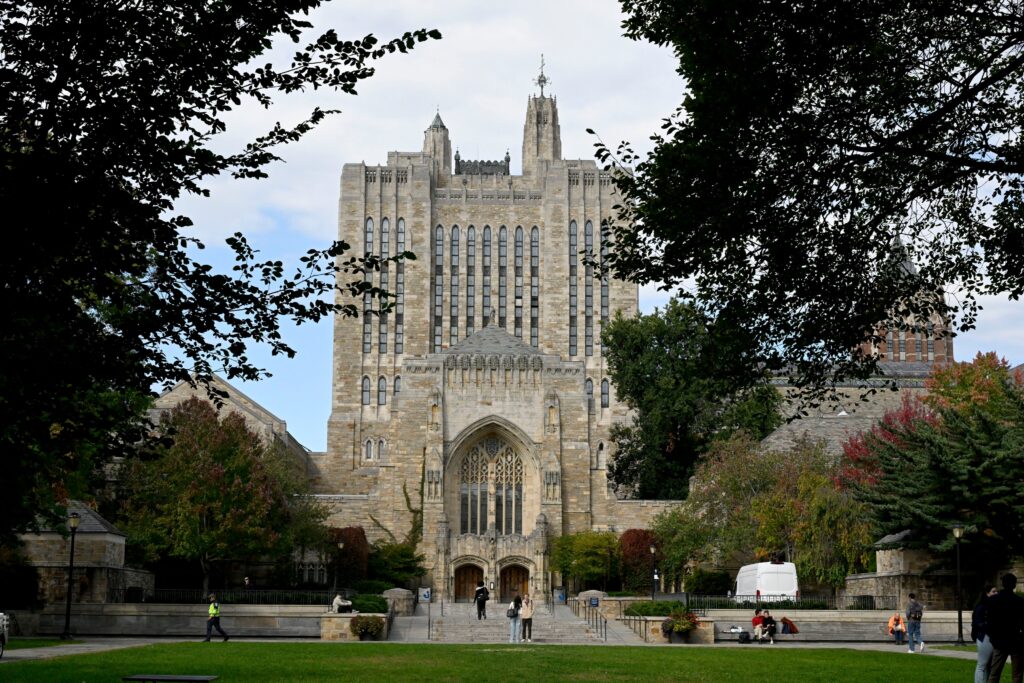
Yale University’s board of trustees could soon decide on a possible “deal” with the Trump administration with consequences far beyond its New Haven, Connecticut, campus. But to assign responsibility to a “board of trustees” is to assign it to no one. Yale’s board members will own — as individuals — whatever Yale does next.
One of us served as the U.S. education secretary; the other as U.S. ambassador to Hungary during Viktor Orban’s time as prime minister. Between us, we have some experience with education and authoritarianism. In Yale’s fight with the Trump administration, the tools of the federal government are being used not to advance nondiscrimination and academic freedom, but to undermine them.
The decisions taken by Yale’s board will have profound consequences, including for the legacies of the trustees themselves. The Trump administration has opened a wide-ranging investigation into whether Yale’s admissions practices have violated antidiscrimination laws. While the details of settlement talks between the two sides aren’t publicly known, too many institutions facing similar pressures — including the threat of major cuts to federal funding — have acquiesced to the administration’s weaponization of legal tools to attack institutional independence.
During his years in power, Orban was incredibly successful at many things destructive to democracy, and he had a particular interest in higher education. His attack on higher education in Hungary didn’t begin with the well-documented expulsion of Central European University in 2018. It began with small tests that carefully probed the resilience and resistance of Hungary’s academy — dangling financial security in exchange for signals of political obedience. Each time, resistance was weak, and the backlash manageable, until Orban ultimately learned that he could even expel from the country a renowned private university with strong U.S. ties.
Authoritarianism doesn’t have to involve men in suits dragging people into cars in the night. Orban showed that critics — or pockets of independence — can be rendered pliable by making them believe that the smart move is to affirmatively sacrifice some of their independence.
No doubt the pressure on Yale feels immense. We know many of the university’s trustees personally, count some as friends and respect all of them. These are decent people who have been entrusted with securing the future of one of the world’s great institutions.
What is essential for them to appreciate in this moment is that the actions Yale takes will not be attributed to the “institution.” They will attach personally to those empowered to decide.
This is another lesson from Orban. He had a knack for making the general personal. He would randomly unleash his propaganda apparatus against little-known judges, businessmen and academics to turn them into infamous caricatures, an unmistakable reminder of the cost of getting out of line. He didn’t need force. The ridicule of obscure actors — and the threat of financial uncertainty — was enough to convince many that dissent wasn’t worth it.
As the United States has struggled to deal with its own authoritarian breakthrough, the opposition has often focused on institutions. Accountability, however, can attach only to individuals. Boards of trustees are composed of people with agency. Orban imposed costs on those with no power in order to chill those with plenty of it. But the lesson can be inverted in defense of America’s democratic institutions. Orban personalized to intimidate the powerless; the foes of government intrusion must personalize to demand accountability from people with maximal power, resources and protection.
So we address Yale’s trustees directly. We understand that your role at Yale is prestigious and something that you value. It is also a hard one. You are being asked to make a decision that will have effects well beyond the institution to which you have a fiduciary obligation. But your institution has rightly held itself out as having something of a fiduciary obligation to the country and its citizens, too.
American law firms who last year cut “deals” to seek peace with the administration now find themselves subjects of renewed investigations. It doesn’t take a Yale Law School degree to understand what’s happening. Perhaps that’s why your law school’s leadership has advocated fighting this through the courts, rather than making political concessions. If a university with Yale’s prestige and resources opts not to fight this administration’s extralegal pressure, imagine the message sent to institutions with fewer resources, less history, smaller endowments and less prominent trustees.
By settling, you will not avert a crisis; you will create one. And it will not be the “board” that is remembered, but each of you, individually. Just like in Orban’s Hungary.
You are among the most privileged people in America, which means the cost of courage is lower for you than for almost anyone else being asked to show it. It’s true that Yale, like Harvard, may suffer real pain if it stands up for its values. It’s true that some programs may be undermined. But the project that is in your hands is far bigger.
That project is the future of academic freedom and independence, values foundational to American democracy. So too is whether Americans can still believe institutions like Yale when they describe their mission as helping form citizens in service to American democracy.
Marta Tellado, Gina Rosselli Boswell, Derek Chang, Philippe Costeletos, Maryana Iskander, Fred Krupp, Felicia Norwood, Mariko Silver, Carter Brooks Simonds, David Sze, Jaime Teevan, David Thomas and Neal Wolin, don’t let democracy — and yourselves — down.
The post Yale trustees, history is watching you appeared first on Washington Post.