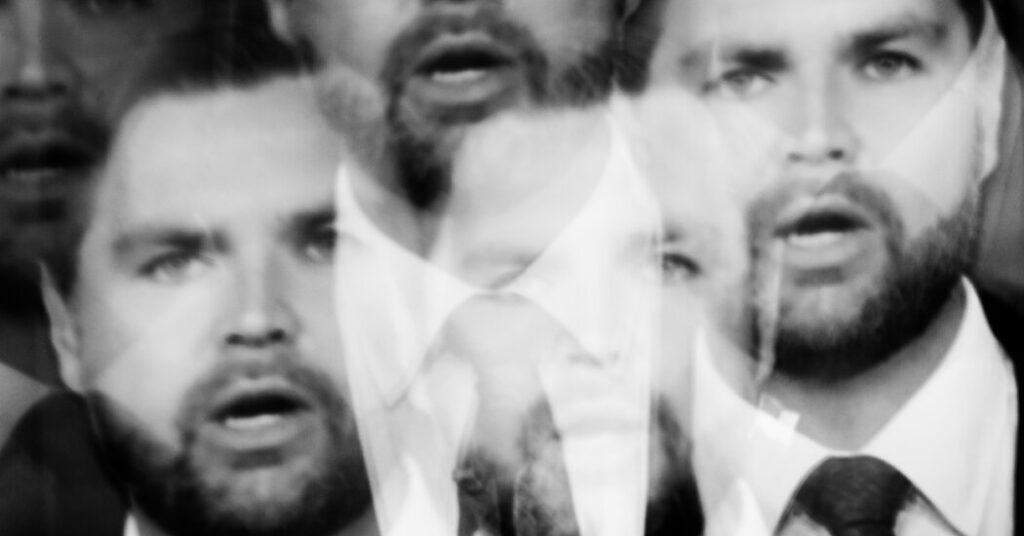
Whenever Vice President JD Vance takes the microphone, he has to decide which combination of his multiple identities to select for the specific audience before him, a choice he sometimes seems to find bewildering.
The range of Vance’s mix-and-match choices includes hillbilly, intellectual, Trump successor, raging MAGA loyalist and high-tech investor, not to mention veteran threatening other countries and veteran no-long-wars guy.
Vance’s difficulty finding well-being, much less genuineness, raises basic questions about his expected presidential campaign.
Is he, for example, a trustworthy heir to the Trump mantle or are his real feelings reflected in his 2016 comment to a friend: “I go back and forth between thinking Trump is a cynical asshole like Nixon who wouldn’t be that bad (and might even prove useful) or that he’s America’s Hitler.”
Vance’s problem is his failure to find comfort in any combination of identities so that he comes across as inauthentic, cross-pressured, forced — even counterfeit.
“Vance may be a standout when it comes to personal reinvention,” Ryan Enos, a political scientist at Harvard, wrote by email responding to my query, “perhaps partially because it has happened so rapidly and in the social media era.”
“Vance,” Enos added,
may cynically believe that being such a chameleon doesn’t matter in the world of MAGA politics, and he might be right. After all, he became Trump’s vice president. But I think this misunderstands being appealing to Trump, who just values subservience — perhaps even seeing somebody willing to do a 180 to ingratiate themselves as a good thing — with being appealing to Trump voters.
Part of Trump’s appeal is that, despite his ideological incoherence, you believe his commitment to the politics of resentment is genuine because he is personally motivated by resentment: feeling that he was disrespected by the establishment is his casus belli. In the end, that seems to be the only consistent feature of his governing style.
Vance lacks this characteristic; rather, he appears to have adopted resentment politics because it serves him politically. In that sense, it lacks Trump’s authenticity and probably won’t serve him well when he is out of Trump’s shadow.
At the moment, Vance enjoys a substantial 19.2-point lead in polling for the 2028 Republican presidential nomination, ahead of Marco Rubio 41 percent to 21.8 percent, according to the average of national surveys aggregated by 270toWin.
Vance’s clumsiness and awkward language in the public arena provide the basis of the July 24 article by Natalie Allison of The Washington Post, “Knives Are Out for Vance in the G.O.P. His Allies Say It’s a Coordinated ‘Op.’”
Allison suggests that Vance opened himself to attack during a three-hour session on “The Joe Rogan Experience” that was released on July 15, giving critics fodder for accusations of antisemitism and disloyalty to President Trump.
What did Vance say that stirred up so much criticism?
-
“I know beyond a shadow of a doubt that there have been people within the Israeli government who are trying to, like, actually shift us away from that policy” — meaning in Iran — “because they want to continue the military campaign.”
-
“When I open up the pages of Time magazine, and I see that there’s a literal foreign influence campaign being funded to tank the very deal that I was pursuing, and oh, by the way, many of the people who were receiving that money were actually attacking me in completely dishonest ways. You know my response to that is: Well, go to hell.”
Jeffrey Epstein, Vance added, “clearly had connections to the upper, the highest levels, of American intelligence. He clearly had connections to the highest levels of Israeli intelligence.” Notably, the vice president described himself as “one of the O.G. Epstein conspiracy theorists.”
The attacks on Vance came within days. On July 18, Michael Goodwin, an influential New York Post political columnist and a solid conservative, contended that Vance’s remarks should disqualify him for the presidential nomination.
Goodwin cited a poll of likely Republican primary voters showing that they
want a 2028 candidate who supports a strong U.S.-Israel relationship by a margin of 57 percentage points.
They also want one who forcefully denounces antisemitism by a margin of 52 percentage points. As of now, JD Vance is not that guy.
Less than a week later, Jeffrey Lax wrote in The Jerusalem Post, in “JD Vance’s Antisemitism Is Showing,” that “Vance failed to sell” the memorandum of understanding, “failed to close the deal or to manage the fallout, and here we go again. He blames the Jews, and it’s hardly the first time.”
Perhaps, Lax continued,
the most troubling and dangerous problem here is Vance’s implication that American Jews are somehow less American than everyone else. That our opinions, our advocacy or our support for a democratic ally must be filtered through some foreign loyalty test that does not apply to Irish Americans, Cuban Americans, Armenian Americans or any other group with ties to their ancestral homelands.
This double standard is not subtle. It is the classic dual-loyalty smear dressed up in modern language about “influence campaigns” and “well-funded” efforts. It has no place in the mouth of the vice president of the United States.
A few days earlier, the self-described evangelical Christian Zionist leader Laurie Cardoza-Moore declared: “As one of the millions of evangelical Christians who stand with Israel and our Jewish brethren, I call upon President Trump to immediately distance himself from the vice president’s recent statements on Israel and the Jews.”
In a July 19 column in The Jerusalem Post, “From Silence to Script: JD Vance Stops Tolerating Antisemitic Tropes, Starts Using Them,” Micha Danzig sought to explain how Vance’s comments were perceived as antisemitic: “Allegations that shadowy Israeli or Jewish actors secretly manipulate American policy inevitably echo one of the oldest antisemitic narratives: that Jews exercise hidden control over governments for their own ends.”
Danzig did not stop there: “Vance is no longer merely tolerating conspiratorial rhetoric circulating within his political coalition. He is employing it himself.”
What is striking about this back-and-forth is the failure of Vance, an intellectually gifted Yale Law School graduate with a keen interest in politics, to grasp the sensitivity of his choice of words in dealing with explosive issues involving Israel. Instead, he demonstrated exceptional tone deafness accompanied by bulldog persistence.
Brian Schaffner, a political scientist at Tufts, put a different spin on Vance’s word choice: “It reminds me a bit of Al Gore’s struggles as the intelligent policy wonk trying to dumb down his personality to gain more widespread appeal. It just doesn’t quite come off.”
It’s clear that as a member of the commentariat I am not alone in my fascination with Vance’s verbal gaucheries.
Margaret Sullivan, a columnist at The Guardian, wrote “Why Does JD Vance Keep Saying Loony Things?” earlier this month. Sullivan’s answer is that there is method to the madness: “In recent weeks alone, the Catholic convert has suggested that Pope Leo — the head of the Catholic Church, after all — should be careful when discussing theology.”
In addition, she wrote, Vance
declared that the Watergate scandal and its cover-up were no big deal, and that it’s absurd that these (clearly corrupt) acts should have brought down President Nixon.
He even described as “troubling” the Vatican’s welcoming views on immigration. Vance went so far as to say such tolerance — echoed in lawn signs that say, for example, “no person is illegal” — run against core Catholic beliefs.
“Add this,” she continued, “to Vance’s scorn, during the 2024 presidential campaign, for single women as “childless cat ladies.”
Or, Sullivan noted, “recall his spreading the ugly lie that Haitian Americans were stealing and eating pets in Springfield, Ohio”:
What exactly is all this craziness intended to accomplish? Why would a guy who wants to be president make a practice of unnecessarily insulting huge swaths of the electorate and going up against a hugely popular American-born pope?
Sullivan’s explanation:
Strange as it seems, his outrageous comments — presented as if they are the product of a thoughtful, serious person — are no accident. Vance is sending a clear message to Trump’s dedicated base that he’s just as good at stirring up hate and grievance as the man they elected twice as president.
In essence,
he’s saying something like this: I might have written serious books and have a law degree from Yale, but don’t worry, I hate the same people you do. And governmental malfeasance doesn’t rattle me.
Also this month, David Graham, a staff writer at The Atlantic, added his two cents with “JD Vance Isn’t a Fool. Why Does He Act Like One?”
Graham wrote:
Accounts of Vance’s time in law school, including stories of his close friendship with a transgender classmate, all point to a young man with an open mind, broad interests and knowledge. This makes it peculiar to watch Vance work so hard to appear dumb these days.
Why, Graham asked, “is a smart man spending so much time saying stupid things? The simplest explanation is that Vance believes his voters are stupid.” Vance’s performance, Graham added, “plays as tragicomedy: comic because he’s so bad at it, but tragic because of who Vance was not that long ago.”
When Vance ran for the Senate in 2022, Graham included him among a group of “very intelligent Republicans who were clumsily pretending to be fools for electoral purposes.”
Vance, he added, “seems to have doubled down on the strategy since then, but each new incident just offers more evidence of his dripping disdain for voters’ intelligence.”
Responses to my queries suggest that Vance has provoked a kind of morbid curiosity among political scientists and historians.
“For Vance, simply being Trump’s V.P. has a cost to his popularity,” wrote Diane J. Heith, a professor of government and politics at St. John’s University. “Rhetorical skill and persuasiveness are hard to separate from ideology and issue positions.”
Vance’s rhetoric, Heith continued,
does suggest a mindfulness of the competing pressures of the job. Vance came to the V.P. with his own issue positions, and some significantly differ from the president’s.
When differing perspectives emerge publicly, like with Iran, Vance is placed in the awkward position of massaging his rhetoric to support the president’s while not diluting his own positions too far. It is a difficult tightrope to walk, and that struggle will get harder if he runs in 2028.
John Murphy, a professor of communication at the University of Illinois Urbana-Champaign, argued by email that Vance’s problems are of his own making, rather than related to the structural constraints of the vice presidency:
Vance always tries to generalize — he wants to be seen, I think, as a public intellectual, so he’s willing to exaggerate, distort, twist the specific so that it “proves” a larger theory.
His memoir caricatured many in his life to show the obstacles he overcame and to show that those people wouldn’t try hard enough and he did.
He told tales of Haitians to attack immigration in the debate.
In each case, Murphy contended, “it was about a theory — rising out of poverty, great replacement stuff, communism v. capitalism. Even on simple stuff — Vance felt the need to change his name.”
Karrin Vasby Anderson, a professor of communication studies and co-director of the Center for Democracy, Art, and Popular Culture at Colorado State University, wrote:
Vance has an authenticity problem that stems both from the range of small and large things he has shifted on since entering public life, and from the fact that he just seems like a typical politician.
Some of what you are sensing no doubt emanates from his ideological flexibility. There is a sense that he lacks a core set of beliefs and, therefore, lacks stability and groundedness.
There is, according to Anderson, only one constituency firmly in Vance’s corner: “It’s men who spend time in the so-called manosphere, which is where Vance cultivated his political support. He knows how to talk with that demographic on their own terms, so they are more likely to identify with him.”
There is survey data that provides inferential evidence in support of Anderson’s thesis.
Civiqs amassed 53,032 voter comments on Vance’s favorability/unfavorability ratings over the past two years and found that an overwhelming majority of Vance’s support is concentrated among Republicans, 86 percent favorable, 7 percent unfavorable, while independents were 33 percent favorable, 59 percent unfavorable, and Democrats 3 percent favorable, 95 percent unfavorable.
In other words, Vance goes into the 2028 contest with his support at its strongest inside a partisan bubble that will power his campaign for the Republican nomination but constrain his ability to reach beyond that bubble in the general election.
Vance’s political position calls to mind a quotation of uncertain origin but often attributed to Abraham Lincoln: “You can fool all the people some of the time and some of the people all the time, but you cannot fool all the people all the time.”
The Times is committed to publishing a diversity of letters to the editor. We’d like to hear what you think about this or any of our articles. Here are some tips. And here’s our email: [email protected].
Follow the New York Times Opinion section on Facebook, Instagram, TikTok, Bluesky, WhatsApp and Threads.
The post Who Does JD Vance Think He Is? appeared first on New York Times.