On a sticky evening in July, leaders of the surging democratic socialist movement in New York City jumped onto Zoom to begin crafting the next phase of their campaign.
Democratic socialist candidates had just toppled five incumbents, capturing two House primaries in the city and a handful more in state legislative races. But with an off-cycle election year ahead, leaders in the city’s chapter of the Democratic Socialists of America were shifting their focus from winning votes to changing policy.
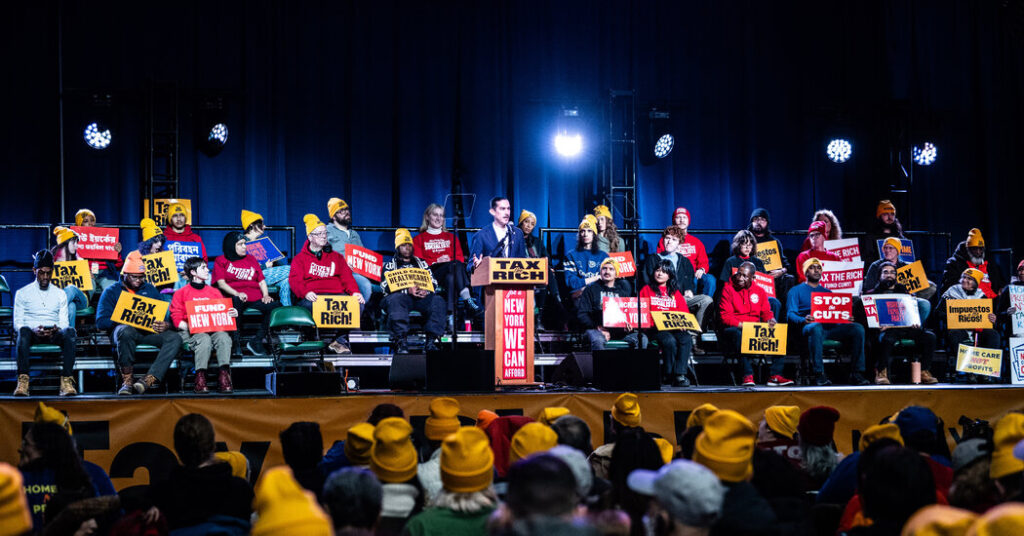
The group’s next order of business, its members agreed in the nearly hourlong Zoom, is to pressure Gov. Kathy Hochul, a centrist Democrat, to raise income taxes on the wealthiest New Yorkers when the state Legislature convenes in Albany in January.
The group had failed to persuade Ms. Hochul to do so earlier this year, settling instead for a much more limited tax on multimillion-dollar second homes in New York City. But with its influence on the rise, the group believes that a broader tax-the-rich campaign may succeed next year, despite Ms. Hochul’s continued resistance.
“We brought the fight to Hochul to tax the rich last session when we had only nine socialists in the State Legislature,” Gustavo Gordillo, the co-leader of New York City’s D.S.A. chapter, said in an interview. “This cycle, our forces will be almost doubled, and there’s a whole new crew of progressive legislators who are going to demand what New Yorkers want, which is for Hochul to tax the rich.”
Since Zohran Mamdani’s mayoral primary win last year, the New York City D.S.A. chapter, active since the 1980s, said it has added more than 7,000 members. Its current membership of roughly 15,000 is spread across the city, often concentrated in gentrified pockets of Brooklyn and Queens (the so-called Commie Corridor), along with Upper Manhattan.
As the organization matures, it is confronting how to chart its path forward. Some members are laser-focused on drafting their most prominent political ally — Representative Alexandria Ocasio-Cortez — to run for president in 2028, sometimes putting them at odds with their national brethren. Others are pushing for a more expansive policy agenda, including a renewed focus on public safety, condemning Israel’s military actions through legislation and considering a public takeover of its largest utility company.
The city’s D.S.A. arm has 14 working groups focused on policy goals, but it has so far trained its focus on selecting political candidates and winning elections. Knocking on doors and building energy for elections have tended to be more central to the organization than in-the-weeds policy analysis.
“The organization feels that the sky’s the limit in New York City,” said Asad Dandia, the Brooklyn borough historian and a D.S.A. member. “There’s an understanding that D.S.A. has emerged as one of the major political players in New York City, and arguably the most powerful political organization in the five boroughs.”
Members of the D.S.A. will be making a renewed push to pass the “Not on Our Dime” bill, which would strip New York nonprofits of their tax-exempt status if their funds are used to support Israelisettlement activity. They are also trying to persuade lawmakers to introduce a bill that would penalize airlines that facilitate arms shipments to Israel from Kennedy International Airport. The chapter has also talked about increasing its focus on climate and energy — issues that can be difficult to mobilize voters around, though they have felt more urgent in a summer of heat waves and wildfires.
D.S.A. is part of a coalition of advocacy groups that is pushing for the state to build enough public renewable energy to power 12 million households. Far more ambitiously, members of the coalition have discussed pushing either the state or city to step in and take over Con Edison, with the aim of lowering utility bills and making the case that the public sector ought to run the grid, not the private sector. Such a plan would face major logistical and financial hurdles and is unlikely to get Ms. Hochul’s support.
During their recent planning meeting, leaders spoke at length about how to use the governor’s promises to expand free and low-cost child care statewide as a way to pressure the governor to raise taxes on the wealthy.
“She’s already committed to a major child care program, which is unfunded at this point,” Mr. Gordillo said in the interview. “It would be a huge embarrassment for her not to raise taxes on the rich in order to fund the program she helped to start.”
Ms. Hochul, for her part, has found opportunities to partner with Mr. Mamdani on initiatives big and small, from child care to the World Cup to the so-called pied-à-terre tax. But as she faces re-election in November, she has also embraced the role of playing the moderate foil to Mr. Mamdani and his progressive base, knowing that the city relies on Albany to fund the new administration’s expansive agenda.
“Governor Hochul has been focused on lowering costs for New Yorkers and making it easier for both businesses and residents to stay in our state,” her spokesman, Anthony Hogrebe, said. “She does not believe in raising taxes for the sake of raising taxes, and has only considered new revenue raisers when absolutely needed to solve real problems. The governor makes decisions based on what’s best for New Yorkers, and no amount of political pressure can change that.”
In the early months of his administration, Mr. Mamdani has sought to strike a conciliatory tone with the governor. He endorsed her re-election in early February, which infuriated some democratic socialists. When progressive groups in New York staged a major “Tax the Rich” rally in Albany, busing hundreds of people from the city, Mr. Mamdani privately told organizers that he planned to skip the event.
Democratic socialists have tended to give the mayor a pass. But now, in private conversations, some are analyzing whether the mayor can play a more active role in pushing their priorities, given that he is more firmly established inside City Hall.
Many members of Mr. Mamdani’s progressive base remain opposed to his police commissioner, Jessica Tisch. While her appointment spurred frustrated messages in chapter group chats, D.S.A. members have done little to push Mr. Mamdani to drop her. Recent primaries demonstrated that democratic socialists in New York City are frustrated by economic inequality, Israel and President Trump’s immigration enforcement tactics — but its leaders have been a lot more muted around public safety reforms.
Mr. Mamdani has prioritized improving his affordability agenda and condemning Israel’s military actions, while keeping the issue of police reform at a distance. The D.S.A. recently pressured him, successfully, to scrap his plans to hire another 580 police officers and is pushing him to expand the new Office of Community Safety, which would divert certain 911 calls from police officers to clinicians.
Mr. Mamdani had promised to create a larger Department of Community Safety that would have a $1.1 billion budget, but so far the endeavor is far more modest — a mayoral office with a $270 million budget, most of which is money diverted from existing programs. The operation tasked with handling the 911 calls — the heart of the whole project — is getting a mere $35 million.
Tiffany Cabán, a city councilwoman and member of the D.S.A. who describes herself as a “hard-core abolitionist,” said she wanted the mayor to push the Police Department to cease its increased focus on enforcement of low-level crimes and build out the Office of Community Safety. But she acknowledged that drawing in voters with an anti-policing agenda remains a challenge.
“We’ve seen a lot of movement around Palestinian liberation, on antiwar organizing; we’ve seen a lot of movement around tax the rich,” Ms. Cabán said. “But policing is just hard.”
As the influence of the D.S.A. grows, so, too, does the volume of its critics. One persistent area of concern is how the organization addresses racial inequality, a matter that was highlighted this week when a Black Democratic leader, Donovan Richards, invoked an accusation of “white supremacy” on X. The comment, directed at the D.S.A. in response to discourse around a New York Times story on the group, was plastered on the cover of the right-leaning New York Post and was being circulated by critics of the organization.
The Rev. Al Sharpton, the veteran civil rights leader, argued that the D.S.A. should fine-tune its focus on affordability by addressing racial disparities, rather than treating all types of financial struggle the same. Mr. Sharpton applauded the group’s recent string of victories and said they “raise expectations” for the organization.
“There is a race gap in affordability. They’ve got to deal with more than class, and also deal with race,” Mr. Sharpton said. “If they do not, then they run the risk of having some people in the Black community come back at them, saying you’re ignoring race.”
A poll of 719 likely New York State voters, conducted in May by the firm Data for Progress, found the D.S.A. is unpopular with 42 percent of those who responded, and popular with 30 percent.
Jay Jacobs, chairman of the state Democratic Party, said he appreciated the D.S.A.’s commitment to affordability, but he questioned some of the group’s tactics and policy goals. He argued that their focus on taking down centrist Democrats wasn’t helping in the broader effort to flip Republican-held seats and win back Congress.
“Too often they look at moderate Democrats as the greater enemy than Republicans,” Mr. Jacobs said. “They don’t appeal to people in the middle. Most Americans are moderates.”
The post Democratic Socialists Are Winning Big. Now They Want Action. appeared first on New York Times.


