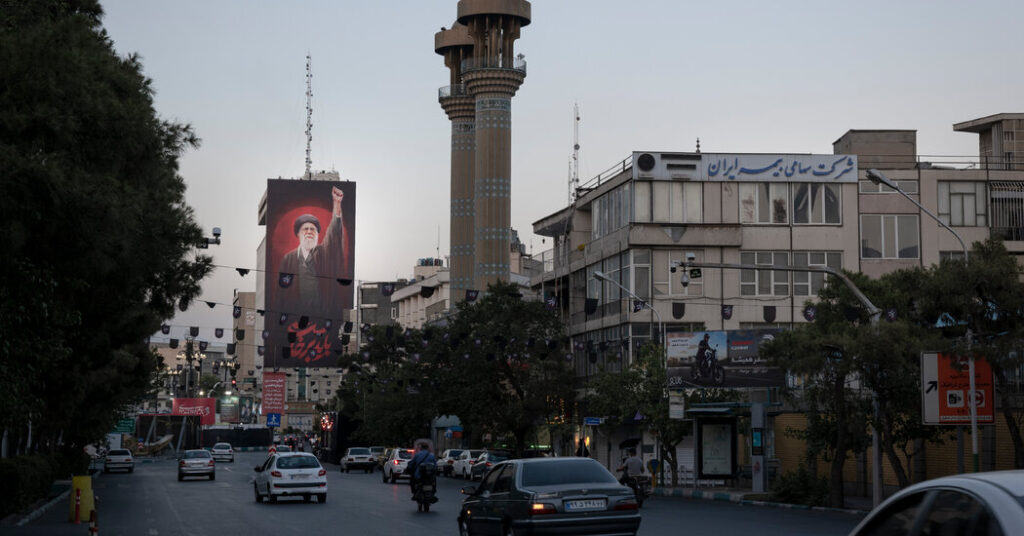
Before I had even set foot in Iran, the country had begun telling me a version of its modern-day story.
It started on the Iran Air flight. Tucked into the seat pocket in front of every passenger was a leaflet bearing the face of Ayatollah Ali Khamenei, the country’s supreme leader who was killed months earlier, at the onset of the U.S.-Israeli attacks on Iran. The message was unmistakable. Before visitors saw Tehran’s streets or spoke to a single Iranian, they were being introduced to a nation in mourning, one determined to highlight the foreign aggression it had endured.
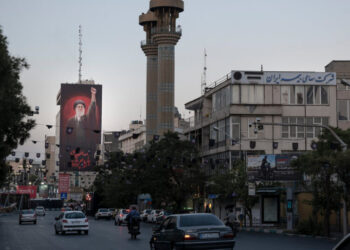
When I reached the airport, portraits of Ayatollah Khamenei were watching over the arrivals hall. Giant banners proclaimed endurance. Posters and flags called for revenge. The message from Iran’s leaders was clear: The country had suffered. It had survived, and the world needed to see both.
I arrived in Iran in early July as part of the first team of New York Times journalists allowed into the country since the war began in late February. Before that, thousands of protesters were killed following anti-government protests that began in late December. We were allowed to report on Ayatollah Khamenei’s funeral ceremonies, accompanied by a government-appointed translator and a guide.
We spent several days reporting in Tehran, the capital, before traveling to Mashhad, the birthplace of the ayatollah and the city where he would be buried. During our visit, the war, which had briefly paused under a fragile cease-fire, began flaring again.
While the Iran we encountered was shaped by war, it was not defined by it alone.
Even as the state projected strength, resilience and national unity, the people we met revealed a more complicated reality. We found grief accompanied by a fierce sense of national pride, opposition to the government tempered by unease over foreign intervention, outwardly liberal lifestyles unfolding alongside religious mourning, and anger at Israel and the United States alongside frustration with economic hardship and state restrictions.
Understanding Iran meant holding all of those realities in view at once.
Enter Tehran
Our first stop was Golestan Palace.
The government’s choice was hardly accidental. It wanted to show how the war had reached beyond military targets to places central to Iran’s history and identity.
The sprawling UNESCO World Heritage site dates to a chapter of Iranian history that predates the Islamic Republic. Once the ceremonial seat of the Qajar dynasty, it was where Persian kings held court beneath glittering mirrored ceilings and elaborate tilework.
Now parts of it bore fresh scars after being damaged in a strike targeting a judiciary building nearby.
Shadi Jafari, who led the media tour, said it was “unfortunate” how the palace survived centuries of Iranian history only to be scarred by modern war.
Throughout our trip, we encountered reminders everywhere of the strikes’ broad reach.
At Sharif University of Technology, one of Iran’s premier academic institutions, damaged buildings had crumbled into heaps of concrete and mangled metal. The Iranian space research center had been reduced to a tangle of collapsed floors. The Azadi sports complex, a landmark venue that has long hosted major concerts, sporting events and public gatherings, lay in ruins. American and Israeli officials have said that certain civilian sites are used by Iranian security forces to generate revenue or produce materials that can be used for military purposes.
This destruction — along with the killing of top military, intelligence and political leaders — loomed over the ayatollah’s funeral, which coincided with Muharram, the month when Shiite Muslims commemorate the martyrdom of Imam Hussein, the Prophet Muhammad’s grandson. This year, the losses of the recent war have been woven into that centuries-old narrative of sacrifice and martyrdom.
Many mourners did not speak of compromise. They wanted retaliation. They wanted President Trump dead. To them, diplomacy was weakness.
At the Grand Mosalla prayer complex in Tehran, one woman told us that Iran had been attacked by the world’s most powerful military and was still standing. That, she believed, was victory enough. A man carried a yellowed newspaper from the era of Ayatollah Ruhollah Khomeini, who died in 1989, bearing his declaration that “nobody has the right to negotiate with America.” Beside it, he held a handwritten sign that read, “This is the result of negotiations.”
When Ahmad Vahidi, the commander of the powerful Islamic Revolutionary Guards Corps, appeared just a few feet from where I stood after the funeral prayers, chants of “Revenge! Revenge!” rippled through the crowd.
It was a sentiment shared by Seyed Mustafa, a businessman who had traveled from the southwestern city of Ahvaz. “Resistance and revenge are the only paths forward,” he said.
Parallel Worlds
Only a few miles from where mourners gathered for days, a very different scene unfolded.
In north Tehran, the city’s upscale district, young people filled sandwich shops, cafes and boutique storefronts. Luxury cars inched through the nighttime traffic. Young tattooed men in shorts wore fresh bandages from cosmetic nose surgery. Women, dressed in bare-shouldered tops, rode motorcycles, their hair flowing behind them.
At one restaurant where we ate dinner, music featuring a female vocalist poured through the speakers. Only weeks earlier, a female singer had been sentenced to 74 lashes for performing at a concert without wearing a hijab.
Looking around the room, one of the government guides remarked, almost with amusement, “For people here, it’s as if Ayatollah Khamenei didn’t die.”
It was an understated acknowledgment of the parallel reality we had walked into.
Many of the Iranians we approached were remarkably warm. They asked where we were from. They wanted to know why we had come. Yet none agreed to be interviewed on record. Again and again, they apologized.
“I don’t want problems.”
“Why would I talk to journalists? Am I crazy?”
“You understand.”
Their silence was its own form of testimony.
Everyday Survival
Beneath the politics, another crisis threaded through many conversations: the struggle to make ends meet.
The war had accelerated financial pressures that many Iranians had been feeling for years because of sanctions, corruption and economic isolation.
Monthslong internet cutoffs had crippled businesses, including parts of Iran’s bustling tech sector, leading to mass layoffs. A spiraling currency had eroded purchasing power. University graduates spoke of struggling to find stable work. Those with jobs worried their wages no longer stretched far enough.
At one restaurant, a worker approached us at the washroom to say the restaurant would be forced to close during the upcoming funeral ceremonies, leaving him without the wages he needed to feed his family. He shrugged as he spoke, as though disappointment had become too familiar to provoke outrage.
To many Iranians, the funeral also became a measure of the state’s priorities. Even as elaborate mourning ceremonies were staged — complete with misting stations, free water and food — some Iranians described living through water shortages and power cuts.
The way that Ayatollah Khamenei’s funeral events were planned and carried out left “a deeply troubling sense of inequality and discrimination,” said Lida, 44, a doctoral student who spoke by phone from Tehran and on the condition that her last name not be used for fear of retaliation.
“The government under his authority appeared to support only one segment of society — those regarded as insiders or loyalists,” she said, “and this is clearly reflected in the way his funeral ceremonies have been conducted as well.”
Exit Iran
Our journey ended in Mashhad, where Ayatollah Khamenei was to be buried. Mourners converged on the Imam Reza shrine from across the world. But even here, reminders of war interrupted devotion.
At the arrivals hall of Mashhad airport, dozens of mostly pink and blue backpacks were displayed in memory of children killed when a U.S. strike hit their school in the southern city of Minab early in the war. The bags were paired with roses and children’s shoes.
At a bakery in the city’s bazaar, a worker taped to the door a photograph of his nephew, a sailor who he said was killed when a U.S. submarine torpedoed his ship.
Just hours before, the United States had reimposed sanctions on Iranian oil and conducted new strikes inside Iran. The cease-fire was already beginning to unravel, giving way to a wave of fighting that has once again engulfed the wider region.
Hours after the ayatollah’s burial, we drove toward the Afghan border. At immigration, two officers motioned me over to their booth. With only limited English, one officer typed some words into a translation app on his phone and held up the screen for me.
“What do you think of Iran and its people?” it read.
As I looked up from the phone, the other asked, smiling: “Do you think we are strong?”
They were, in many ways, the questions that had followed us throughout the trip.
Iran had spent my entire journey asking the world to recognize its strength.
Its people had answered with something far more complicated: strength, yes, but also grief, defiance, weariness, fear and hope.
The post What a Journey Through Wartime Iran Revealed appeared first on New York Times.