Prime Minister Narendra Modi of India appeared to avert one of the biggest crises to hit his government in more than a decade by acquiescing to the demands of an upstart youth movement, prompting its leaders to call off nationwide protests that had shown few signs of fizzling.
The concessions, including the resignation of India’s education minister — a key demand of the protesters — represent a rare retreat for Mr. Modi, a strongman under whom the space for dissent has shrunk steadily in India, the world’s largest democracy. The minister, Dharmendra Pradhan, a key player in Mr. Modi’s political party, stepped down on Saturday, after demonstrators repeatedly demanded accountability over a botched medical school exam.
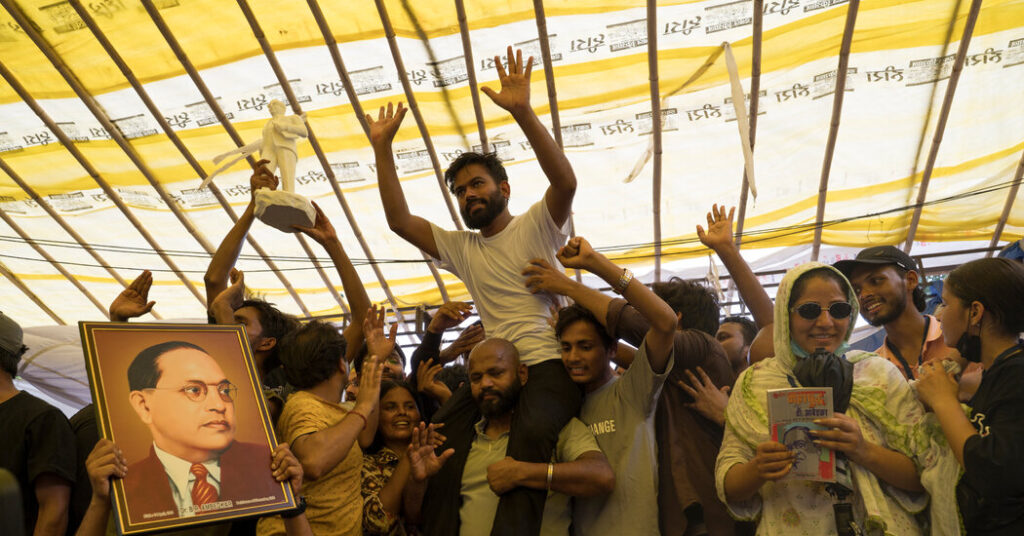
“We have done it,” said Abhijeet Dipke, 30, the founder of the Cockroach Janta Party, whose satirical name belies the explosive power it acquired just months after he turned a joke into a youth political movement. Loud cheers erupted at the protest site near Jantar Mantar, an 18th-century observatory in New Delhi, where he spoke.
“What did they say? That no one in this government resigns?” Mr. Dipke said. “As the saying goes, “The world bends, if you know how to make it bend.”
Not long after, another party leader said in a statement that the protests had been called off because the government had agreed to all of its demands, including compensation for the families of students who had died by suicide after the recent scandal.
Despite the call for an end to protests, the movement could endure, especially as opposition parties have stepped in to support young people. Their underlying reasons for anger remain, reflecting a deep dissatisfaction with a shoddy and underfunded education system and a lack of jobs.
The protesters — mainly students — had accused Mr. Pradhan of not doing enough to stop repeated leaks of college-entrance exam papers, including a significant medical school test in May that forced millions of students to retake it. Mr. Modi did not directly address the protesters until two days ago, when he reassured them that the culprits were in custody.
By then, the movement had morphed into something far bigger, capturing the frustrations of millions of young Indians struggling to understand why the world’s fastest growing major economy is yet to create enough jobs or fix an education system despite assurances from the government that it was bound for greatness. Roughly 40 percent of India’s 1.4 billion people are under 25, and unemployment among those under 30 is high.
Many students have taken aim at Mr. Modi — who has often talked in lofty terms about the power of India’s youth — criticizing him as not following through on his promises to deliver more jobs.
Still, protesters took a moment to savor a hard-won victory from a government that is typically unwilling to engage with dissenters.
“It shows that with sustained pressure and passion, Gen Z can accomplish anything, including making their government do right by them,” said Chinmayi Menon, 20, at the protest site in New Delhi, where thousands of people had gathered daily to make their demands heard.
In his two-page resignation letter, Mr. Pradhan said he had been “deeply pained” by the recent events, but he pointed a finger at what he called “anti-national forces,” saying he did not want them to take advantage of the massive protests.
In a reflection of the generational divide involved, Mr. Pradhan wrote his letter in formal Hindi and posted it online. The Cockroach party leaders, in contrast, communicated in video clips, memes and language studded with emojis. For days, protesters also mocked Mr. Pradhan and Mr. Modi online, including the latter’s adoption of Instagram videos to deliver his messages.
Mr. Dipke founded his satirical partyin May after a disparaging remark by India’s top judge comparing India’s youth to cockroaches. The party quickly became the vehicle through which millions of young Indians began to express their frustrations.
The Cockroach Janta Party was founded just days after the medical school exam was canceled. Mr. Pradhan’s education ministry announced a fresh date for the test, but in the interim, at least 21 students killed themselves, according to the party’s count.
The party’s protests began in June, and the movement gained momentum after the police cracked down with force on demonstrators as thousands marched to Parliament in New Delhi last Monday. Protests spread to major cities across India.
One of the demands Mr. Dipke and other leaders of the movement put to the government was compensation of 10 million rupees (about $103,000) for the families of the children who took their own lives.
Mr. Dipke said his group also wanted accountability for security forces who cracked down on peaceful protesters. “Action must be taken against the police officers for that,” he said.
On Saturday, the C.J.P. said the government had also agreed to its demand that protesters would face no charges, now or in the future. At a joint news conference, a senior government minister, Jagat Prakash Nadda, who had been in talks with party leaders in recent days, said the government had accepted the group’s demands and would also consider a separate document presented that called for education reform.
Mr. Pradhan was previously largely dismissive of the protests. In a social media post he accused opposition parties of exploiting students to “manufacture disruption,” and in an interview last month with a local media outlet called student protesters “the B-team of terrorists.” But that appeared only to strengthen students’ resolve to remove him.
That pressure forced Mr. Modi to weigh loyalty to his supporters against the need to placate young people. Over a nearly three-decade political career, Mr. Pradhan has held various positions in Mr. Modi’s Bharatiya Janata Party and was credited with helping it come to power in some recent state elections.
But addressing young people’s long-simmering frustrations may not prove to be a simple fix. India puts students through a pressure-cooker education system, and yet nearly 40 percent of graduates between the ages of 15 and 25 are unemployed, according to a university study in March.
Late Saturday, not many people had left the protest site, even though the stage where leaders had sat was being dismantled. Many protesters celebrated in small groups, showering rose petals. And people displayed mixed feelings about what had been achieved.
Arshdeep Malik, a graduate student from the state of Maharashtra, said it was an “overwhelming moment” for students to see Mr. Modi accede to their demands. “I now feel that democracy is still alive in this country.”
But Deepak Sharma, an engineering student, said the protesters had focused on the wrong goal.
“Asking for Pradhan’s resignation was a mistake from the start,” Mr. Sharma said. “Someone else will take his place, but nothing will really change. The goal should have been to change the system, not to remove one minister.”
Pranav Baskar contributed reporting.
The post India’s ‘Cockroach’ Protesters Declare Rare Victory Over Government appeared first on New York Times.