You may know the British actor Tom Hiddleston for his role as Loki, the Norse god of mischief in Marvel films and TV series. Or for his character Jonathan Pine in the spy thriller “The Night Manager.”
Or for his acclaimed Shakespearean stage acting.
Or even for his dancing.
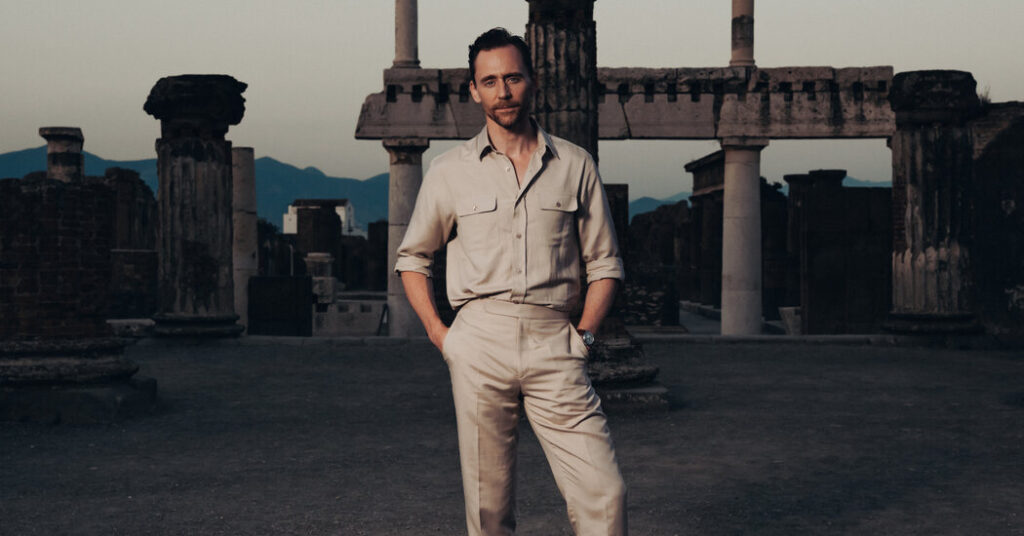
But there is another side of him he wants you to know about: “amateur classicist,” his onscreen title in “Pompeii: Out of Time With Tom Hiddleston,” a three-part National Geographic documentary series about the final day of Pompeii in A.D. 79, before the bustling Mediterranean city was destroyed by the eruption of Mount Vesuvius.
In the series, which began streaming on Thursday on Disney+ and Hulu, Hiddleston plays himself as a kind of time-travel detective zipping around Pompeii and nearby Herculaneum, then and now, encountering dramatized versions of historical ancient Romans and learning about who they were, how they may have lived and how they may have confronted — and in some cases survived — this catastrophic event.
Behind it all is a longtime passion for the classical world that goes beyond that of the mere amateur — a passion Hiddleston began cultivating in his youth as a student of Latin and Greek.
“I loved Homer and Virgil and Euripides and Sophocles,” Hiddleston, 45, said in an interview this week at the Soho Hotel in London, during which he recited a line of poetry in ancient Greek and peppered the conversation with Latin.
“I am fascinated by Western European civilization, by the fact that the Greco-Roman world in so many ways is the root of Europe,” he said, noting also that many of America’s Founders were classically educated. “In our systems of thinking, in our systems of language, in our systems of politics, culture, literature, art, architecture, you can’t ignore the ancient world.”
Hiddleston’s bona fides in the classics are genuine. The moment “that changed everything,” he says in the series, came in 1998, when at 17 he visited Pompeii, near modern-day Naples, Italy, on a trip across Europe with two friends.
The city, buried and preserved for centuries under several meters of volcanic debris, had become on some level an archaeological memorial to death, he says, where victims lay immortalized as plaster castings. “It suddenly seemed real and the disaster seemed like it was much closer than 2,000 years ago,” he said in the interview.
Seeing that ancient tragedy so vividly rendered helped propel him toward a classics degree at Pembroke College at Cambridge University, where he was awarded a double first, the highest honors.
“He had a fantastic command of the languages, ancient Greek and Latin, to a very high degree,” said Prof. Torsten Meissner, who was his director of studies in classics at Pembroke. “The translations had real flair.”
Hiddleston was most fascinated by the stories of the great Greek tragedies, Meissner recalled, and he wrote a thesis titled “Who Is Pylades?” about a character from the tragedies. “It was very clear from the word go that his heart was in classics, and it became clear fairly quickly to me that he really loved Greek tragedy, and that is a nice bridge to his acting career,” Meissner said.
His passion for the ancient world paralleled his interest in acting. At Cambridge, he played Orestes in a 2001 university production of Sophocles’s “Electra,” a performance spoken entirely in ancient Greek.
His professional acting career started to take off while he was still a student, and he got parts while classes were still on. He recalled reading Cicero in Latin while waiting around during the filming of “Conspiracy” (2001), at Shepperton Studios in London.
The idea for the Pompeii show started to germinate many years later, in 2020, after filming an episode of the Marvel-Disney+ production “Loki,” about a character from not Greek but Norse mythology. He was in Atlanta, acting in a scene in which Loki visits ancient Pompeii and speaks Latin, a confluence of his interests.
“I was so happy,” he said. Afterward, he was approached by producers who were aware of his background and asked if he wanted to revisit the story of Pompeii. He agreed.
The past is a useful place, he said, to ask tough questions about the present.
“The story of Pompeii is much more contemporary than I had considered,” he said. The destruction of Pompeii, as the series emphasizes, was not immediate. Instead, inhabitants of the doomed city had time to heed warnings, including earth tremors, about the impending disaster — a ready comparison, he argued, with the various ecological crises we face now.
“There were many warnings that nature was sending, and not everybody heeded those warnings,” he said. “We could learn from that today.”
In the series, as Hiddleston flits around Pompeii and Herculaneum, and between time periods, his efforts are centered on identifying real Romans who may have survived the catastrophe and become refugees. His professors had drummed into him the importance of rigorous sourcing, he said. As such, he consults an archaeologist, psychologist, classicist and other experts on camera in an effort to reconstruct these Romans’ stories.
Hiddleston was motivated in part by a desire to generate empathy for people who face similar circumstances today, he said — refugees, for example, whom we encounter as mere numbers in our news feeds but who are, in fact, real humans in harrowing situations.
“There is a dissociation in our culture in terms of how we digest and metabolize what is going on in the world,” he added. “If we can look at it and confront it and ask questions, and ask again and think again and trust in the experts, I think the picture will look very different.”
Kevin R. Wright, an executive producer who worked with Hiddleston on “Loki” and “Pompeii,” said the actor’s palpable interest in the ancient world was central to the documentary’s potential to engage.
“There is such a deep passion from this guy for this world that that’s the reason to do it,” he said. “It’s a host who’s incredibly enthusiastic, saying: ‘I really think this is cool. And maybe some people think it’s nerdy, maybe it’s a little intellectual, but I really like it. And if you come with me, I think you’re going to like it, too.”
Hiddleston’s role as a time-traveling sleuth and storyteller will not be a mere interlude between his larger, glossier productions, which include the role of Sir Edmund Hillary in the biographical drama “Tenzing,” scheduled for October; a return to Broadway this fall in “Much Ado About Nothing”; and another reprisal of Loki in “Avengers: Doomsday,” slated for December.
He and Wright, who together formed a production company — called Ithaca after the Greek island, the home of Odysseus in legend — hinted at coming projects that will rely on a similar approach to place and story. They may include ancient Greece, maybe “The Iliad.” (“I would have loved to have been in ‘The “Odyssey,’” Hiddleston said of Christopher Nolan’s latest film. But Achilles is a character he would also one day relish playing.)
Telling stories that are thousands of years old represents more than just a return to a beloved early passion for Hiddleston. Telling them also “makes me feel humble,” he said.
“I feel reassured by it — the basic essence of a human life is the same as it ever was,” he continued. “It’s a useful humility. It makes you feel connected to the human experience in a very profound way.”
The post In Pompeii, Tom Hiddleston, ‘Amateur Classicist,’ Sees Lessons for Today appeared first on New York Times.