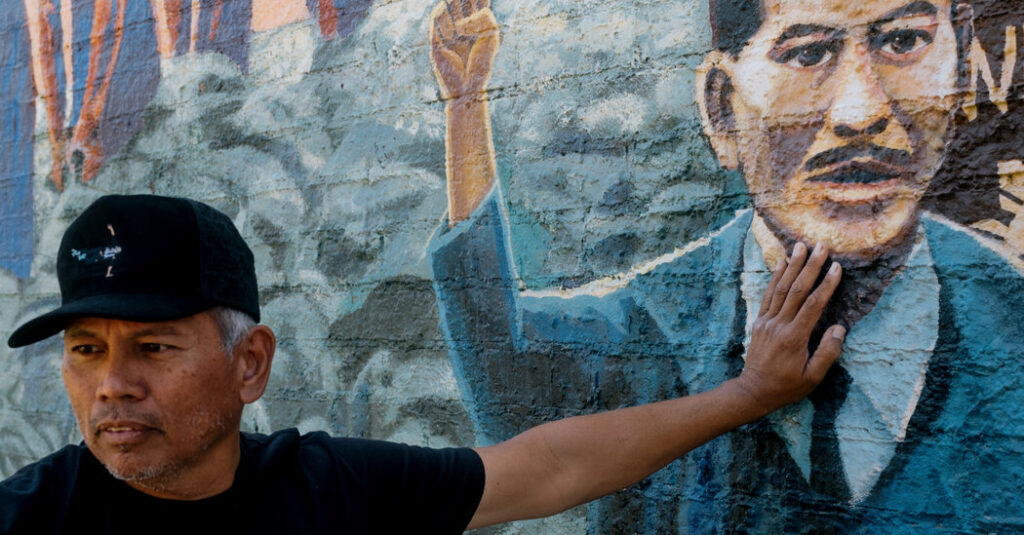
It was Magic Monday, the weekly convocation of roller skaters on Venice Beach in Los Angeles, and a nearly sacred observance for Johnny Itliong. As usual, he was helping out his entrepreneurial friends on the boardwalk by sporting their merch — a “Skate Famous” branded hat from one, stickers on his gear from others.
The music was bumping and the sun had come out. On most Magic Mondays, that and a little weed would have been all Itliong needed. But on this afternoon, as he felt his way through the steps of a line dance and passed a vape to a buddy, he had more on his mind.
Days before, the news that Cesar Chavez had been accused of sexually abusing girls landed like a bomb, forcing a reckoning over one of the nation’s few Latino civil rights icons.
Those girls were the daughters of farmworker organizers whose movement Chavez had famously led. Itliong, 61, felt sorrow for the victims, who included the sister of a close friend. But the revelation also brought something like vindication — and opportunity.
Itliong’s father was Larry Itliong, the Filipino American farmworker leader who was perennially overshadowed by the younger and more telegenic Chavez. While Chavez’s name was reverently bestowed on schools, streets and libraries, the Itliong name remained largely unknown even in Delano, the agricultural town in California’s Central Valley where Johnny was born and Larry died.
For decades, the son has made it his life’s work to change this. He has traveled California, attending United Farm Workers events and ceremonies honoring the farm labor movement to proclaim what he sees as the truth: After his father spent decades toiling in the fields, learning multiple languages to communicate better with workers and making grueling treks to find them, he said, Chavez and his followers muscled in on their work and took the credit.
“I have been fighting to get the story of my father out for decades and have been waiting for the U.F.W. to step up and honor Larry as they do Cesar,” he said at one such event.
His efforts, he said, have cost him money, untold time, three marriages and his relationships with his three children.
But now the world could find out what Itliong had believed for as long as he could remember.
“He was a narcissist,” Itliong told me, jabbing his two middle fingers into the air whenever he said Chavez’s name. He paused to nod at friends passing by on their skates.
“They’re writing about my dad!” he told them.
He was confident and breezy, joking and laughing as he glided around the rink. But later, he reflected on a life in which he has often felt thwarted — punished, even — for trying to carry forward his family’s legacy.
“I want this for my children,” he said. “I may be a piece of shit, but I want them to be proud of their grandfather.”
Everyone was waiting for Itliong, and when he finally appeared on the video call, he apologized; he had been looking for a place to plug in his laptop.
In the weeks since the Chavez news had broken, he had given about two dozen interviews reminding journalists that the movement Chavez had come to embody was actually about much more than a single person. He told The Los Angeles Times that his father’s purpose “was to raise everybody up.”
Members of a loosely organized group of Asian American civil rights advocates had read the coverage. Seeing an opportunity to highlight the work of Filipino American leaders, they asked Itliong to help them strategize.
“This is a very critical moment with this openness,” said Eric Chen, a pastor. He began working as an activist after a mass shooting at a ballroom that left 11 mostly older Asian Americans dead and devastated the Asian American enclave in Los Angeles County that he calls home. “We’ve got to strike while the iron is hot.”
The question was how. Chen and Itliong had identified a turning point, but they had a harder time figuring out a mission. All they knew was that they wanted to bring more attention to Larry Itliong’s contributions without deifying him or anyone else. In the end, they decided that they would host a kind of informational “round table” and news conference, both aimed at moving the celebration of the farmworker movement from Chavez’s birthday to some other day and elevating the stories of others in the movement.
Chen offered a benediction.
“I pray that as we embark on this journey to rewrite history, that it would be a journey of healing as well, a journey of redemption,” he said as the others nodded solemnly in their little boxes on the screen. “Because, Lord, we know that it was not about one man. It was a movement.”
Larry Itliong married six times, and Johnny’s mother was mostly absent from his childhood. He was cared for by a large, shifting group of aunts and uncles, related by blood and not, who were animated by the common goal of building a farmworker movement.
In his first memories, he is a toddler watching Mickey Mouse cartoons on a jet to the Philippines with one such couple — a Filipino American doctor and his wife. They took him to visit the rice paddies his father left behind when he came to the United States in 1929.
Larry Itliong had begun rallying agricultural workers up and down the West Coast in the 1930s, from the canneries of Alaska to the vegetable fields of the Coachella Valley. He spent decades pushing for higher pay and safer working conditions for farmworkers who were then, as now, nearly all immigrants.
As the leader of the Agricultural Workers Organizing Committee, he helped orchestrate the Delano, Calif., grape strike and boycott of 1965.
Historians say it was only after Larry Itliong helped persuade the predominantly Mexican and Mexican American leaders of the nascent National Farm Workers Association to join the Filipinos’ strike that the modern farm labor movement was born.
Growing up in Delano in the 1960s and ’70s, Johnny sometimes rose in the early hours of the morning to follow older relatives into the grapevines, where they did the backbreaking work it took to feed the nation.
Even as a child, he had a sense that his family was at the center of something important. After dinner, he and the other children would stay outside while the adults talked inside Delano’s Filipino Hall, their voices often erupting into shouts. In conversation, Itliong routinely rattles off names of other leaders who he says were harmed by the cult of personality surrounding Chavez. Many of these organizers, like his father, understood the sacrifices that it took to make it as a farm laborer. Itliong said he could relate to this struggle in a way that Chavez’s children could not.
But during those years, forces beyond Larry’s control were conspiring to change the course of history.
One of the founders of the National Farm Workers Association was Chavez. At the time, he was a young man amassing followers as he sought to transform the long effort to unionize migrant farmworkers into a broader civil rights movement.
Born on an Arizona farm just two years before Larry Itliong arrived on the West Coast, Chavez was a sharp strategist and strong-willed Mexican American leader who galvanized Latinos, a fast-growing demographic in search of their own Martin Luther King Jr.
In Itliong’s telling, Chavez’s growing fame created an opening for his ambitious cohort to elbow his father and other longtime organizers out of the way. The tension between Chavez’s mostly Latino followers and the Filipino Americans close to Itliong lingers even now.
Itliong remembered his father’s anger when Chavez moved the United Farm Workers’ headquarters from Delano to an isolated community in the Tehachapi Mountains, farther from farmworkers’ homes. He remembered how journalists and documentarians focused on Chavez and did not widen the frame to include Larry or other Filipinos.
“Their passion is a product of their frustration,” said Matt Garcia, a historian at Dartmouth College and a Chavez biographer who has written critically about the way Chavez wielded his power. “And that frustration is legit.”
While Professor Garcia said there was no evidence of a conspiracy by Chavez and his allies to exclude Larry Itliong or other Filipinos from the history books, he said that Itliong and Chavez represented clashing visions of the farmworker movement.
Larry was a strident “meat and potatoes” union organizer, eager to flex the untapped power of farmworkers like himself. Chavez, as a Mexican American, was a member of a demographic majority of farmworkers, and he saw the movement as a broader social one. Collective bargaining and the fine points of contracts, Professor Garcia said, didn’t interest him.
Chavez also had “a will to power,” Professor Garcia said, and it was fulfilled by society’s impulse to venerate individuals instead of the messy collectives who make change. And so Chavez became the face of the movement.
The United Farm Workers union he left behind had been grappling with his legacy since long before the revelations of abuse. In response to questions from The New York Times, the group acknowledged that there were “many, many names who don’t have enough recognition,” including but not limited to Itliong.
“The best way the modern U.F.W. can honor Larry Itliong’s legacy is to continue what he spent his incredible life doing,” the statement said: “organizing workers to win the dignity and protections of a union contract.”
The Chavez family declined to comment for this article.
Much of the maneuvering that ultimately sidelined Larry Itliong took place when his son Johnny was too young to understand what was happening. In 1971, Larry resigned from the union that became the United Farm Workers. His children helped care for him as he suffered from A.L.S., the harrowing degenerative disease, until his death in 1977.
“I just remember the doctor sitting in the white chair we had, or yellow leather, or something,” Itliong told me, wiping away tears. “And then the preacher came.”
At age 14, he left home, where life had become turbulent, and stayed with friends or in a car. With the help of an empathetic teacher, he graduated from high school in Delano and moved to the nearest big city, Bakersfield.
He said he worked as a contractor overseas in roles he maintains he can’t talk about. He worked as a chef. He lived in the San Francisco Bay Area and in Nevada, where the last of his marriages dissolved in acrimony.
He is estranged from his children — not by his choice, he said, though according to divorce court records, he has not taken opportunities to see them.
In 2004 he was convicted of domestic violence, after an incident in which his wife at the time, Kelly Cornell, said he slapped her and assaulted her while she was on the toilet. Itliong maintains he was not violent and said Cornell lied. More than two decades later, Cornell said she harbors no “hard feelings.” But after going for years without child support for their son, now an adult and also named Larry, she said, “I just wish his dad would step up a little bit.”
Reached by text message, the younger Larry, 25, said he didn’t want to talk about his father. He didn’t reply when asked if he felt any connection to his grandfather’s legacy.
On and off for about three decades, Itliong has lived in Los Angeles, mostly hanging around the beach. For money, he said, he helps mount televisions for wealthy customers. A skateboarder for decades, he has also taken up roller skating, joining an enthusiastic community that blasts music and wears glowing lights. He describes his living situation as mobile; he has eschewed many of his possessions to live “the way the manongs lived,” referring to Filipino immigrants like his father.
But when anyone — the office of an elected official, a Filipino American nonprofit, a reporter — calls asking to talk about his dad, he picks up. And after the accusations of sexual abuse by Chavez emerged, there were lots of calls.
In Delano as in other communities in the Central Valley, suburban neighborhoods have replaced some of the fields. Still, small reminders of Larry Itliong’s legacy are tucked throughout the town. On Memorial Day weekend, a crowd of siblings, cousins and in-laws held an impromptu gathering at Larry Itliong Unity Park, which was dedicated two years ago. Johnny Itliong had come to spend time with his sister, Sandra Itliong Bowman, who had driven down from the Seattle area.
Sandra’s adult children say that they remember being dismissed by classmates and teachers, even in Delano, when they talked about their grandfather as a historic figure of note. Sandra said she was grateful that her brother had continued to publicize their father’s accomplishments. She wants her seven grandchildren to know where they came from.
“I’m not here to judge anybody,” she said, reluctant to blame anyone for overlooking Larry. “I can only build on the future for the ones who will carry on the legacy.”
The next stop was an elementary school where Itliong’s half sister, Patricia Itliong Serda, worked for decades as a librarian. On the exterior wall of the library, a colorful mural depicts Larry’s journey from the Philippines, the Delano grape strike and symbols of his legacy. Johnny stopped to point out details, including an image of Patricia as a child standing at Larry’s knee as he reads from an open book. Patricia said she worked for years to secure a nonprofit grant to commission the piece.
Most of the students at the school are Filipino American, Latino or a combination of the two, and she said she had poured her energy into teaching them about their heritage. The mural has invited discussion.
“Coming from our little town, it means a lot,” she said. “This is where I can make the most impact.”
Later, Itliong stopped by the cemetery where his father was buried beneath a simple headstone. Itliong once worked there, helping to maintain the grounds.
“I’ve come here at times throughout the years, you know?” he said, almost to himself, as he plucked stray weeds and bits of trash from the grass. Not for the first time in our conversations, Itliong alluded to a sense that his own life hadn’t worked out entirely as he might have hoped.
“Struggling, because my life — you know, I get great satisfaction from helping people, right? But you know the old saying: No good deeds ever go unpunished.”
He said he talked to his father when he visited the grave but never told him about the work he was doing on his behalf. Accolades wouldn’t have interested Larry, Itliong said. He said he used to skip ceremonies and events himself until one day a friend helped him think of things another way.
“‘You’re the connection to him,’” Itliong recalled her saying. “All this weight on the shoulder? It increased a hundredfold. I’m like, ‘Are you kidding me?’”
Soon Itliong was back in Los Angeles, hosting a panel with other Asian American activists. He took his place at the center of a table facing a group of nonprofit workers and labor rights advocates at the Pilipino Workers Center, a nonprofit in Historic Filipinotown.
Itliong was joined on the panel by his longtime friend Desirée Rojas, a daughter of Al Rojas, a farmworker and labor organizer. Rojas’s sister Debra was among the women who upended Chavez’s legacy when they described how he had abused them as young teenage girls.
Itliong seemed nervous, getting up briefly to fiddle with the audiovisual setup. But as others on the makeshift dais spoke about his father’s work, he relaxed into his role as a kind of magnanimous convener.
“It’s always been an honor to be the son of Larry Itliong. Those are very, very hard shoes to step into,” he told the room. “But I’m here now. I’ve been here my whole life, doing exactly what he did, standing up for those who needed to be heard.”
Aquilina Soriano, the director of the Pilipino Workers Center, urged the audience not to let their stories or perspectives remain in that room.
Tell your leaders, she said, that it’s important to pick a different day to celebrate the farm workers’ movement, that it’s important not to simply swap in the name of another imperfect person on every street sign or school that now reads “Cesar Chavez.”
“This is a call to action,” she said. “We still have a lot of work to do.”
To end the day, Itliong invited the audience to join him in what has become known as the unity clap, which begins with a slow clap and builds to the cacophony of loud applause. The Filipino version is punctuated with a cry of “isang baksak,” which roughly translates from Tagalog to “one down” — another day completed, another task done.
“Yeah! Isang baksak!” Itliong yelled, pumping his fists as the applause rang out.
Another task done, many more left. In the days after, Itliong would meet with the others to discuss strategy as Los Angeles County officials debated how to rename things named after Cesar Chavez.
But first, he went skating.
Kirsten Noyes contributed research.
The post The Roller Skater Trying to Reframe the History of Farmworker Rights appeared first on New York Times.