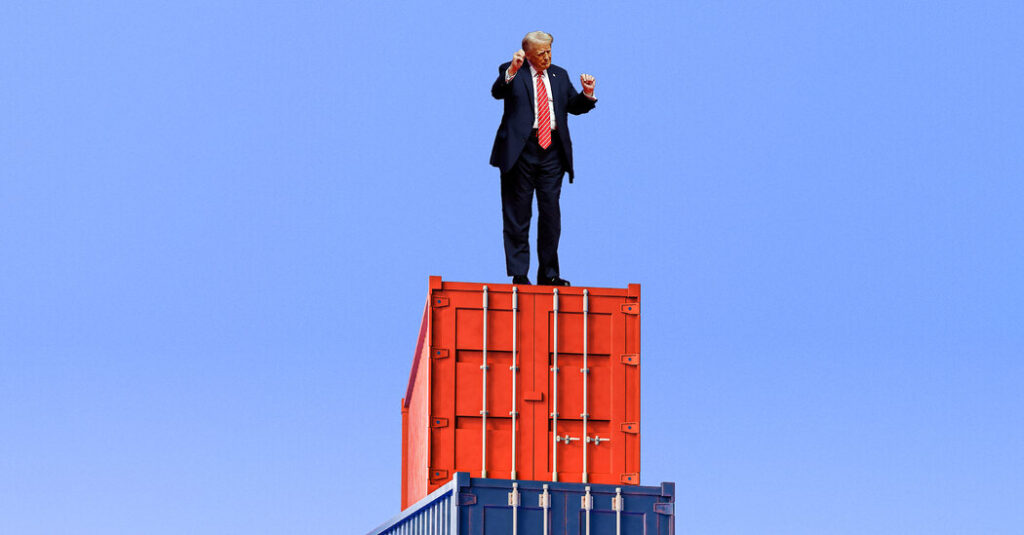
Effective tariff rates are going to change on Friday for the 45th time in the last 18 months — an average of once every 12 days. Rates will ratchet up yet again next month if President Trump’s recently announced 50 percent levy on some Canadian goods goes into effect.
That includes hockey sticks, a product that serves as both a symbol of Canada and possibly a visual of what’ll happen to prices, too. The tariffs do not apply to critical imports, such as oil or potash, but they, too, could get more expensive should the Canadians retaliate.
The president is, in effect, resurrecting a misguided strategy that harms our economy and further undercuts longstanding trade partnerships. The average rate for all our trade partners is set to rise to nearly 13 percent by fall — below April 2025’s “Liberation Day” levels, but still damaging.
Tariffs, as everyone outside the administration seems to know, are taxes paid on imported goods. Companies such as Walmart pay them and typically pass part of the cost along to consumers. At their current levels, these taxes will slow economic growth — as prices rise, people buy less — and cost the average American family around $1,100 annually.
One reasonable question to ask is why, in the months leading to the midterm elections, with most Americans reporting affordability as their top concern and gas prices at $4 a gallon, the administration is fixated on policies that feed inflation.
Another question that’s been on my mind: Didn’t the Supreme Court rule that Mr. Trump couldn’t do this?
When the court struck down the administration’s signature tariffs in February, its opinion wasn’t particularly ambiguous: The founders, it said, “did not vest any part of the taxing power in the executive branch.” That’s why the Treasury Department has so far refunded more than $80 billion in tariffs in this fiscal year.
It’s true that the president has other ways to institute tariffs — if countries dump goods priced below the cost to make them, for instance, he can step in. But the six justices who concluded the executive had overreached were clear that those other approaches imposed “limits on the duration, amount and scope of the tariffs they authorize.”
Over the last few months, as many predicted (including me and more important, Justice Brett Kavanaugh in his February dissent), the administration has quickly leveraged its other authorities to try to reconstruct its overall global trade policy.
First, the administration announced it would reinstate many of the disallowed tariffs by using Section 122 of the Trade Act of 1974, which authorizes temporary tariffs to address “fundamental international payments problems.” The Court of International Trade struck them down in May, but the government appealed, keeping them alive. In the interim, the 150-day clock on those temporary tariffs is expiring Friday.
Some thought the administration would evade the 150-day limit by claiming to institute another set of Section 122 tariffs that were substantially similar. Instead, the Trump trade team, led by the United States trade representative, Jamieson Greer, has a new pretext for broad-based tariffs: combating forced labor.
In March, Mr. Greer announced an investigation into 59 countries and the European Union for failing to take action on forced labor. A few months later he found what he was looking for, sort of, in a report that cites the need to block the import of goods produced with forced labor. The report points to a few areas where forced labor practices are of concern — tobacco from Malawi, rice from Myanmar, cotton from China.
Those specific examples are being used to justify 10 percent to 12.5 percent tariffs on nearly all the economies investigated, including Norway, which is understandably frustrated since it has actually pioneered laws to prevent forced labor in global supply chains. Miraculously, the new “forced labor” duties recreate a tariff regime similar to the one the Supreme Court struck down in February, even though the goal then was combating trade deficits, not policing labor practices. (Or was it about manufacturing jobs? We’re not doing that well there, either. Manufacturing employment continues to decline during the president’s second term.)
Mr. Trump’s tariff trickery is not quite an Andrew Jackson moment, with the executive openly flouting the law of the land. Mr. Trump’s patchwork approach to reconstructing his tariffs is in keeping with the text of the Supreme Court’s ruling, but not with its spirit.
The Supreme Court clearly declared that taxing power rests with Congress and that any delegation of tariff authority to the president is “subject to strict limits.” Faced with those limits, the administration is betting that it can outrun institutions meant to constrain it. New tariff authorities may continue to face legal challenges. Those will take time to play out. And in the meantime, the administration can try to attach a new rationale to an old law to accomplish much of the same.
This whole game of tariff Whac-a-Mole has the flavor of my regular negotiations with my toddlers: When I tell one he can’t hit his brother with a shovel, he produces a stick instead. (Points for creativity, though.)
There isn’t much to be done in the short run to curb the administration’s tariffs, which flout negotiated trade agreements and the clear constraints on the executive’s power. You have to hope that Congress will eventually push back against this unlawful usurpation of its authority. This week’s expiring tariffs were meant to be temporary; instead they have been extended, seemingly indefinitely.
Natasha Sarin, a contributing Opinion writer, is a professor at Yale Law School and the president of the Budget Lab at Yale. She served in the Treasury Department during the Biden administration.
Source images by Hector Roqueta Rivero, and Anna Moneymaker, via Getty Images.
The Times is committed to publishing a diversity of letters to the editor. We’d like to hear what you think about this or any of our articles. Here are some tips. And here’s our email: [email protected].
Follow the New York Times Opinion section on Facebook, Instagram, TikTok, Bluesky, WhatsApp and Threads.
The post Trump’s Tariff Runaround Defies the Courts and Common Sense appeared first on New York Times.