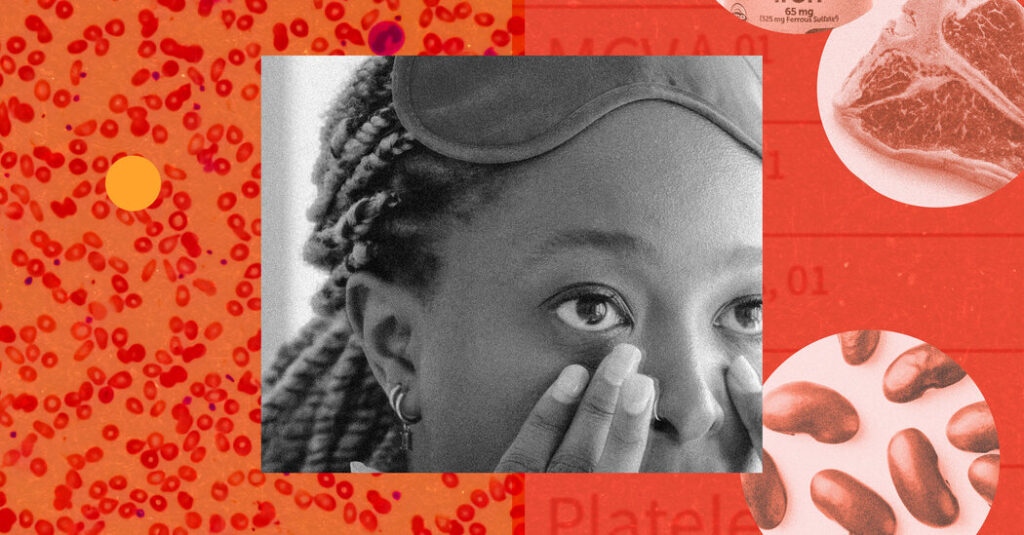
“Ferritin face” is what social media influencers call the tired, sallow, dark-circles-around-the-eyes look they claim is a signal that your body isn’t getting enough iron. Iron deficiency is also a common subject of posts by doctors, nurses, wellness coaches and others in health fields.
While this might seem like just another internet health trend, iron deficiency is the No. 1 nutritional deficiency globally, and one of the most overlooked. In the United States, it affects almost one in three adults, a disproportionate number of them women.
Referring to the iron women lose through menstrual bleeding, Dr. Soumya Rangarajan, a geriatrician in Ann Arbor, Mich., said, “When you’re a woman in your 20s and 30s, I think things like iron deficiency are written off as a normal part of life.” She said she had her iron levels checked after she came across a colleague’s social media posts about iron deficiency.
In social media posts, some women who were later diagnosed with iron deficiency describe complaining of fatigue and being told by doctors that it was just a symptom of a busy life and stress.
How do doctors diagnose iron deficiency?
Iron, a mineral found in many foods, is important in making hemoglobin, a protein in red blood cells that carries oxygen through the blood. Ferritin, another protein, stores iron in the body.
Iron deficiency can be a result of blood loss, not eating enough iron-rich foods, the body’s failure to absorb the iron it takes in, pregnancy, dialysis or other factors. Fatigue is a hallmark symptom, but doctors also watch for hair loss, headaches, shortness of breath, dizziness and in extreme cases pica, a craving for nonfood items like ice, paint, chalk, paper or dirt. Tongue inflammation and changes in fingernails can also be symptoms in severe cases.
Doctors may screen for iron deficiency by testing your hemoglobin levels. But because the test doesn’t measure ferritin, it doesn’t typically show a drop until your iron reserves are already significantly depleted. As a result, the standard blood test can miss someone who’s iron deficient, said Dr. Angela Weyand, a pediatric hematologist at the University of Michigan.
In fact, ferritin levels are the best reflection of total iron storage, and a ferritin test can catch iron deficiency in the early stages, before it becomes anemia, the most severe form of iron depletion.
In a ferritin test, iron deficiency is characterized by ferritin lower than 30 nanograms per milliliter. Many doctors argue that the cutoff for a diagnosis should be higher, signaling iron deficiency when ferritin drops below 50 nanograms per milliliter, especially for women or people who have symptoms.
The American Society of Hematology has proposed draft guidelines that would adopt that threshold for people with symptoms or risk factors like heavy menstrual bleeding or pregnancy, with the recommendations expected to be published later this month.
The gap in iron levels between women and men starts during puberty, when girls begin menstruating, and doesn’t close until menopause, when women’s monthly blood loss finally stops, Dr. Weyand said. “That’s a whole lifetime of these patients being iron deficient, and it’s not as if you stop having periods and you’re immediately iron replete,” she added. “It can take some time to recover.”
But many women who have heavy periods don’t realize they have an iron deficiency because they’re not tested for it. And many tests use anemia, the most severe form, as the bar for a diagnosis of iron deficiency. In a 2021 review article, the authors reported a finding that iron deficiency — measured by ferritin, not just anemia — affected 48 percent of 271 women screened at a running event in Singapore who said they considered themselves “fit and healthy.”
The American College of Obstetricians and Gynecologists recommends routine complete blood counts during pregnancy, another time when iron can be depleted. But this guidance flags only patients who are already anemic and not those who have low iron but do not have anemia, Dr. Weyand said.
In August 2024, the U.S. Preventive Services Task Force, a panel of independent experts that makes recommendations for preventive health screenings, said there was not enough evidence to recommend for or against screening pregnant patients who are not anemic for iron deficiency.
Are there other conditions that contribute to low iron?
Several conditions can decrease iron absorption regardless of diet. Patients with a history of bariatric or gastric surgery can experience impaired iron absorption, since the procedure alters the part of the gut where absorption happens. Infection with H. pylori or prolonged use of some medications used to treat acid reflux can also contribute to iron absorption.
Dr. Imo Akpan, a hematologist and associate professor of medicine at Columbia University Irving Medical Center, said inflammatory bowel disease and celiac disease can damage the intestinal lining that iron needs to pass through, affecting absorption. Some patients with inflammatory bowel disease may experience blood loss, leading to iron deficiency as well.
Chronic inflammation, from conditions like autoimmune diseases, kidney disease, heart failure or cancer raises a hormone called hepcidin that shuts down iron absorption in the gut, no matter how much oral iron someone is taking in. If left unaddressed, it can progress into what is called anemia of chronic inflammation, Dr. Akpan said. “In these patients,” she added, “we typically manage their iron deficiency with IV iron infusion because this will overcome the influence of hepcidin.”
Because the symptoms of low iron are so nonspecific, any of them is reason enough to ask a doctor for a full iron panel, not just a ferritin test alone. “It could be a million other things, too, which is what makes it so difficult,” said Dr. Nate Wood, an internal medicine specialist and director of culinary medicine at Yale School of Medicine.
If bleeding and inadequate intake are ruled out, he said, he starts looking for conditions that can impair absorption, including celiac disease, inflammatory bowel diseases like Crohn’s or ulcerative colitis, an H. pylori infection, a history of bariatric or intestinal surgery or taking acid-suppressing medications like omeprazole, which can reduce how much iron the body absorbs.
How is iron deficiency treated?
It depends on how iron deficient someone is and what is causing the deficiency.
Supplemental iron can be taken orally or administered intravenously by a licensed clinician. Iron pills are commonly prescribed for low iron levels, but a significant number of people who take them experience gastrointestinal side effects, Dr. Weyand said.
Typically, doctors prescribe one pill to be taken every other day, at doses of 65 milligrams to 100 milligrams of iron. If levels haven’t improved after three months, the patient may need to turn to alternative treatments like iron infusions, said Dr. Toby Richards, a professor of surgery at the University of East London who runs the Iron Clinic, which offers iron infusions.
But these treatments do not necessarily pinpoint the deficiency’s root cause, Dr. Wood said. Infusions and pills address the core issue only if the deficiency is from inadequate intake, he said. If it is caused by bleeding, malabsorption, a higher need for iron or other conditions, supplemental iron must be paired with treatment of the underlying cause.
Should you start taking an iron supplement just in case?
While it may be tempting to reach for a supplement at the first sign of fatigue, experts warn against doing so.
Taking iron if you don’t really have a deficiency can lead to iron overload, which can make you feel just as tired as if you were deficient. And in people with hemochromatosis, a genetic tendency to absorb too much iron, supplements can cause serious harm over time, with damage to the liver, heart and pancreas.
“The body is like Goldilocks with everything, iron included,” Dr. Wood said.
Short of taking supplements, there are natural ways to get more iron.
Meat and seafood contain a form of iron called heme iron, which is absorbed more easily than the iron found in beans, leafy greens and fortified grains.
Pairing plant-based iron with food containing vitamin C, like citrus fruits, berries, bell peppers or tomatoes, helps the body absorb more of it. Dr. Wood recommends dishes like lentils with tomatoes, beans with salsa or an iron-fortified cereal topped with berries.
Vegetarians need almost twice as much iron per day as people who eat meat, since their bodies absorb less of the mineral, Dr. Wood said. It’s also best to avoid tea, coffee or dairy within a couple of hours of eating iron-rich foods, since they can block absorption, he added.
The post Fatigue? Dark Circles? How to Tell if It’s Iron Deficiency. appeared first on New York Times.