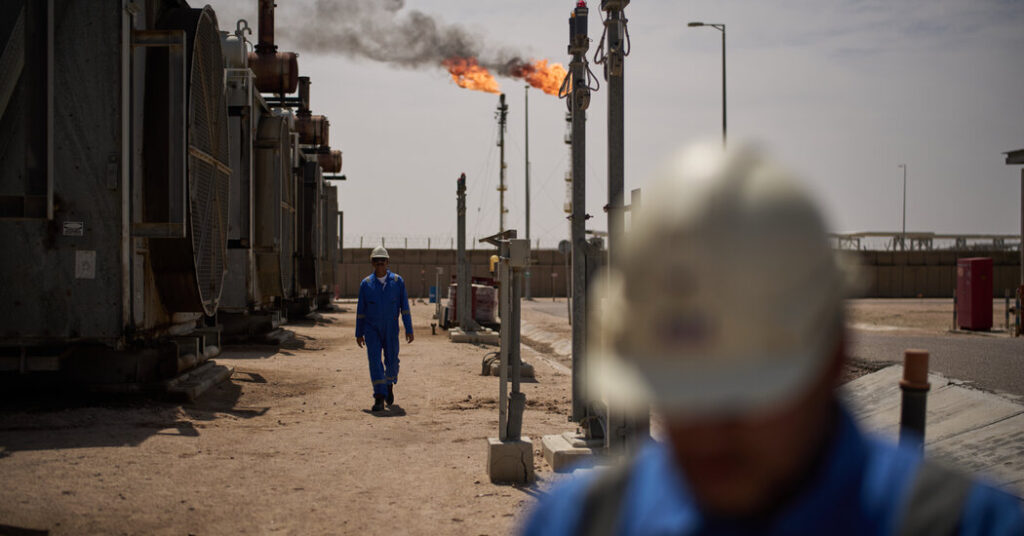
Global oil prices hit $100 a barrel on Thursday for the first time since May as the widening war between the United States and Iran stifled the flow of energy in the Middle East.
The price rebound in Brent crude oil over the past few weeks reflects the market’s growing concern about the expanding conflict, which now extends from the Persian Gulf to the Red Sea. Both arteries are vital to the global energy trade.
The Houthi threat to prevent ships from traveling to and from Saudi Arabian ports on the Red Sea has complicated travel in an area that was serving as an alternative to the Strait of Hormuz, where Iran and the United States are jousting for control.
The Houthis, an Iran-backed group in Yemen, claimed on Wednesday that they had targeted two Saudi oil tankers with missiles and drones. If the Houthis manage to block Saudi Arabia from using the Red Sea, they would be cutting off about 4 percent of the world’s oil supply and leaving Saudi Arabia, one of the world’s biggest producers, with very little access to global markets.
“The conflict has entered a decidedly more dangerous phase,” analysts from RBC Capital Markets wrote on Wednesday. Even though oil prices have risen a lot in recent weeks, “we still see them as a lagging indicator of the extreme pressure building in the region,” they added, forecasting that a “full regional war” could send prices toward $150 a barrel.
Brent oil prices are now nearly 40 percent higher than on the eve of the war. (U.S. oil prices, at around $91 a barrel, are on a similar trajectory.) More expensive oil will push prices at the pump around the world even higher, unwelcome news for drivers already faced with stubbornly high gasoline and diesel prices.
The cost of those transportation fuels remained elevated even as oil prices eased in June, briefly falling below prewar levels. More oil was flowing through the Strait of Hormuz at that time, but fewer refineries were available to turn that crude into the fuels that power cars and airplanes.
That is partly because of the war with Iran, but also because Ukraine has inflicted significant damage on Russian refineries — so much so that Russia banned diesel exports in early July to preserve domestic supplies.
A gallon of regular gasoline in the United States cost 37 percent more on Thursday than it did prewar, at a national average of $4.09 per gallon, according to the AAA motor club. Diesel prices were 39 percent higher than they were when U.S.-Israeli strikes on Iran started in February.
The refineries that remain open are reaping huge rewards. In the United States, profit margins on turning oil into gasoline and diesel are near multiyear highs, according to data from commodities research firm Argus Media.
The threats to shipping in the Red Sea, paired with continued fighting between the United States and Iran around the Persian Gulf, are stoking concern about the outlook for oil supply, Fatih Birol, executive director of the International Energy Agency, said this week.
“A resolution to the ongoing conflict that includes a full and unconditional reopening of the Strait of Hormuz will be essential to avoid a further deterioration in global energy security,” Mr. Birol said.
The post Global Oil Price Hits $100 a Barrel for First Time Since May appeared first on New York Times.