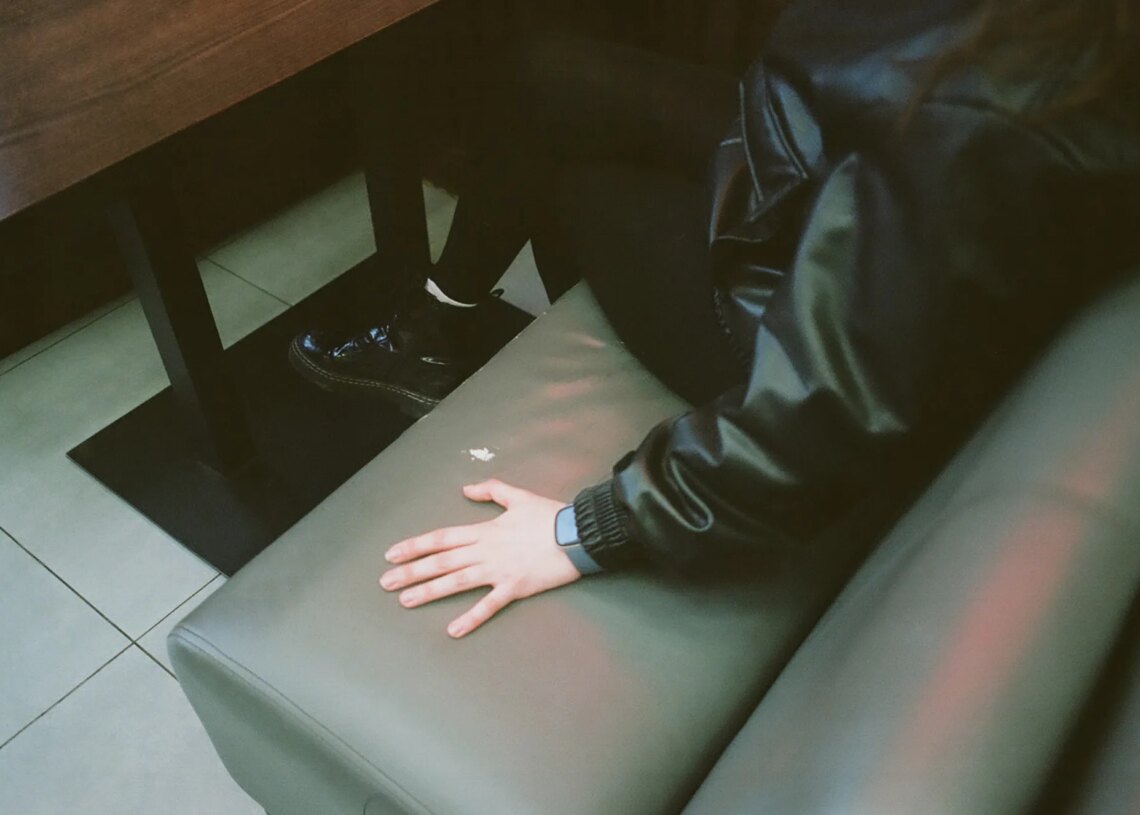
For many, late-night chicken shops are the final port of call before the sweet oblivion of sleep; a holding pen for the drunk and the tired with psych-ward lighting that it’s preferable to escape from as rapidly as possible.
For Lucy*, one branch of London fried-chicken chain Morley’s conjures up different kinds of memories, as her trips there revolved around picking up not food, but men. “It’s a bit of a time warp,” Lucy tells me, her face illuminated by the harsh LED panels of an eatery she now associates with the height of her sex addiction. “Maybe I feel a little bit horny… Don’t judge me for that. You know how places evoke a memory or a feeling within you?”

The 30-year-old, who struggled with sex addiction between the ages of 22 and 24, admits being back here is something of a trigger. At that point in her life, Lucy would find it difficult to go a day without sex, and was usually sleeping with five different men each week, most of them strangers she’d pick up impulsively—here in Morley’s, in McDonald’s, at gigs, and on the street. It didn’t really matter who they were. She didn’t think about them after, and rarely told her friends. “I’d check their nails a bit, just to see they were clean,” she shrugs.
“Mindless” is the word Lucy uses to describe her behavior at this time. “It did occasionally feel like I was leading a double life,” she says. In hindsight, Lucy thinks her appetite for sex was sparked when her partner cheated on her with her best friend. Things changed when she fell pregnant and had a late-stage abortion. “There were three men who could have been the dad,” she recalls. “I’m just lucky nothing bad happened, looking back. I thought I was just being young, wild, and free. I didn’t think I had a problem.” Lucy says she has now made peace with her sex addiction and is eager to distance herself from her former routine.

Unlike substance abuse or alcoholism, sex addiction often lacks obvious symptoms. There are also no established criteria for diagnosis, which—along with the enduring stigma and awkwardness around discussing sex—makes it harder to identify and more complex to treat.
In recent years, there has been an uptick in research attempting to grapple with the reality, and scale, of what many believe is a hidden epidemic of sex addiction, at a time when novel new tech and social pressures are throwing our relationship to intimacy into disarray. Yet some estimates have suggested that 2.6 million people in the UK can be defined as sex addicts—4.7 percent of the entire adult population. This would amount to three sex addicts on every London double-decker bus, and four in every full tube carriage. The sense that this figure is surely too high speaks to the difficulties of documenting this issue and those affected by it.
There is one place, however, where you are guaranteed to meet sex addicts.
~~~
It’s the longest day of the year and I’m sitting in a sweltering church hall in suburban southwest England, knocking back piss-weak tea. The meeting begins the same way that I have come to learn all Sex Addicts Anonymous meetings begin, with the emotional bureaucracy of strangers reading from laminated print outs of community literature. There is the abstinence statement, which immediately acknowledges that SAA does not have a “universal definition of abstinence.” Then, an acknowledgement of “the empty chair”—a literal empty chair that has been placed in the room to represent those who have come, gone, or are yet to join the group. The empty chair is a powerful metaphor that encapsulates the furtive nature of sex addiction. Depending on their needs, some people attend as many as six meetings a week. I’m curious about what those here today will have to say. Through my regular visits, I have come to understand that sex addiction can mean very different things to very different people.
Within the safety of a circle of plastic seats, interspersed with garish, flowery sofas that wouldn’t look amiss in Austin Powers’ living room, one man explains how he’d spend eight hours a day binging porn. Another, to my left, says he was put through conversion therapy on the NHS, and another recounts walking into the sea in an attempt to take his own life. “I firmly believe the only person who can cure an addict is another addict,” the third man says. “Only you guys know where I am coming from, because you’ve either been there or still are.”
There are 13 men and three women in the room. The latter are here to support their husbands and boyfriends. Partners wouldn’t usually attend meetings, but this particular session is open to members’ loved ones, professionals (therapists, social workers, healthcare workers), and those, like me, who are interested in learning more about sex addiction. Besides the partners, I’m the sole person who is not part of SAA, but it’s a community—or, by its own definition, a “fellowship”—that I’ll become well acquainted with over the coming months, through in-person meetings in Bristol, online group therapy sessions, and regular phone calls with three self-professed sex addicts. (The photos in this story were shot at places resonant to those in the portraits, for being physical locations that sex addiction led them to.)
“Some estimates have suggested that 2.6 million people in the UK can be defined as sex addicts […] This would amount to three sex addicts on every London double-decker bus, and four in every full tube carriage”
SAA follows the same 12-step recovery model as the Alcoholics, Narcotics, and Gamblers Anonymous programs. AA was developed first, in 1930s Minnesota, with roots in Christian beliefs of surrender and redemption. Five of the 12 steps mention God explicitly. However, “adherence to any specific set of beliefs or practices,” as SAA puts it, is not a prerequisite to membership. The emphasis is on a belief in a “power greater than ourselves,” whatever you consider that to be. Where SAA differs from other recovery models is that it does not advocate for blanket abstinence. Rather, it asks “each member to define his or her own abstinence.” That could mean forgoing masturbation and/or pornography but continuing to have sex, or withdrawing from all kinds of sexual activity—whatever works for the individual.
Like many people I meet in the fellowship, Paul* traces his addiction back to childhood. Growing up in Merseyside in the 1960s, Paul tells me his upbringing was colored by “terrible deprivation,” in a lengthy interview away from the group. His father died when he was two, and most of his eight brothers and sisters have long since moved away. Even so, there wasn’t much space at home, and he was forced to share a bed with his mum and two siblings. At the age of 13, when his mother developed schizophrenia, life began to spiral out of control.
At 14, he started drinking. By 15, he was sniffing solvents. By 16, he was regularly taking acid, and by 19, injecting heroin. Once, when he was drinking heavily, he smashed a bottle of liquor on a vinyl floor, soaked it up with two J-cloths, and squeezed it into a pint glass, before filtering out the pieces of glass through another J-cloth and drinking it. Another time, he injected himself with rum. But his dysfunctional relationship to sex, he says, predates all of that. “I found different ways to comfort myself and the earliest were with sexual activity,” he says. “As soon as I found out how to orgasm, it became a continual daily occurrence.”
At 29, Paul started AA, and later NA. He hasn’t touched drugs or booze since, but within six months of seeking help for his drinking he realized that he was struggling with sex addiction too. He began going to Sex and Love Addicts Anonymous in London in 1985, but failed to fully engage, only attending meetings twice a year due to the days spent traveling to and from Merseyside. In 1992, he stopped going to meetings, believing he was “cured.”
Over the following decades, Paul’s sex addiction spiraled. His porn consumption became obsessive, and he frequently cheated on his wife. “When I was younger I had the morals of a tom cat,” he says. When the family got their first home computer, things got worse; technological advances enabled his porn addiction to ramp up considerably. “I was exhausted all the time,” he recalls. “My ritual was: get up around 5AM, look at pornography for about an hour and a half, then start cleaning up the computer [before] my wife would get up at 7.”

When Paul’s addiction was at its peak, he would be watching porn for up to four hours every day. He’d also be “chatting up women every day, 24/7, 365 days a year,” he explains. “If I was awake, I was thinking about where I was going to get the next sexual fix. If I was asleep, I’d be dreaming about sex. It was just constant.” Sometimes, if there were people at home, he would go for a drive to look at pornography and masturbate in lay-bys.
“I found different ways to comfort myself and the earliest were with sexual activity. As soon as I found out how to orgasm, it became a continual daily occurrence”
Discussing his multiple lengthy affairs, some of which overlapped, Paul says he believes that he was looking for women to fix him, as well as yearning for connection. Unlike some of the people he has met through SAA, though, who have spent small fortunes on sex workers, Paul’s addiction never burned a hole in his pocket. His main expenses were budget hotel rooms, where he would take women, and the price of broadband.
The World Health Organisation officially recognized compulsive sexual behavior as a disorder in 2022. While it’s generally seen as lacking in physical symptoms, Paul’s experience suggests otherwise. He describes the brutal comedowns he would get after his sex and porn binges. The sprees would anesthetize his negative feelings, but only temporarily. “There is an actual comedown from sexual behavior,” he says. “There is a withdrawal. Sometimes, you just feel totally flat. With sex addiction, it’s looking for that bigger thrill, that bigger taboo. In the end, it’s a basic inability to cope with reality, so you just try and find ways of ducking out of it.”
In 2017, Paul returned to SAA, and continues to attend meetings regularly. He credits them with turning his life around. “By and large, people aren’t interested in what you’ve done,” he says. “They’re only interested in what you do today, so you don’t do it again.”
Things haven’t been so straightforward for Paul’s wife, whose life changed immeasurably after he told her he was addicted to sex. Present at the first meeting I attended, she agreed to speak a few months later. “I am quite guarded,” Liz* cautions at the start of our interview. Married to Paul for 40 or so years, she explains that she was aware of his interest in porn from early on in their relationship, and was concerned their children would find out, but he was vigilant about keeping it away from them. She had never heard of sex addiction until Paul told her he was attending Sex Addicts and Love Addicts Anonymous meetings, and that he had been having affairs. “I guess it was difficult because I don’t know what sex addiction means,” she says. “I don’t know what it means for him, or anybody else; for me, and our relationship.”
Unsurprisingly, for Liz it was devastating. “Especially when he resumed an affair with one of the women after breaking it off,” she adds. “I blamed myself, withdrew, and suppressed a lot of my feelings.” Paul’s decision to attend SAA meetings initially made their relationship rockier, as he probed her on things she struggled to talk about, but overall the impact has been positive. She says the fear of Paul having affairs has dissipated and he is now much more open about his life.
~~~
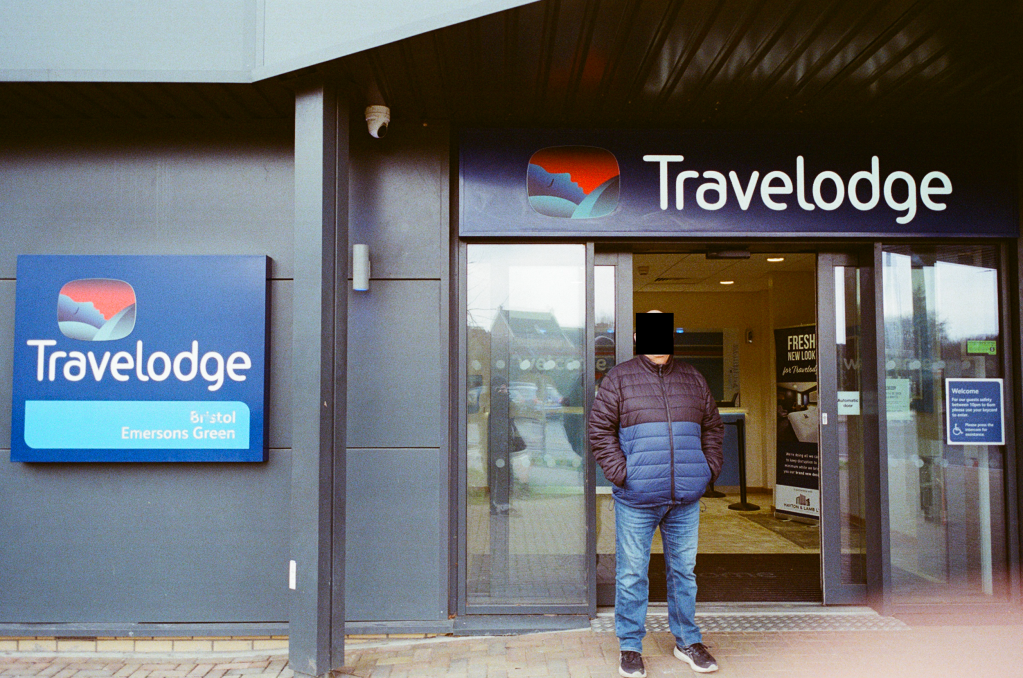
The Travelodge on the outskirts of Bristol is not a particularly glamorous destination. It’s functional and boxy, furnished garishly with random words like “relax,” “meet,” and “yummy” sprayed in jaunty fonts across the walls. Music that sounds like a polyphonic ringtone from 2003 wafts across the foyer, and there are more builders than guests when Paul and I meet on a typically overcast British winter’s day. Before seeking help with SAA, Paul brought women here often. “I used to quite like it because I imagined I was on holiday in a separate existence,” he says. The fantasy never lasted long, though. He only used rooms for an hour at a time, fearing his wife would rumble him. Outside the hotel, middle-aged men unload car boots as the dull roar of traffic numbs the senses. Blue lights attempt to enchant the flat-pack building, but the desired effect isn’t quite the same in daytime. Besieged by a Costa, McDonald’s, and Greggs drive-through, you could be anywhere in the UK.
Whenever Paul visited a Travelodge with his wife years later, he would feel overwhelmed with guilt. Now, he insists that returning doesn’t stir much emotion in him. Conversation turns to the attitude of Brits towards sex more broadly. Paul feels desire has morphed into an extension of the dopamine-seeking, hyper-consumerist world we live in. “It’s very easy to drift into fantasy,” he reflects. “It’s sex everywhere. Pornography everywhere. The commercialization of sex and consumption of sex has just carried on in line with other means of escaping reality.”
The gender split at the second SAA meeting I attend, located in the same church hall, is similar to the first: 18 men, two women. There is one difference, though. Someone’s mother is here. She sits quietly as her son introduces himself as a sex addict, and then describes how he would get drunk and obsessively stream himself masturbating on cam sites. When he finishes speaking, he concedes: “I bet that’s weird to hear, Mum.” In keeping with the theme of the evening, another man recounts how his interest in sex began when he stumbled across his mum’s catalogs as a young boy. This led to watching porn, and later progressed into what he categorizes as more serious pornography use, as well as paying for sex workers and spending lengthy periods of time in chat rooms. Living alone in a bedsit in Leeds, he would “act out” (a term the fellowship uses for obsessive, unhealthy sexual behavior) all night before going to work on one hour’s sleep, and then clock off and do it all over again.
Away from the group, the mother who attends the meeting with her son agrees to speak to me—admitting she was horrified to learn that her son was a sex addict. She had no idea what was happening while he was living with her, but says in hindsight it all makes sense as he had been spending a lot of time in his room. “Being a parent, you go, ‘Oh god, how did it happen?’” she says, her voice filled with concern more than anything else. “You look back on their childhood, their upbringing, and you think—what caused it, how could I have helped?”
“She recalls often wearing a specific shirt in her early twenties that she knew would burst open if she squeezed past people”
The meetings I attend in person are dominated by men, but women do go to mixed-gender in-person meetings. Others opt for women-only meetings (which are typically remote, as female membership is lower and scattered across the UK). Eager to hear from a woman who is part of Sex Addicts Anonymous, I’m introduced to Daisy*. Over the phone, the mother of three tells me that she didn’t admit to herself she was a sex addict until she was 47. Now 55, she thinks the roots of her problem dates back to being sexually abused as a child. She also explains there was a great deal of alcoholism and drug use in her family. “When I was six or seven, I was acting inappropriately, coercing my classmates into games of kiss, cuddle, and torture, and the torture was a kiss and a cuddle,” she tells me. “I would have coerced peers into exposing themselves and kissing. There was always this sexual undertone with me, which continued through primary school, and then in high school it just progressed.”
From the age of 14 to 47, Daisy was unfaithful in all of her relationships; cheating on partners multiple times with multiple people as the same pattern repeated itself. “He didn’t know it, but one time my husband walked past me getting off with someone in the street,” she recalls.
For a very long time, sex was “everything” to her. It informed her sense of humor, and the music and the films she gravitated toward. It affected how she partied (she preferred to meet men in pubs rather than raves, feeling that dancing served as a distraction from sex) and how she dressed (she recalls often wearing a specific shirt in her early twenties that she knew would burst open if she squeezed past people). Moreover, it dominated her thoughts, and she would be sat in work meetings consumed by fantasies. “There is no drug on the planet that can do everything I thought sex could do for me: it would calm me, it would excite me,” Daisy says. “It would make me feel strong and also make me feel suicidal.”
Daisy’s fixation with sex also involved intermittent heavy porn use and what she describes as compulsive masturbation. At times she would need to have up to ten orgasms before she could fall asleep. This part of her story is similar to the ones I’ve heard relayed by men in the groups: It started with porn and progressed to chat-rooms. There, Daisy would speak to people four or five nights a week, and sometimes go on to meet them in person. Eventually, her mental health started to deteriorate. “Towards the end, I was depressed,” Daisy says. “I couldn’t look at myself in the mirror. I was absolutely miserable.”
After a friend suggested she might be a sex addict, Daisy sought help from SAA. She has now been involved in the fellowship for seven years, and feels her approach to sex has been in a healthy place ever since. She goes to meetings two or three times a week and avidly follows the program. Perhaps contrary to assumptions about those in recovery, Daisy still has, and most importantly still enjoys, sex. “Sex was never my problem,” she reflects. “It was my solution to my problems.”

While Paul and Daisy are now facing their addiction head on, many sex addicts can spend a lifetime refusing to admit they have a problem at all. Dr. Paula Hall, a sexual and relationship psychotherapist at the Laurel Centre, believes that many sex addicts go undiagnosed. In her book Understanding and Treating Sex and Pornography Addiction (2012), she warns that moral debates over the definition, or even the existence, of sex and porn addiction, means that many struggle to get help. Dr. Hall attributes the rise in people seeking support from the Laurel Centre to growing awareness. “When it comes to treatment, it’s not about abstinence,” she says. “It’s about helping people to develop a healthy relationship with their sexuality. It’s helping them to enjoy their sexuality more, not less.”
“There is no drug on the planet that can do everything I thought sex could do for me: it would calm me, it would excite me. It would make me feel strong and also make me feel suicidal”
The 12-Step program is just one of many ways to approach the issue. “SAA doesn’t refer to sexual disorders, because their focus is on the experience of addiction rather than sexuality, and because sex addiction is not a disorder,” Dr. Hall says. “Plus, SAA is a peer support group and not a treatment provider. Addiction treatment language doesn’t cover sexual disorders. If someone thinks they have a sexual disorder, they should consult a professional.”
Sex addiction shouldn’t be conflated with sexual disorder or criminal sexual activity. However, there can be some overlap. For instance, around 10 percent of the people Dr. Hall supports with sex and porn addiction at the Laurel Centre are sex offenders. “Not all sex addicts are sex offenders, and not all sex offenders are sex addicts,” Dr. Hall clarifies. “If someone has crossed the line into sex offending then the addiction or compulsion may be an explanation for the behavior, but it doesn’t excuse it.”
~~~
Bradley* is a member of SAA and a convicted sex offender. You would expect this to cause tension in the group, but the members I speak to insist it does not. The ethos of the fellowship is to accept people, as long as they want to change, and their regular presence at meetings is taken as a sign of that. Number three of their 12 traditions specifically states: “The only requirement for SAA membership is a desire to stop addictive sexual behavior.” In society, pedophilia is often swept under the rug but this can be counterproductive. Not all offenders can be reformed, of course. But for those who can, treatment and rehabilitation are the most likely methods of preventing reoffending, and of stopping more damage being done to young lives. Spaces offering this are few and far between. SAA is a rare example.
Bradley, who attended all of the meetings I went to, tells me that his porn addiction started when he was just ten. At the height of his addiction, he was masturbating ten times a day. He would sometimes skip breakfast and a morning shower to make time for porn. “My family were none the wiser, and a part of me was a bit like, ‘Really?’” the 28-year-old says.
At work and at home, sex monopolized Bradley’s world. “I would chop an onion and look at it and think it looks like a vagina,” he says. His porn addiction evolved dangerously when he went to university and a fellow student introduced him to the dark web. He used it to look at child sexual abuse content, and was subsequently convicted. He now understands, he says, that this was a form of indirect victimization, because he was “creating the demand for the supply,” and “every time that image gets used, it’s technically another assault.”
As repentant as he may be now, the conviction wasn’t the sole spur for him to change his ways. A few months later, Bradley was in his room watching porn when his father had a heart attack. He heard a plate smash downstairs, then his father’s friend raising the alarm. Bradley rushed down and gave his dad CPR, but it was no use. Shortly after, Bradley’s father was pronounced dead at hospital. Bradley often blames himself for his dad’s passing, and wonders what would have happened if he hadn’t been in bed masturbating at the time.
“Sex was never my problem. It was my solution to my problems”
The combination of criminal charges and the loss of his dad compelled Bradley to start attending SAA meetings in April 2023. He now attends three to four a week and abstains from porn completely. “Even on my darkest days, where I feel like the world is against me and no one would want to spend any time with me, I know there’s always a meeting where it doesn’t matter what has happened. I’ll be welcome as long as my desire to stop having addictive behavior is the reason why I’m there.”
Dave*, described by Bradley as his “surrogate father,” has supported him throughout. He accompanied Bradley to court and was close to his dad—in fact, he was the friend in the house at the time of the fatal heart attack. “The first time I came into contact with [Bradley’s] issues was when his dad rang me and said the police had been to the house because they were confiscating various items,” Dave tells me. “It was a twin reaction, really. One was that I love him. I’ve known him since he was a little kid and I really felt for his dad. The other was revulsion.” Dave explains he’s seen a change in Bradley since he started SAA, saying he has become more emotionally intelligent and is able to take responsibility for his behavior.
Vicky Young, who works for the Lucy Faithfull Foundation, a UK charity working to prevent child sexual abuse, believes people who have looked at indecent images of children online can be rehabilitated. “There is a lot of work that we can do with people to help them change their behavior,” Young, head of the charity’s predominantly government-funded Stop It Now helpline, adds. “In some situations, the offending is limited to the online environment. That is a very different environment to contact offending.”

Bradley and I drive down the M5 to a particular lay-by where he’d park up and binge porn. The sky is cigarette-ash gray and traffic thunders by. “There’s the gravity of knowing what I used to do and how often I did it and the dangers I’d put myself in,” Bradley says of returning here. “But then the pride of being able to go, ‘I don’t do this anymore. I’m not that person.’”
~~~
I attend my final SAA meeting from a B&B in Liverpool on a mid-August Saturday night. It’s an online session. The meeting follows the now-familiar format: the literature is read out, one member speaks about their addiction and recovery journey for around 20 minutes, and then others do the same. People seem more subdued in their natural habitats. One man is in a room full of power tools, a woman is sitting on a sofa, one guy is lying on a hospital bed in his home, another is lying on his duvet with his partner behind him, and one is walking down the street with headphones in. This reminds me of the tenth step in SAA’s program, which asks members to “take personal inventory”—which essentially means taking daily stock of their emotions, and being vigilant about things like fear and resentment. The meetings place an emphasis on the importance of showing up, with the mantra “it works if you work it” popping up again and again.
The rise in people pursuing help for sex addiction in the UK reflects a growing awareness of the issue. However, ignorance and stigma is still a huge barrier to understanding, as is access to treatment. These things feel, in part, tied to the difficulty in defining sex addiction in the first place. Paul, Daisy, Bradley, and Lucy’s stories show how hard it can be to recognize, wrapped up as it often is with other psychological and environmental factors. Then, there is the Jekyll and Hyde nature of sex itself. At its best, sex awakens feelings of ecstasy, sanctuary, and self-belief, bringing you closer to others and yourself. At its worst, it can be another coping mechanism used to anesthetize pain and trauma—but becoming, in the end, the very thing that perpetuates it. Many sex addicts sleep-walk around the UK in denial about their situation, lying to both themselves and to others. I’m reminded again of the empty chair: a symbol not just of the invisibility of sex addicts as individuals, but of the concept of sex addiction itself.
This report was undertaken with the full consent and support of Sex Addicts Anonymous. Names have been changed for privacy.
If you’re struggling with addiction, you can visit the official UK and U.S. website of Sex Addicts Anonymous for treatment information.
Follow Maya on Instagram @maya_oppenheim
Follow Thurston on Instagram @guamcruise35mm
The post British Sex Addicts (and the People Who Love Them) appeared first on VICE.