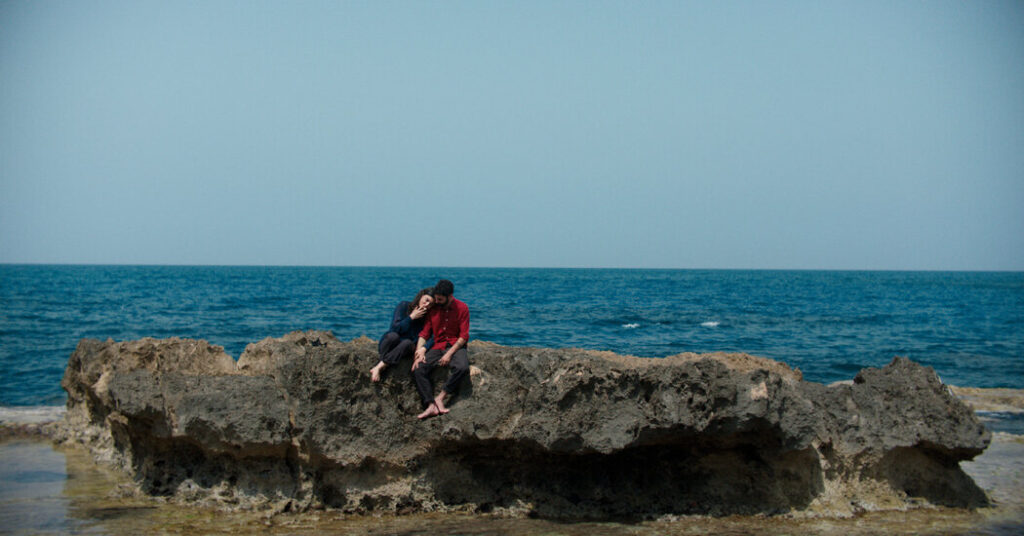
Many of the great cinematic love stories take place against the backdrop of war — “Casablanca,” “Doctor Zhivago,” “Cold War,” “Reds” — for reasons that emerge naturally. The conflict lends itself to tales of separation and reunion, for one. The stakes of the romance go up, too. In any kind of life you might lose your beloved; in a life lived during a time of destruction and death, sudden and tragic loss seems more plausible.
“A Sad and Beautiful World” fits some of the contours of the classic wartime romance, with its multidecade love story happening amid periods of havoc and instability in Beirut, Lebanon. But the story it tells is more intimate than epic, and somehow more contemporary as well, with a pressing question at its core: How do we retain our humanity when the world is full of atrocities?
The writer and director Cyril Aris has ruminated on this question for a while. His previous film, “Dancing on the Edge of a Volcano,” is a documentary shot during another film’s production, which was interrupted by the staggering 2020 port explosions in Beirut. The film shows a group of artists scrambling to decide whether, and how, they can go on with the shoot when forces far beyond their control intervene. The documentary builds toward a haunting question: Why — and how — can you make art in the midst of anxiety, fear and suffering?
The film being made during “Dancing on the Edge of a Volcano” is “Costa Brava, Lebanon,” which Aris edited and which opened in theaters in the United States in 2022. That movie’s director, Mounia Akl, who also wrote the story with Clara Roquet, stars in “A Sad and Beautiful World” as Yasmina, a high-powered businesswoman whose life takes a turn, thanks to love, or fate, or both. After an easygoing restaurateur, Nino (Hasan Akil), accidentally crashes his car into Yasmina’s mother’s business, the two meet, soon realizing that they already know each other. When they were 7, they were schoolmates and childhood sweethearts. But Yasmina’s family situation took her away from Nino, and he has spent decades hoping to meet her again.
Aris weaves the present-tense timeline into the childhood one, showing us the reasons that Nino and Yasmina have grown into the adults they are. Both grew up with the sound of explosions as a constant companion, never quite sure if they were hearing missiles or fireworks. Both yearn for a safe place to rest and find that place in each other. But whereas Nino, raised by his grandfather, has turned into an optimist, with a lighthearted joke for every situation, Yasmina has gone in the other direction. Her parents’ breakup has left her skeptical about love, and her childhood makes her reluctant to bring children into a world like this one.
Aris manages to infuse both perspectives, Nino’s and Yasmina’s, into the film, which is funny, even joyous, without discounting the darkness that lives just outside (and sometimes inside) the walls of its characters’ homes. They dance and laugh and eat well and celebrate. They also worry, as conflict reignites, about the cost of food, about the electricity that isn’t on at night, about whether this is any kind of a life at all, or if they’d be better off somewhere else. The two moods intertwine effectively, sometimes within the same scene, as Nino and Yasmina return to their shared childhood fantasy: that they might travel together to “the Island,” a place where they’ll be secure and warm, where the power is always on and the sun is bright and they never need to fear guns, war or missiles.
Most romances pivot on the lovers’ yearning for one another as they overcome obstacles to be together. In “A Sad and Beautiful World,” the same feeling of longing suffuses the story, with the cinematographer Joe Saade often cropping more than the suggestion of others out of the frame so that we can concentrate on Nino and Yasmina’s internal feelings and their electric connection. Sometimes they succeed in creating their own two-person universe, where no world outside can intrude, the way people can in the presence of their beloved.
But by the midpoint of the story, we realize that the ache they both carry is not only for each other. They wish for “the Island,” for the bright place they have imagined together, and know that it is only their connection to each other that can bring them peace. The love they share seems unbreakable, but the conflict that has shadowed both their lives is trying to break it anyhow. Is it possible to live a real life when the world around you is crumbling? When forces beyond your control make the conditions of life dangerous, how and why should you keep on living?
The answer the film has is not conclusive, because there’s no conclusive answer to give. The world is sad, and it is beautiful, and we are left to figure out what we do with it.
A Sad and Beautiful World Not rated. In Arabic, with subtitles. Running time: 1 hour 50 minutes. In theaters.
The post ‘A Sad and Beautiful World’ Review: A Love to Overcome Fear appeared first on New York Times.