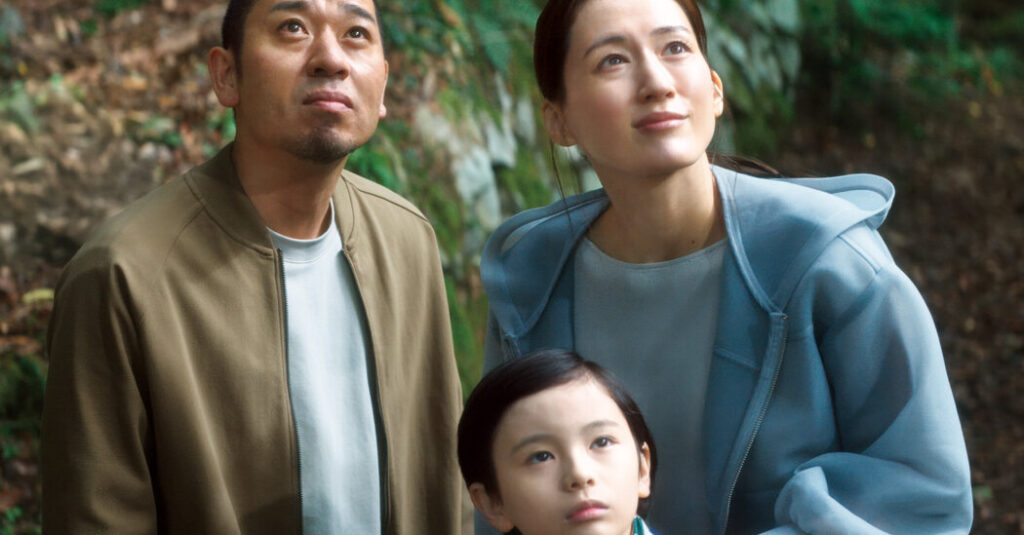
For an auteur whose work has been rooted in human dramas — loss, unspoken love and familial disconnection among ordinary people — it might come as a surprise to see the Japanese master filmmaker Hirokazu Kore-eda explore android genre territory in “Sheep in the Box.” Yet, across an oeuvre haunted by the notion of absences, this story about a robot boy coming home to a couple grieving their late son appears as an inevitable progression.
After all, most stories about artificial life are about interrogating humanity: what makes one truly human, what it means to have a soul, what connects us. Add the pain of missing a loved one and an ache to fill the void and you have a trademark Kore-eda work. Yet from that angle, “Sheep in the Box” is a halfhearted rehash of both the director’s past ideas and the familiar questions behind so many speculative science-fiction stories, all while abandoning that delicate emotional touch that makes the director’s work so special.
Most immediately, “Sheep” calls to mind Steven Spielberg’s “A.I. Artificial Intelligence,” in its broad structure: After the loss of their young son, Kakeru (Rimu Kuwaki), a couple bring home a robot imitator to replace him, and eventually the clone finds himself in communion with other androids. Yet, Kore-eda’s film is a story of half-measures, winding up but never achieving flight. It’s not fair to judge Kore-eda on how he riffs, or doesn’t, on Spielberg’s film, and yet “Sheep” nevertheless feels like it’s perpetually mired in the rising action of a film like “A.I.,” circling in that space before real drama unfolds.
There are multiple intriguing strands that it never manages to fully unfurl: the mystery of what exactly led to Kakeru’s death; the internal tear it created within his parents; the existential ambivalence that bonds the robot Kakeru with other bots. When the film reaches a drawn-out conclusion of swelling emotions, it’s as if we’re watching a transcendent culmination of segments that were mysteriously left on the cutting room floor.
The ingredients here are all of the messy and painful interpersonal conflicts that we’ve seen before from Kore-eda. “Sheep” ultimately lives in the shadow of his other most moving films, while borrowing from them in piecemeal fashion: the hovering ghost of a lost son in “Still Walking”; the swapped sons of “Like Father, Like Son”; the chosen family of “Shoplifters” and “Nobody Knows.”
At its core, the film is burdened by an underdeveloped script, but there is also the subtle, richly poetic observations innate to those past films that is missing here. There are moments of exception, including a scene involving an altercation with police, as a train churns violently across the screen in the foreground. We’re reminded of that gut-punch of emotion that Kore-eda often induces. It’s a potent jolt, but a brief one — everything else feels artificial.
Sheep in the Box Rated PG. In Japanese, with subtitles. Running time: 2 hours 6 minutes. In theaters.
The post ‘Sheep in the Box’ Review: Haunted by His Absence appeared first on New York Times.