Russian businesses have been feeling the effects of the war in Ukraine through tax increases, rising costs caused by fuel shortages, and supply chains disrupted by sanctions. Now, there is another risk to contend with: Ukrainian drone strikes on their facilities.
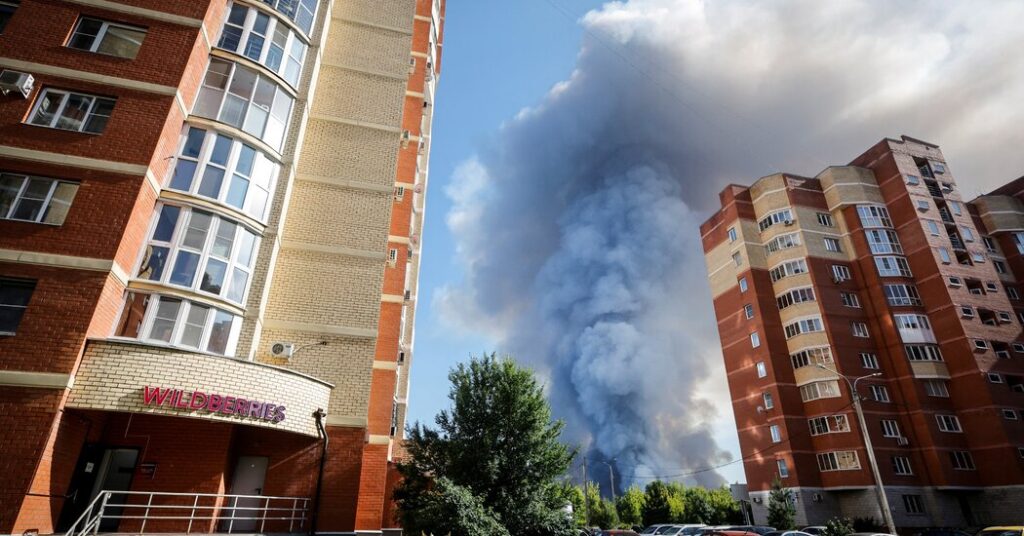
As Ukraine wages a campaign to bring the conflict home to ordinary Russians, it has opened a new front aimed at the online marketplace Wildberries, a pillar of the country’s retail economy and a potent symbol of modern life in Russia.
In recent days, Ukraine has hit five warehouses belonging to Wildberries, a Russian analog to Amazon, as well as storage sites for other large retailers. Eight people were killed in attacks on Saturday and one person on Wednesday, the Russian authorities said. The strikes on Saturday alone were reported to have wiped out between 6 and 9 percent of the storage capacity of Wildberries.
Ukraine’s long-range strikes on Russian economic targets, including a monthslong campaign of attacks on oil processing facilities, are intended to pressure President Vladimir V. Putin to end the war, in part by hampering his ability to finance it. The oil strikes have caused fuel shortages that have led to lines at gas stations, and they could affect the coming harvest season.
Mr. Putin has signaled no intention of backing away from his objectives in the conflict, and the economy, while weakened by the war, is not on the verge of collapse. Still, analysts said that if the attacks on Russia’s business infrastructure continued, the ripple effects could pose severe economic challenges on top of a range of other war-related strains, reducing tax collections and adding to inflation.
Ukraine has targeted Wildberries warehouses in five regions across Russia, including a reported strike early Thursday in the Voronezh region, south of Moscow. A fire at a warehouse in Elektrostal, a city in the Moscow region, took three days to extinguish.
The day after the initial strikes, Russia unleashed the largest missile attack on Kyiv, the Ukrainian capital, since the war started in 2022, firing at least 35 ballistic and hypersonic cruise missiles.
Ukraine has said that its strikes are in retaliation for Russian attacks its postal delivery hubs and other civilian infrastructure, a yearslong campaign by Moscow that has been far more devastating than Kyiv’s strikes against Russia. A Russian attack last week on a postal terminal in the northeastern city of Kharkiv left three people dead and 20 injured.
President Volodymyr Zelensky of Ukraine has also said that Wildberries facilities are a legitimate target because the company sells goods to the Russian military. The Kremlin spokesman, Dmitri S. Peskov, has denied the accusation.
Wildberries has a policy of not selling military-grade weapons, but it does sell goods used by soldiers, like commercial drones that can be jury-rigged with explosives, as well as fiber-optic cables, tactical clothing and other so-called dual-use items.
The Wildberries attacks have been calamitous for small Russian entrepreneurs who sell goods through the site, the country’s largest online marketplace.
One of them, Timur, woke up on Saturday morning to news that he had lost clothing and shoes worth about $25,000 as a result of the attacks on the Wildberries warehouses in Elektrostal and in Kotovsk, in the Tambov region, southeast of Moscow.
Timur, who was nervous about speaking with foreign journalists when reached by telephone and asked that his last name be withheld to avoid reprisals, said that his main concern was the uncertainty that he and other Russian entrepreneurs now faced.
He said on Tuesday that it was unclear what would happen next “because most likely they are not the only warehouses that will be attacked.”
Hours later, two more Wildberries warehouses that contained his apparel, in the southern Stavropol and Krasnodar regions, were hit by drones. His losses doubled.
Timur said he had been building his business for five years, “and it can just collapse in a week,” he said, a precarity that Ukrainians have been living with for nearly four and a half years.
He warned of the effects on the Russian economy, saying that continued strikes could cause the Wildberries business model to collapse, raising prices and bringing about shortages.
Alexander Kolyandr, director for Europe at the Eurasia Group, a consulting firm, echoed that view.
“The company itself and all the sellers will likely pay less in taxes than last year, and given the size, it might be pretty substantial, especially at a time when the Russian budget is experiencing a widening deficit,” Mr. Kolyandr said.
Additionally, the cost of protecting, rebuilding and insuring the warehouses will be passed on to consumers, he said, contributing to already high levels of inflation.
The attacks on Saturday in the Moscow and Tambov regions destroyed goods worth almost as much as Wildberries’ entire profit last year, according to expert estimates reported by Kommersant, a Russian newspaper, and by Forbes Russia.
The company’s chief executive, Tatyana Kim, promised financial compensation of about $25,000 to families of the workers who were killed and half of that amount to the injured. She did not pledge to reimburse sellers who lost goods.
At the beginning of the month, Wildberries and another large online marketplace, Ozon, changed their terms and conditions to stipulate that the company had no legal obligation to offer compensation for losses caused by drone attacks.
Many sellers on Wildberries financed their products with loans, including Timur, who told of interest rates as high as 35 percent. Some vendors risk having their bank accounts frozen as soon as next week if they are unable to make tax payments due in the coming days, according to the business newspaper Vedomosti.
A civilian facility like a warehouse can become a lawful military target if it is being used, or is being prepared to be used, for military purposes, said Michael Schmitt, who teaches international law at the University of Reading in England and is a former legal adviser to the U.S. military.
Combatants, he said, must take into account exactly what kind of materials are inside, have a high degree of certainty about the site’s future military use and make efforts to mitigate harm to civilians.
Maria Snegovaya, a researcher at the Center for Strategic and International Studies, said that Russia’s economic slowdown, related in part to Ukraine’s long-range strikes, had coincided with declining levels of support for the war.
But some in Russia said that the increased drumbeat of attacks could rally Russians around their leader.
“The adversary started doing the job of our propaganda, which is to explain to the nation that a real war is underway, and no one can just lie low,” a Russian military blogger, Roman Saponkov, wrote on Telegram. “At first they switched off fuel at the petrol station, now they took on Wildberries warehouses. Next, it will be beer factories and nail salons.”
Cassandra Vinograd, Milana Mazaeva and Nataliya Vasilyeva contributed reporting.
The post A New Target for Ukraine’s Long-Range Attacks: Russia’s Version of Amazon appeared first on New York Times.