Iranian attacks on nine U.S. locations across the Middle East in the two weeks since the cease-fire broke down show that the country maintains an ability to inflict damage on precise targets, despite the Trump administration’s repeated claims that Iran’s military capabilities have been diminished or destroyed.
A New York Times visual analysis of U.S. military bases and other sites found the strikes have caused damage to living quarters and working areas, drone shelters, radar systems and other structures.
One of the attacks, on Muwaffaq Salti Air Base in Jordan, killed three U.S. soldiers and wounded others. A military official told The Times that nearly a dozen troops were also wounded severely enough by Iranian missile and drone attacks in Jordan and other countries this month that they were flown to a U.S. military hospital in Germany for treatment.
Four of the sites, including Muwaffaq Salti Air Base, had already been struck in the first months of the war, when Iran hit a total of 18 military sites used by the U.S. in seven countries.
Determining the damage to U.S. military sites has been hindered by a lack of high-resolution satellite imagery of the region. The government has asked major U.S. satellite providers to withhold visuals — a longstanding practice that precedes the Trump administration — citing risks to U.S. troops.
But the locations of the bases are public knowledge, and Iran regularly and widely circulates imagery of their strikes on these and other U.S. targets as part of its propaganda efforts.
The Times assessed the damage using a range of visual evidence, including those Iran satellite images which were corroborated using videos captured from inside the locations that were attacked, and photographs and lower-resolution satellite imagery from NASA and the European Space Agency.
A Defense Department spokesman told The Times that “for operational security reasons, the department declines to comment on satellite imagery,” adding that “because the investigation on the incident in Jordan is active, we do not have anything to announce at this time.”
The three soldiers killed on Friday — First Lt. Tyler James Feehan, 25; Pvt. Isabella Gonzales, 19; and Sgt. Angel Rampersad, 28 — were assigned to missile defense units at Muwaffaq Salti Air Base, a hub for the U.S. Air Force. In the days leading up to the deadly attack, Iran had already struck the base at least once. Satellite imagery showed that an airfield hangar was destroyed sometime between Wednesday and Friday morning.
Following the attacks on Friday night, a video emerged on social media showing a projectile explode near several buildings that resemble prefabricated housing. It’s unclear if this was the same explosion that killed the soldiers or whether the weapons were missiles, drones or a combination of both. At one moment, it appears the person filming retreats into a shelter as debris rains down. There is no footage available that shows whether air defense systems for the base were activated.
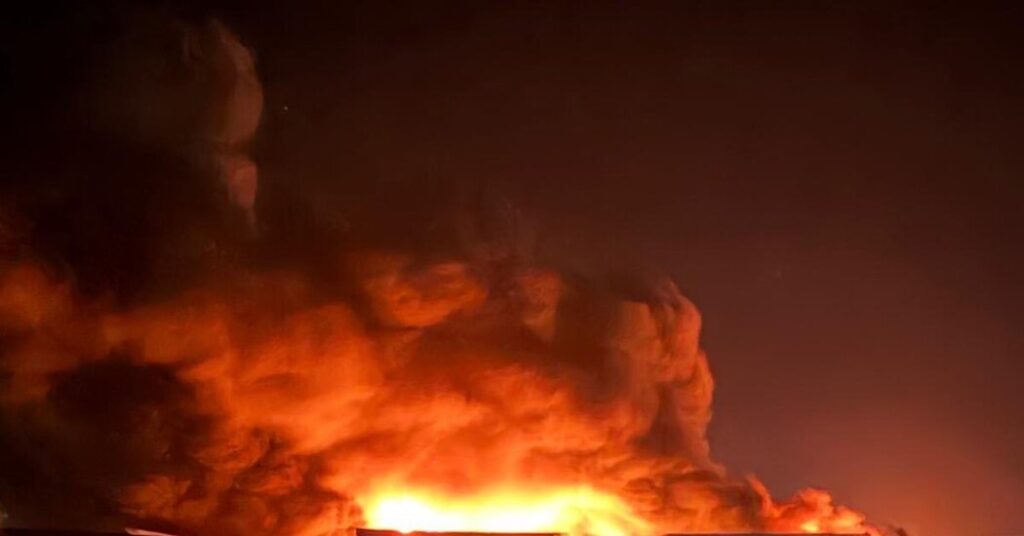
A photograph also began circulating soon after the attack that shows a number of structures burning. The original source of both the image and footage, which were verified by The Times, is unknown, but they were most likely captured by personnel on the base.
Iran later released several satellite images showing at least 20 structures were completely or partly destroyed.
Along with the strike on the area that appears to be living quarters, Iranian strikes also damaged two hangars and three drone shelters on the air base.
Iran also struck Tower 22, a U.S. military outpost on the northern Jordanian border with Syria. The destruction was first visible in low-resolution European satellite imagery captured on Monday, which helped confirm the time frame of the attack. The next day, Iranian media published a higher-resolution satellite image that clearly showed one of the outpost’s structures had been destroyed.
A video that began circulating on Telegram on Tuesday from an unknown source, but which has been verified by The Times, showed a building turned to rubble at Tower 22. The southern wing of the structure was leveled, but it’s unclear if the strike caused casualties.
In 2024, a drone attack on the outpost, which the U.S. said was conducted by an Iran-backed militia, killed three American service members.
Jordan’s King Hussein International Airport, where the U.S. military maintains a presence, was also struck, and hangars and a radar system were hit at two other air bases in the country.
The Times also corroborated Iranian satellite imagery that shows a radar system at Ahmad al-Jaber Air Base in Kuwait was destroyed around July 20, only six months after its construction had been completed.
Most of the attacks earlier in the war targeted military infrastructure such as radar systems, air defense complexes and aircraft hangars. However, some strikes hit personnel facilities, including an attack on a makeshift command post in Kuwait that killed six American soldiers in March. In April, Defense Secretary Pete Hegseth told a congressional committee that “every possible measure” was used to protect U.S. service members on Gulf bases.
Four sites, including Muwaffaq Salti Air Base, were struck again in the past two weeks after being attacked earlier in the war. At a naval facility in Bahrain, Iran targeted warehouses, a radar site and communications systems in one-way drone attacks in the spring. Now, satellite imagery shows a warehouse was struck two weeks ago.
Satellite imagery also showed relatively minor damage to Ali Al Salem Air Base in Kuwait, which was also struck in the spring.
And a large military tent was destroyed at a U.S. military site at Erbil International Airport in Iraq, which was also struck earlier in the war.
Riley Mellen and Sanjana Varghese contributed reporting. Leanne Abraham and Samuel Granados contributed visual production.
The post What Visuals Show About Recent Damage to U.S. Military Sites in the Middle East appeared first on New York Times.