Mayor Zohran Mamdani recently disclosed that he was in “active conversation” with his legal team about whether he could make good on a campaign vow to arrest Benjamin Netanyahu, Israel’s prime minister, should he set foot in New York City.
What the mayor neglected to say, in a wide-ranging interview with The New York Times last week, was that he had already been advised by lawyers that he had no authority to do so.
His declaration risked a rare public clash with his police commissioner, Jessica Tisch, whose pro-Israel stance runs counter to the mayor’s longstanding position.
Ms. Tisch had no intention of arresting Mr. Netanyahu, and the Police Department was ready to make that clear with a formal statement declaring that it lacked the authority to take such action. Ms. Tisch was worried about being forced to make an arrest that lawyers agreed was not within the scope of the Police Department, according to an agency spokeswoman, Delaney Kempner.
“N.Y.P.D.’s position is entirely rooted in the law,” Ms. Kempner said.
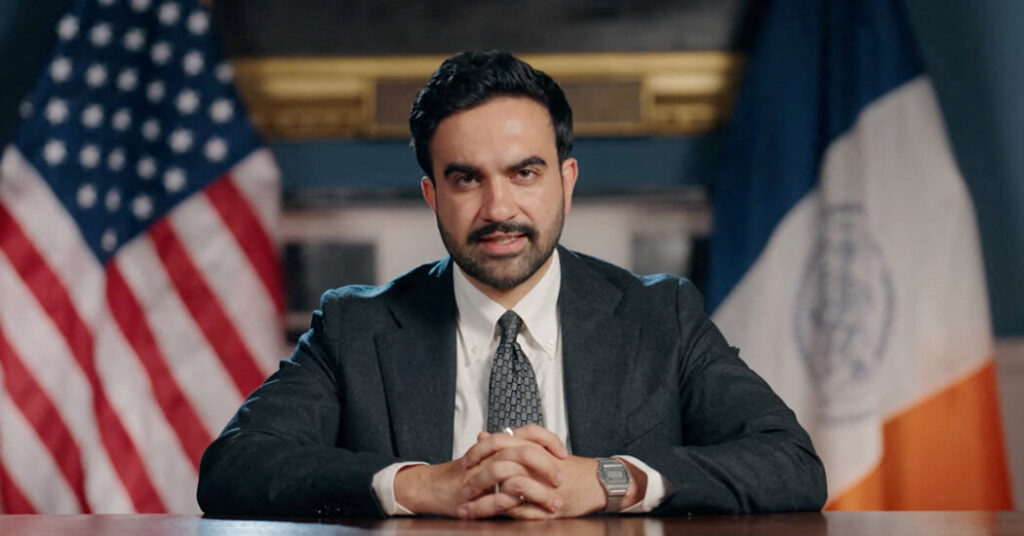
Mr. Mamdani quickly pivoted. On Tuesday evening, he released a direct-to-camera message in which he called Mr. Netanyahu a war criminal, but admitted that New York City police officers were powerless to arrest him.
In the two-minute address, which has garnered more than 64 million views on X, Mr. Mamdani sat between flags of the United States and the City of New York and spoke solemnly about the impact of Israel’s actions in Gaza, which followed the deadly Hamas-led attack on Israel on Oct. 7, 2023. The spot appeared under the words “Benjamin Netanyahu is a war criminal.”
The mayor then said that city lawyers had determined he did not have the authority to arrest Mr. Netanyahu, and urged the federal government to enforce the International Criminal Court’s arrest warrant for the Israeli leader. (The United States is not party to the I.C.C., and President Trump said that Mr. Netanyahu would not be arrested in the country.)
Mr. Mamdani recorded the video Tuesday afternoon and was personally involved in editing the clip, according to a city official familiar with its preparation. The message seemed designed to assure his supporters that he remained steadfast in his criticism of Israel despite his inability to make good on his campaign vow, while reassuring others that he would not overstep his authority.
The video instantly reinforced Mr. Mamdani’s stature as a pre-eminent voice of the international left, and gave the issue prominence at a time when Mr. Netanyahu’s conduct of the war in Gaza has led two independent United Nations inquiries and humanitarian groups inside and outside of Israel to accuse him of perpetrating a genocide — an accusation that Mr. Netanyahu denies.
“It is clear that we do not have the independent legal authority to enforce this warrant,” the mayor said. “The federal government, however, does, and I call on them to join the I.C.C. and execute this warrant.”
The video also drew backlash from pro-Israel groups and from the Israeli government. Several said the video could inflame antisemitism, and accused the mayor of being overly focused on international relations at a time when his city is facing acute problems.
When Mr. Mamdani was interviewed by The Times, the mayor had already been told by his lawyers that he could not carry out his threat, but he wanted to let his supporters know that on his own terms, according to several people familiar with his thinking who were granted anonymity to speak freely about a sensitive matter.
After his remarks to The Times prompted another news cycle about the legal impracticability of arresting Mr. Netanyahu, Mr. Mamdani’s team decided that it needed to hasten the plan, those people said.
So Mr. Mamdani sought to use his skills as a gifted communicator to turn the problem to a political advantage.
In an interview on CNN on Wednesday, Danny Danon, Israel’s ambassador to the United Nations, agreed with Mr. Netanyahu, saying that Mr. Mamdani “picks on the prime minister” and that his statements about arresting Mr. Netanyahu were “a stunt.”
“Prime Minister Netanyahu will come to the U.N., will speak in the General Assembly, will defend our country,” Mr. Danon said. “And if you want to arrest someone, I think you should arrest Mayor Mamdani, because he continues to incite against Israel.”
Though Israel occupies a central place in the mayor’s political formation, Mr. Mamdani said at a news conference on Wednesday that his concern was “not specific to Benjamin Netanyahu” and that he would support enforcing an arrest warrant for anyone wanted by the International Criminal Court for crimes against humanity.
That includes leaders of Hamas, he suggested. The court had sought arrest warrants for three Hamas leaders in connection with the Oct. 7 attack, but Israel said it had killed all of them by the time the warrants were issued in November 2024.
“When it comes to the I.C.C., they’ve put forward warrants, whether it’s Yahya Sinwar, whether it’s Benjamin Netanyahu, I think a few other members of the Israeli government — I believe that all of them should be honored,” he said, referencing a Hamas leader who was killed by Israel in 2024.
Originally, Mr. Mamdani’s team had planned to release some sort of statement attesting to the legal hurdles to arresting Mr. Netanyahu before the prime minister’s expected attendance at the annual meeting of the United Nations General Assembly in September.
After that plan changed, city officials hurriedly called people with strong feelings about Israel to alert them to the imminent release, the city official said.
“The mayor’s statement on Benjamin Netanyahu affirms his commitment to universal human rights and dignity for all,” Asad Dandia, the Brooklyn borough historian and an ally of the mayor, said. “Even if he does not have the power to enforce an I.C.C. warrant as a municipal leader, it’s about the principle of the matter.”
Nerdeen Kiswani, the co-founder of the pro-Palestinian group Within Our Lifetime, said she welcomed Mr. Mamdani’s statement but added that “this has never been about one individual” and urged him to do more.
In a statement, the UJA-Federation of New York, a Jewish philanthropic group, accused Mr. Mamdani’s video of being “rife with distortions and disinformation” and said that his repeated criticism of Israel “puts Jews at greater risk and leaves many Jewish New Yorkers feeling targeted and unwelcome in the city we call home.”
The annual U.N. General Assembly meeting draws officials from around the world, and several of its meetings have been marked by tensions between city leaders and foreign officials they find to be politically unsavory. The results have often been more theatrical than carceral.
In 1995, Mayor Rudolph W. Giuliani ordered a top aide to kick Yasir Arafat, the chairman of the Palestine Liberation Organization, out of a concert at Lincoln Center that was held for world leaders in town to attend the Assembly meeting.
In 2009, Libya’s leader Muammar al-Qaddafi was denied permission to erect a tent, his preferred mode of lodging for the Assembly meeting, in locations across the New York area, including Central Park and a Westchester estate owned by President Trump.
On Wednesday, Mr. Mamdani said he sympathized with New Yorkers who were “disappointed” to hear that Mr. Netanyahu would not be arrested during his anticipated September visit but noted that, “one of the bedrocks of our city is protest.”
“I understand that because we are talking about someone who has been charged with crimes against humanity, someone who has visited this city on many an occasion, and who has been welcomed by previous mayors,” Mr. Mamdani said. “And I want to make it very clear that welcome ends with me.”
The post Mamdani Knew He Couldn’t Arrest Netanyahu. But He Could Denounce Him. appeared first on New York Times.