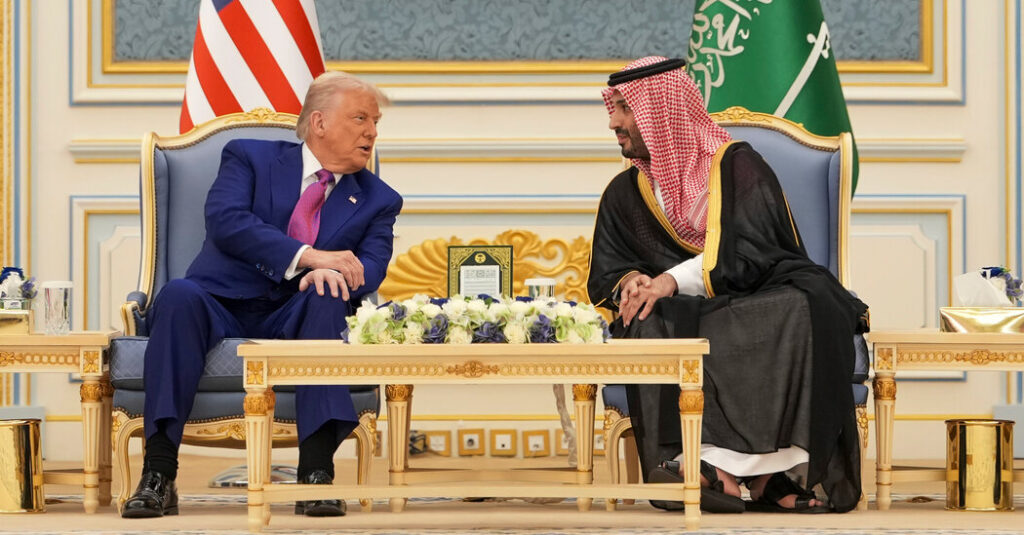
The Trump administration on Wednesday announced that it had officially signed a deal with Saudi Arabia that officials have said could help the country enrich its own fuel for nuclear reactors.
The Energy Department said that Chris Wright, the U.S. energy secretary, and Prince Abdulaziz bin Salman, the Saudi energy minister, had signed a deal to cooperate on civilian nuclear power. The two officials also signed what the administration described as a bilateral agreement on nuclear safeguards.
“Rest assured, these agreements uphold the highest standards of nuclear safety and nonproliferation, while relying on the world’s best nuclear technology and scientists, designed right here in the United States,” Mr. Wright said. “Thanks to President Trump, the American nuclear renaissance is underway and will deliver long-term benefits to the American and Saudi people.”
The agreement will require review by Congress, which has the power to vote a resolution of disapproval. But as a practical matter, the agreement would likely pass, because Congress would have to assemble a veto-proof majority to override Mr. Trump’s initiative.
The accord is intended to further bind the United States with the Saudi government as the war with Iran strains the relationship. The Trump administration, according to officials, estimates it will provide billions of dollars for the U.S. nuclear industry — starting with Westinghouse, which designs many of the reactors sold abroad.
The Saudi government has been trying to seal such an agreement for more than five years, pushing against opposition from American officials and experts who have raised concerns that the Persian Gulf nation could use the technology to pursue a nuclear weapon, spurring a new Middle East arms race.
This type of nuclear deal, known as a 123 Agreement because it’s named for Section 123 of the Atomic Energy Act of 1954, is legally binding and typically lay out rules for the transfer and storage of nuclear materials, although the president can choose to exempt countries from specific requirements.
One notable feature of the deal is that, after a joint study with Saudi Arabia on the economics of producing nuclear fuel, the Saudis may be allowed to enrich uranium or reprocess plutonium on their soil, officials have said. That’s in contrast to a 2009 agreement with the United Arab Emirates, in which the U.A.E. agreed to forgo the right to produce its own fuel.
The accord has been under discussion for years, and during the Biden administration it was envisioned as part of a broader deal that would include Saudi diplomatic recognition of Israel. But after the Oct. 7, 2023, attacks on Israel by Hamas, that prospect receded. President Trump separated the proposal for U.S.-Saudi civilian nuclear cooperation from any demand that Saudi Arabia recognize Israel.
David E. Sanger, Edward Wong, WILLIAM BROAD and Vivian Nereim contributed.
The post U.S. Signs Deal That Could Help Saudis Enrich Nuclear Fuel appeared first on New York Times.