President Trump’s science adviser told lawmakers on Wednesday that the Trump administration intended to drastically overhaul the country’s approach to scientific research, including by shifting research funding away from universities toward individual researchers and private companies.
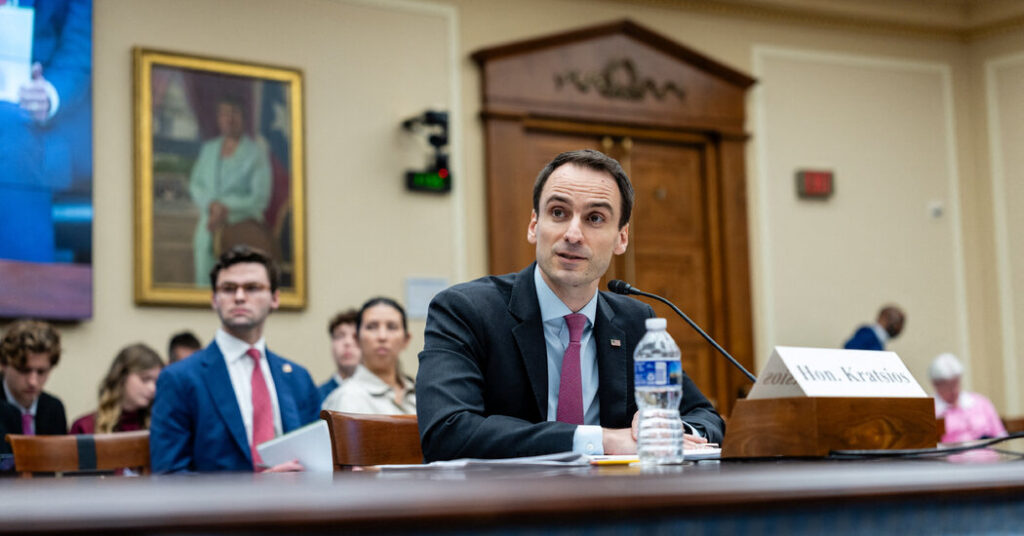
At a House hearing, Michael Kratsios echoed points he laid out in a report released Tuesday, titled “Science: A New Golden Age.” He said the administration would prioritize artificial intelligence, robotics and nuclear energy while reducing the government’s focus on what he called “life sciences.”
“Our ability to make transformational breakthroughs here in the United States has slowed,” Mr. Kratsios told lawmakers in the hearing on Wednesday. “Maybe we should be testing other ways to make breakthroughs than what we’ve been doing for so many years.”
Democrats countered that the Trump administration had harmed scientific research by firing staff members at federal science agencies, seeking deep cuts to research programs, canceling or freezing grants, punishing universities that Mr. Trump is unhappy with, and pushing some of the best researchers in the United States to relocate to other countries.
“Let me propose an alternative title: ‘Unleashing the Golden Age of Science in the People’s Republic of China,’” Representative Zoe Lofgren of California, the top Democrat on the House science committee, told Mr. Kratsios at the start of the hearing. “This administration has been systematically destroying the U.S. science enterprise.”
The White House billed Tuesday’s report as “the first comprehensive rethinking of the U.S. science and technology enterprise in over 80 years,” since one written by Vannevar Bush, the organizer of the Manhattan Project, which produced the world’s first atomic bomb. Dr. Bush’s 1945 report set the stage for the current system, in which the government funds basic research, universities conduct it, and private companies commercialize it.
Mr. Kratsios’ proposal to reduce the role of universities would upend that system, which has been in place since the end of World War II. His call for the administration to de-prioritize “life sciences,” which encompass molecular biology, genetics and other fields in biomedicine, as well as clinical trials aimed at testing new therapies, raised alarms among biomedical researchers and academic medical centers. They fear it will mean less funding for the National Institutes of Health.
Jeremy M. Berg, who led the National Institute of General Medical Sciences, an arm of N.I.H., during the Bush and Obama administrations, called the report “tremendously misinformed.” He said Mr. Kratsios was ignoring the serendipity of science by zeroing in so closely on artificial intelligence.
“I think they’re trying to turn it into a venture capital model,” said Dr. Berg, an expert in computational and systems biology medicine at the University of Pittsburgh. “Why the federal government should be investing in that, I don’t know.”
Unlike most presidential science advisers, Mr. Kratsios is not a scientist. He has a background in Silicon Valley, where he worked at an investment fund run by Peter Thiel, the prominent venture capitalist who backed Mr. Trump’s first presidential bid. Mr. Kratsios’ educational background is also unlike that of his predecessors: While previous science advisers held doctorates, Mr. Kratsios has a bachelor’s degree in politics from Princeton, and no other degrees.
The report from Mr. Kratsios, who also leads the White House Office of Science and Technology Policy, begins with a broad indictment of the federal government’s approach to funding scientific research.
Mr. Kratsios argued that while investments in research had increased in recent decades, the results of that investment had failed to keep pace. “Scientific productivity has slowed,” he wrote. Among the examples he cites: “Despite massive increases in biomedical funding since the 1990s, the rate of significant breakthroughs appears to have slowed, and drug approvals have flatlined.”
To address that problem, Mr. Kratsios called for reducing the amount of time researchers have to spend applying for grants, and directing science agencies to come up with ways to better measure the returns on their investments.
He also directed federal science agencies to focus on a handful of priorities set by the White House, including physical sciences, chemistry and biological sciences.
Those fields, he wrote, were crucial to what he called the Trump administration’s “national missions” — a list that includes artificial intelligence, nuclear fusion, robotics, quantum computing and space exploration.
The report is less clear on the areas of scientific research for which the federal government should reduce funding. It says federal agencies “should prioritize foundational research in the biological sciences over the life sciences.”
Spokesmen for the White House and the Department of Health and Human Services did not answer questions about what they meant by “life sciences” and “foundational research.”
Health Secretary Robert F. Kennedy Jr., who oversees the U.S. biomedical research enterprise, said the report aligned with his own emphasis on using artificial intelligence to uncover the root causes of what he calls an “epidemic” of chronic disease, especially among children.
“America will lead the next generation of medical discovery by harnessing the power of artificial intelligence,” he said in a statement.
The report does not address the Trump administration’s decision to fire large numbers of staff members at scientific agencies. It calls for the government to invest in young researchers, without noting that the administration fired scores of young scientists and terminated hundreds of grants to early career researchers.
It is also silent on the more than 40 percent funding cuts sought by the White House at the National Science Foundation, as well as a proposal in May from the White House Office of Management and Budget that federal grants for scientific research be screened by political appointees, to block initiatives that “promote anti-American values.”
In Wednesday’s hearing, Democrats pushed Mr. Kratsios on those points, asking how they aligned with his pledge to restore what he called “gold standard science.”
Letting political appointees block grants they disagree with is “simply incompatible with any kind of commitment to robust scientific research,” Representative Deborah Ross of North Carolina said to Mr. Kratsios. “The victories that you’re touting are merely cheap, shiny distractions.”
In response, Mr. Kratsios did not directly defend the administration’s proposal for political oversight grants. “I look forward to working closely with O.M.B. to ensure that our enterprise continues to remain world class and trustworthy and accountable,” he said.
One area in which Mr. Kratsios indicated a measure of disagreement with the administration’s actions was on the pace of grants from the National Science Foundation.
Representative George Whitesides, Democrat of California, displayed charts comparing the rate at which money had been awarded this year with previous years, asking Mr. Kratsios to explain why the funding had slowed. When Mr. Kratsios said that was a question for the National Science Foundation, Mr. Whitesides called the answer unacceptable.
“You’re the president’s science adviser,” Mr. Whitesides said. “Why is this happening?”
“I do see these charts, and nothing would make me happier to make sure that we are getting closer to where we were in previous years,” Mr. Kratsios said. “I’ll do everything that I possibly can to help move that line, because I think it’s important for us to get the appropriate dollars out to scientists.”
Adam Sella and William J. Broad contributed reporting.
The post Trump’s Plan for Science: More Money for A.I., Less for Universities appeared first on New York Times.