In April 1994, The Offspring released their third album, Smash, on Epitaph Records. The indie label, back when indie actually meant independent, was owned by Bad Religion guitarist Brett Gurewitz. He originally started it to release Bad Religion albums, but added to the roster in subsequent years. However, none of Epitaph’s bands had ever broken through. But that was about to change very quickly.
Smash was bolstered by two huge hits, “Come Out and Play” and “Self Esteem”. It also featured the popular “Gotta Get Away” and “Bad Habit”. The singles saturated the airwaves, and their music videos were regulars on MTV. In 1994, Green Day was also breaking through with Dookie, bringing mainstream focus to punk rock. But Dookie was Green Day’s major-label debut, and they were constantly met with accusations of selling out.
The Offspring, meanwhile, were finding a similarly huge amount of success, but they were doing it on an indie label. Essentially, Smash not only allowed The Offspring to grow, but it did the same for Epitaph Records. Gurewitz was betting everything on Smash, and it definitely paid off. But it also led to The Offspring’s own Dookie moment. That is, backlash for a major-label switch.
The Album, Like Its Namesake, Becomes an Unexpected Smash Hit for The Offspring
Almost immediately, “Come Out and Play” was in heavy rotation on L.A. radio station KROQ. That was the first indication that something might be changing for The Offspring. At that time, frontman Dexter Holland was in grad school, bassist Greg K. worked at a print shop, and guitarist Noodles Wasserman was a janitor at an elementary school. None of them even left their day jobs until several months after Smash started moving units.
In its first week, the album shipped 50,000 units. As the singles got more airplay, those numbers steadily rose. It got to the point where Gurewitz was strategically using warehouses and rented storage to house all the copies of Smash that were going out to record stores.
“We had Offspring records filling my entire building on Santa Monica Blvd., from the floor to the ceiling,” Gurewitz told Rolling Stone in 2014. “The inside of the building looked like a Rubik’s Cube of pallets of Offspring vinyl, cassettes and CDs.”
The album peaked at No. 4 on the Billboard 200, and was quickly certified Gold, then Platinum. It was the first album on Epitaph to ever earn these accolades. With that came major labels trying to buy the label out from under Gurewitz. But he wanted to keep the independent integrity, and held out against the offers.
“I literally had to take out a second mortgage on my house to get the cash to press enough albums,” he said. “I put everything on the line believing that an indie could do it as well as anyone.”
Relations with Epitaph Records Sour, and the Band Gets in Bed with a Major Label
The Offspring’s mainstream success in 1994 essentially put Epitaph on the map. Gurewitz’s handling of the indie label kept it small but relevant. The band also used a lot of their own money to market Smash at the time, shelling out for the small details like PR and radio play. If not for Smash, specifically at a time when the mainstream was finally ready for punk rock, Epitaph Records might have gone under.
When it came time to renegotiate contracts, however, not everyone was happy.
“We weren’t only investing in us, we were also investing in Epitaph,” Wasserman told Rolling Stone. “So when it came time to renegotiate our contract, we thought we deserved more than Brett [Gurewitz] was willing to give us. He was very hesitant to make anything other than a fairly standard deal. And we felt that we had done something incredible and deserved something more than that.”
Holland added, “On the one hand, Epitaph was trying to do the best they could with their label, and they maybe took some liberties that they shouldn’t have. On the other hand, we felt like, ‘Well, if we’re 95 percent of your sales, we should be treated accordingly.’”
The Offspring jumped ship from Epitaph to Columbia Records in between Smash and Ixnay on the Hombre, released in 1997. It was a nasty public break-up, with both the band and Gurewitz bashing each other in the press. The Offspring felt that the indie model wasn’t sustainable for their trajectory, and that was when many fans gave them the Dookie treatment.
“All of a sudden we were taking a lot of heat for moving to a major, and also for this music getting popular,” said Wasserman. “Then you had guys like Billie Joe [Armstrong] and Green Day, and they were taking a lot of heat too. Like, ‘Oh, man! Those guys are selling out! They’re not punks!’”
Holland added, “Isn’t it ironic? You start a punk band because you feel like you’re being ostracized. Then your punk band gets big, and you get ostracized again.”
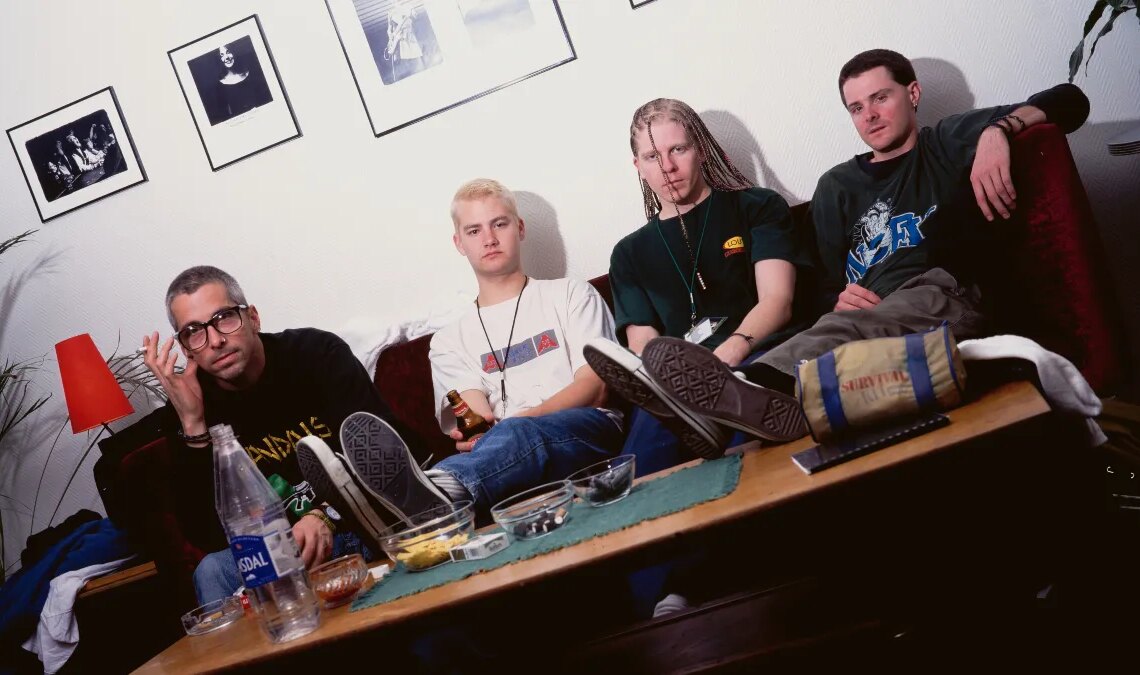
Photo by Mick Hutson/Redferns/Getty Images
The post This Unsuspecting Punk Band Broke Into the Mainstream, Just for Their Fans to Call Them Sellouts appeared first on VICE.